AI handles 80% of routine customer service interactions for businesses that implement it correctly. But Klarna’s very public stumble shows what happens when you move too fast. Here’s how to get the results without the regret.
By 2026, conversational AI will reduce contact centre labour costs by $80 billion. That’s the Gartner projection — and it’s already playing out in measurable ways across industries.
NIB Health Insurance saved $22 million through AI-driven digital assistants, reducing customer service costs by 60% and phone calls with agents by 15%. Klarna’s AI assistant handled the equivalent workload of 700 full-time agents in its first month. H&M’s AI chatbot reduced response times by 70% compared to human agents. A SaaS company using Chatbase reduced first-response time from 4 hours to under 30 seconds. iMoving improved response times by 47% by integrating an AI-powered chat and quote system.
These outcomes are real. They’re also not automatic. They come from businesses that implemented AI customer service thoughtfully — with proper training, clear scope definition, and human oversight for the cases where automation isn’t enough.
The counter-example is equally instructive. Klarna moved too fast and too far, replacing 700 agents with AI comprehensively. The result: CEO Sebastian Siemiatkowski publicly admitted they went too far, and the company began rehiring human agents. The lesson isn’t that AI customer service doesn’t work. It’s that AI customer service works for specific, bounded interactions — and fails when you expect it to replace the human relationship layer.
Here’s how to get the results without repeating the mistake.
The State of AI Customer Service in 2026
The numbers describe an industry at an inflection point.
82% of senior leaders say their teams invested in AI for customer service in the past year. 91% of customer service and support leaders are under executive pressure to implement AI this year. 77% of CRM leaders are already using AI in their customer service stack. Average AI chatbot response time is now under 3 seconds.
Yet only 10% of organisations have reached “mature deployment” — meaning AI is fully integrated and delivering measurable results at scale. The gap between adoption and maturity is where most organisations currently live.
The per-interaction economics make the business case straightforward: where a human agent costs $6-$15 per interaction, an AI chatbot handles similar queries for $0.50-$0.70. That’s a 10-20x cost difference. Companies report average savings of $127,000 annually through AI-powered ticket automation. The global customer service automation market is projected to hit $6.68 billion in 2026.
But — and this matters — the Gartner counter-projection is also worth noting: by 2030, the cost per resolution for generative AI could exceed $3, potentially approaching offshore human agent costs as AI systems are deployed on increasingly complex issues. The cost advantage is real now. Its persistence depends on what you deploy AI to handle.
What AI Can and Can’t Handle — The Honest Breakdown
This is the most important section in this guide. Every failed AI customer service implementation was deployed on the wrong use cases.
What AI handles well:
Frequently asked questions — product details, pricing enquiries, business hours, shipping information. These represent the same questions answered the same way, thousands of times. AI handles them faster, cheaper, and more consistently than humans.
Order tracking and status updates — pulling data from CRM and logistics systems automatically and presenting it conversationally.
Appointment scheduling — booking, rescheduling, cancellations across any time zone, 24/7.
Password resets and account issues — standard troubleshooting flows with clear resolution paths.
Returns and refund policies — explaining policy, initiating standard requests, routing exceptions.
Basic product recommendations — if the customer described X, they probably need Y.
In aggregate, these categories represent 60-80% of most support volume. For businesses implementing AI at this layer, the numbers cited above are achievable.
What AI still struggles with:
Emotionally complex interactions. When a customer is angry, grieving, or anxious, they need empathy — not efficiency. AI can recognise emotional keywords and escalate appropriately, but it cannot genuinely empathise. The best implementations detect emotional signals and hand off quickly rather than attempting to simulate compassion they cannot provide.
Complex problem-solving with ambiguous inputs. The standard chatbot failure mode: a customer describes a multi-part, context-dependent problem, and the bot matches it to the nearest FAQ category rather than understanding what’s actually wrong.
High-stakes decisions. Anything involving exceptions, complaints that have legal implications, or interactions where a wrong answer could cause real harm needs human judgment.
Building customer relationships. This is Klarna’s lesson. Customer service isn’t only about issue resolution. It’s about the relationship between the customer and your brand. AI can resolve the ticket. It cannot build the loyalty that keeps customers from leaving.
Implementation: The Three-Phase Approach That Works
Phase 1: Foundation (Weeks 1-4)
Before deploying any chatbot, build your knowledge base. Compile your top 20-30 most common customer questions with approved answers. This is the content your AI will learn from. Quality here determines accuracy at launch.
Choose your platform based on your volume and complexity. For small businesses: Tidio ($29/month) or Freshdesk (free tier) handle most straightforward use cases. For mid-market: Intercom (from $74/month) or Zendesk AI offer more sophisticated routing and escalation. For enterprise: Salesforce Service Cloud or ServiceNow with AI layers handle complex, multi-system environments.
Set your scope explicitly. Write down exactly which types of queries the AI will handle autonomously and which will route immediately to a human. This is your guardrail document. Every team member involved in customer service should sign off on it.
Phase 2: Guided automation (Weeks 4-8)
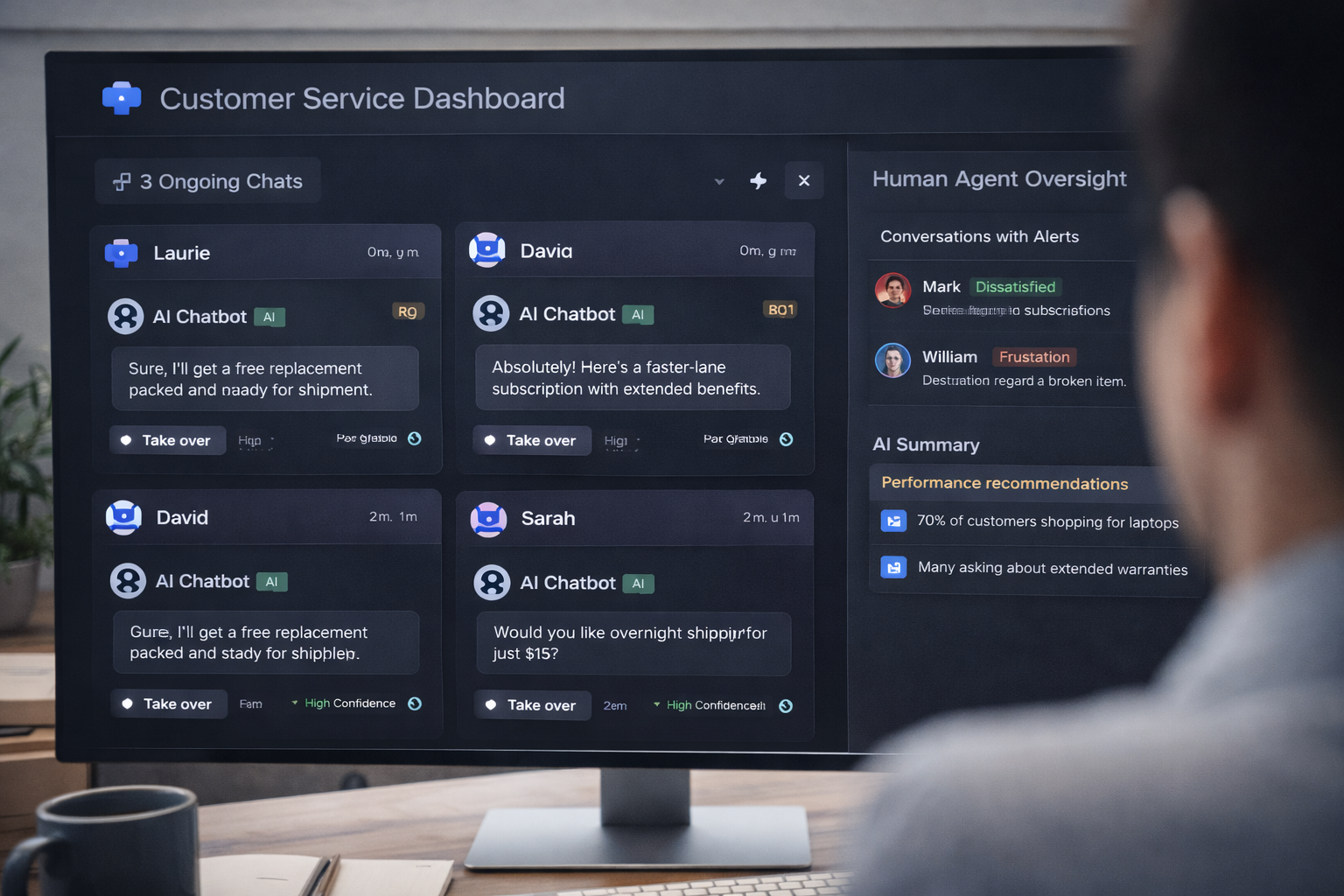
Launch with the AI generating suggested responses for human agents to review and send rather than sending autonomously. This builds your team’s confidence in the output, surfaces failure modes before they reach customers, and generates feedback data to improve the system.
Measure at week 4 against your baseline: average response time, resolution rate, CSAT score. If the numbers are improving — which they should be even in this supervised mode — you have evidence to expand scope.
Phase 3: Autonomous deployment with oversight (Months 2-6)
Expand to autonomous responses on your proven, low-risk query categories. Maintain human review for anything outside the defined scope. Monitor escalation rates — if the AI is escalating more than 30% of conversations, either the scope is too broad or the training is inadequate.
The businesses that report the strongest long-term results are the ones that resisted the temptation to rush to full automation in month one. The phased approach produces better outcomes because it generates the training data and trust necessary for AI to perform well on progressively complex interactions.
The Metrics That Actually Matter
Most businesses measure the wrong things for AI customer service. Here’s what matters.
Automation rate: What percentage of conversations is AI resolving without human intervention? Target: 60-80% of routine queries. If you’re below 40%, your scope is too narrow or your training data is inadequate. Above 85% across all query types is a red flag — you’re probably missing cases that need human judgment.
CSAT after AI interactions: Customer satisfaction scores from AI-handled conversations compared to human-handled ones. If AI CSAT is significantly lower than human CSAT, the automation is saving money but damaging the relationship. That’s a net negative.
Cost per resolution: Total cost divided by resolved tickets. This is the number that makes the business case. A human agent costs $6-$15 per interaction. A well-implemented AI solution costs $0.50-$0.70. The goal is to shift the mix while maintaining quality.
Escalation rate and reason: Every time the AI escalates to a human, that’s data. Analyse escalation reasons monthly. Categories that escalate frequently are candidates for better training or for permanent routing to humans.
First-contact resolution rate: Does the customer’s issue get resolved in the first interaction, or do they have to come back? AI can improve this metric if trained well. It worsens it if deployed prematurely.
The Privacy and Trust Question
51% of consumers prefer interacting with bots over humans when they want immediate service. But only 26% of applicants trust AI to evaluate them fairly, according to Gartner data on hiring contexts — and consumer trust in AI decision-making in service contexts follows similar patterns.
The implication: transparency matters. Customers increasingly want to know when they’re talking to AI and when they’re talking to a human. Hiding AI behind a human-sounding name and persona is a short-term comfort that becomes a long-term trust problem when customers inevitably discover the deception.
The businesses building the strongest long-term AI customer service capabilities are doing three things: being transparent about AI use when asked, designing clear and fast escalation paths to humans, and treating the AI as a first-line tool rather than a comprehensive replacement for human service.
That model — AI for speed and scale, humans for relationship and judgment — is what the evidence supports. It’s also, based on Klarna’s experience and the growing body of customer service data, what customers will accept and reward with their loyalty.