The AI marketing industry hit $47 billion in 2026. Most of the value is going to teams who know exactly how to use it — not teams who dabble. Here’s how to be in the first group.
Let’s start with two numbers that should inform every marketing decision you make this year.
First: 88% of marketers now incorporate AI tools into their daily workflow. Second: only 17% have received proper training on how to use them. That gap — widespread adoption, minimal expertise — is the single biggest opportunity in marketing right now. The businesses that close it have a structural advantage over their competitors.
Organisations implementing AI across marketing functions report 15-25% revenue increases within 18 months, according to McKinsey’s research. Teams using AI report 44% higher productivity, saving an average of 11 hours per week. AI personalisation increases e-commerce conversion rates by up to 10%, while AI-powered product recommendations increase average order value by up to 369%.
These are not projections. They’re outcomes from businesses that implemented AI marketing thoughtfully. Here’s how to replicate them.
The Foundation: What AI Marketing Actually Means in 2026
There’s a version of AI marketing that means slapping “AI” on your existing tools and calling it transformation. And there’s a version that actually changes how campaigns perform.
The difference is whether you’re using AI to produce more content — or whether you’re using AI to make better decisions about what content to produce, who to show it to, and how to optimise it in real time.
Both matter. But the second one is where the real revenue impact lives.
In 2026, successful AI marketing operates across three distinct layers:
Production layer: AI generates content — drafts, variations, images, video scripts, email copy, ad creative. This is the most visible layer and the one most teams start with.
Intelligence layer: AI analyses customer data, predicts behaviour, optimises targeting, and makes recommendations about where to allocate budget and what messages to test. This is where revenue impact compounds.
Optimisation layer: AI adjusts campaigns in real time based on performance signals — shifting ad spend toward what’s working, personalising landing pages by segment, triggering email sequences based on behaviour. This is the layer that separates the 15-25% revenue improvements from teams who are just saving time on content.
Most businesses are operating primarily at the production layer. The teams winning at AI marketing have built all three.
Content Production: The Right Way to Use AI
Content generation is where most businesses start, and it’s a legitimate high-ROI use case when done correctly. The mistake is treating AI output as finished content rather than as a fast first draft.
The workflow that actually works:
Brief it like a human team member. The output quality of AI content is almost entirely determined by input quality. “Write a blog post about our new product” will produce generic output. “You are a B2B marketing writer covering the construction software sector. Write a 600-word thought leadership piece for our blog aimed at project managers at mid-sized construction companies. The key insight: our new automated scheduling feature eliminates the average 4-hour weekly planning meeting. Open with a specific pain point, support with one industry statistic, and end with a soft CTA to a free trial. Tone: direct and practical, not salesy” will produce something useful.
Produce at the right volume. The businesses seeing the strongest content marketing results in 2026 are not the ones producing more content — they’re producing the right content, faster, which allows their human team to focus on strategy and quality control rather than raw production.
Apply brand voice consistently. AI output has a recognisable sameness to it. The editorial work — injecting your specific voice, real examples from your business, opinions that belong to your organisation — is what turns a competent AI draft into content your audience actually wants to read.
Jasper’s 2026 State of AI Marketing report found that 60% of teams that adapted their measurement approach to AI marketing report returns of 2-3x or higher. The teams that don’t adapt measurement — who can’t demonstrate how AI content production connects to business outcomes — are the ones losing budget.
Personalisation: The Revenue Driver Most Businesses Are Missing
McKinsey research shows companies excelling at personalisation drive 40% more revenue from their marketing, with leaders generating 80% of their growth from personalised products and experiences.
In 2026, meaningful personalisation is no longer expensive or complex for most businesses. The practical building blocks:
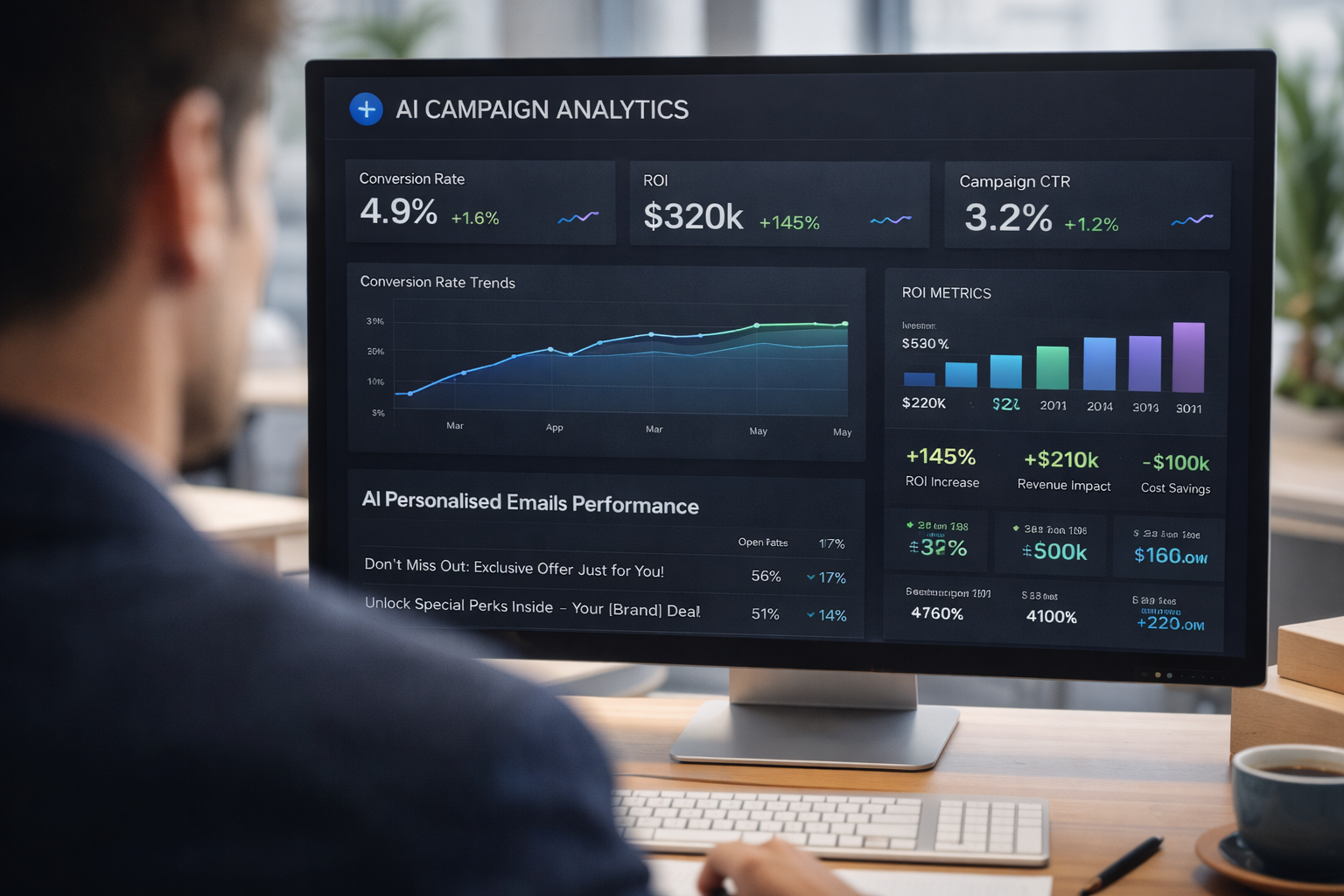
Email personalisation. AI tools can segment your list based on behaviour — what pages they visited, what they bought, how long they’ve been a customer — and trigger different sequences accordingly. The difference in open rates and conversion between a generic email blast and a behaviourally triggered personalised sequence is significant. Teams reporting the highest email ROI in 2026 are using dynamic subject lines, send-time optimisation, and content blocks that change based on subscriber segment.
Website personalisation. Tools like HubSpot allow you to show different content to different visitor segments — new visitors see a different homepage than returning customers; visitors who came from a specific campaign see relevant follow-through. Implementation is increasingly no-code.
Ad targeting. AI-powered ad platforms (Google, Meta, LinkedIn) have made manual audience building largely obsolete for most campaigns. The platforms’ own AI optimisation is now sophisticated enough that broad targeting with strong creative and clear conversion goals outperforms highly segmented manual targeting in most contexts. The skill shift is from audience building to creative quality and offer clarity.
Dynamic pricing and recommendations. For e-commerce, AI product recommendation engines — both native platform tools and third-party solutions like Klaviyo — increase average order value without any incremental customer acquisition cost. AI-powered product recommendations can increase AOV by up to 369% in optimised implementations.
SEO in the Age of AI Search
The landscape is shifting faster in SEO than anywhere else in marketing, and the stakes are high: AI search is changing which results get traffic and how.
The key shift: as AI-powered search interfaces (Google’s AI Overviews, Perplexity, ChatGPT Search) answer queries directly rather than directing users to click through, the traffic model for informational content is changing. Pages that get featured in AI-generated answers receive traffic; pages that don’t are increasingly invisible.
What this means practically:
Structure content for AI answers. Clear headers, direct answers in the first paragraph, specific data points and statistics. AI search systems pull from content that is well-structured and demonstrably accurate.
Go deeper on fewer topics. Topical authority — being the definitive source on a specific subject — is becoming more valuable than keyword breadth. AI systems favour sources they can treat as reliable experts on a domain.
Target long-tail, specific queries. “What is AI” is contested territory. “How to implement AI customer service for a dental practice” is answerable territory where specificity wins.
67% of businesses believe AI will improve marketing personalisation. The businesses that act on that belief — by restructuring their content strategy around AI search behaviour rather than waiting to see how it develops — will capture the early advantage.
AI Advertising: The New Reality
The most significant practical change for paid advertising in 2026 is the role of AI in both creating and optimising ads.
On the creation side: AI tools now generate dozens of ad copy variations, headline tests, and creative concepts in minutes. The old approach — brief an agency, wait two weeks, get three options — is genuinely obsolete for teams willing to work differently. The new approach: brief AI with your target audience, core offer, and constraints; generate 15-20 variations; test them in the platform; let performance data select the winners.
On the optimisation side: budget allocation is increasingly dynamic. AI systems now shift spend toward campaigns and channels showing the strongest performance signals in real time. When your Facebook campaign outperforms Google Ads on a Tuesday afternoon, the system reallocates automatically. This level of continuous optimisation was previously available only to large advertisers with dedicated programmatic teams.
The practical implication for businesses: your job as a marketer is increasingly creative strategy and offer development — not execution and optimisation. The machine handles those. The human provides the strategic direction, brand judgment, and quality control that the machine can’t supply.
Attribution: The Measurement Problem You Need to Solve
This is the piece most marketing teams skip, and it costs them more than any other single mistake.
If you can’t trace revenue back to the specific marketing activity that generated it, you’re making budget decisions based on incomplete information. AI marketing is particularly prone to this problem — because AI-generated content, AI-personalised emails, and AI-optimised ads are all running simultaneously, isolating any single contribution is complex.
The practical solution for most businesses: implement multi-touch attribution tracking before scaling any AI marketing investment. Tools like Cometly and HockeyStack make this accessible to mid-market businesses at reasonable cost. Without this, you’re flying blind.
The businesses seeing the strongest AI marketing ROI in 2026 share a common trait: they changed how they measure, not just how they execute. Instead of tracking activity metrics (posts published, emails sent, ads running), they track business outcomes (cost per acquired customer, lifetime value by acquisition channel, revenue attributed to specific campaigns). AI makes the activity faster. Measurement makes the activity smarter.
The Realistic AI Marketing Budget Allocation
For businesses serious about AI marketing in 2026, here’s where the spend makes sense.
AI marketing spend now represents 9% of total marketing budgets on average, up from 7% in 2024. That number reflects tools, training, and time invested in AI-specific capabilities.
For a business spending $5,000/month on marketing:
- Content creation tools (ChatGPT, Claude, Jasper): $50-150/month
- Email personalisation and automation (Klaviyo, Mailchimp AI): $100-400/month depending on list size
- AI SEO tools (Surfer SEO, Semrush AI): $100-200/month
- Attribution and analytics (basic tier): $100-300/month
- Training and capability building: 2-4 hours/month of team time
Total incremental AI spend: $350-$1,050/month, or 7-21% of budget. The return, based on the 41% average revenue improvement reported by organisations implementing AI marketing properly, more than justifies the investment.