The “AI will replace jobs” debate has been running for years. In 2026, we finally have enough real-world data to stop speculating and start being specific. Here’s the honest, evidence-based picture — by sector, by role, and by timeline.
Let’s be clear about something before we get into the data: this is the question almost every person asking about AI is actually asking, even when they phrase it differently. “Will AI change my industry?” means “will it change my job?” “How should I think about AI skills?” means “do I need them to stay employed?” The anxiety underneath the curiosity is real, and it deserves a serious answer — not a reassuring one, and not a catastrophising one.
Here is the most honest version of that answer we can give, based on what the evidence actually shows in March 2026.
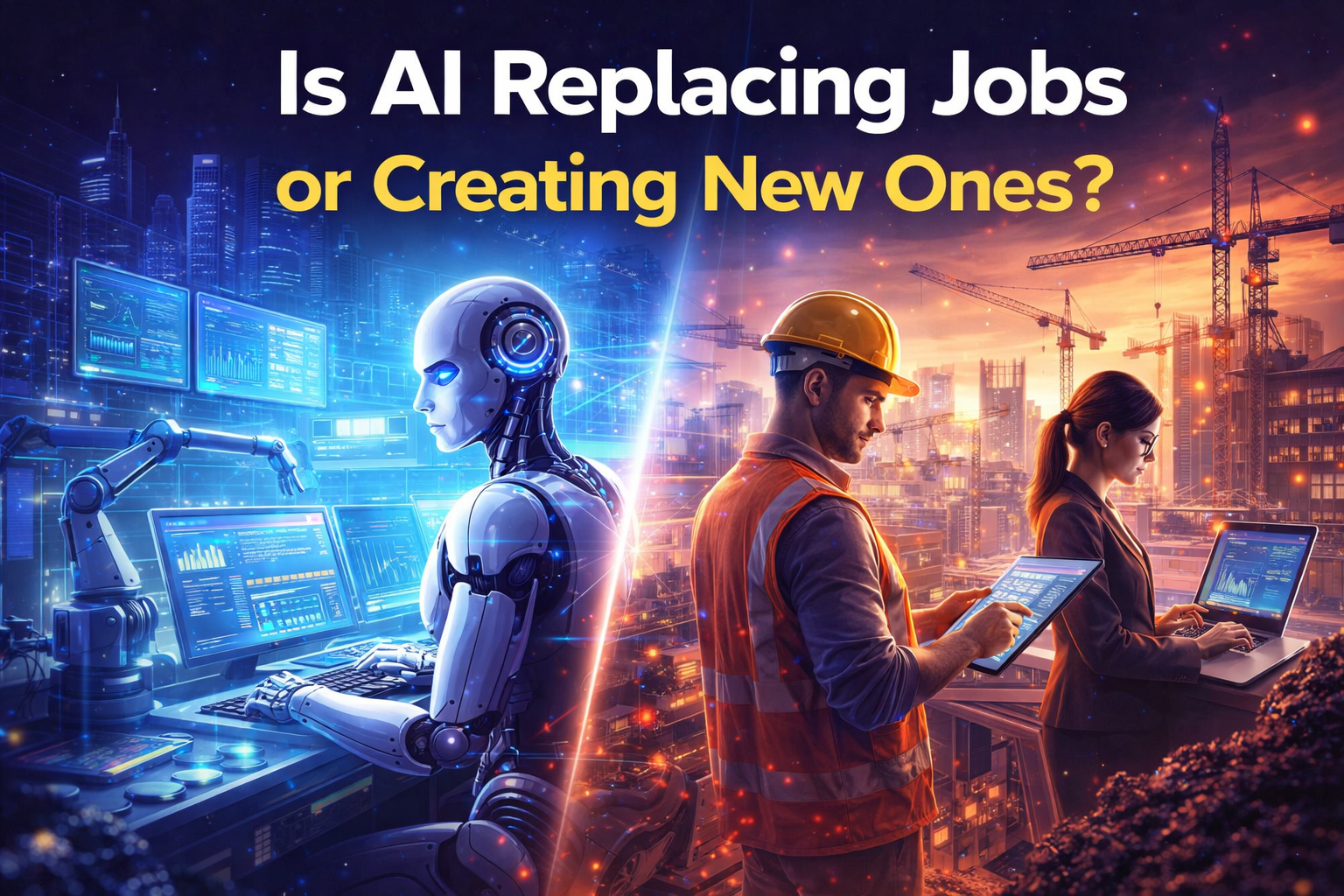
The short version: AI is both replacing jobs and creating new ones, and neither camp is being fully honest with you about the specifics. The replacement is real, concentrated in predictable areas, and accelerating. The creation is also real, but it is not happening fast enough, or in the right places, to offset the displacement for everyone affected. And the most significant labour market effects are still two to four years away.
Now the longer version.
What the Data Actually Shows Right Now
Start with what’s measurable today, not what’s projected for 2030.
In 2025, approximately 55,000 jobs in the United States were directly attributed to AI automation — a small but real and growing number. AI was linked to 4.5% of total job losses reported that year. Around 30% of US companies have already replaced workers with AI tools in some capacity; that number is trending toward 38%.
A February 2026 study by the National Bureau of Economic Research, covering 6,000 executives, found that over 90% of firms saw no measurable employment impact from AI over the prior three years. Read that carefully — it doesn’t mean nothing is happening. It means the impact is currently concentrated in specific roles and sectors rather than distributed evenly across the workforce. The headline number obscures a more important pattern: dramatic change in some corners, minimal change in most others.
The Federal Reserve Bank of Dallas, reviewing wage and employment data through early 2026, found that in jobs with significant AI exposure, wages were not uniformly declining — suggesting that for many workers right now, AI is augmenting rather than replacing their output. But Anthropic’s own research team found evidence that high-usage AI occupations are beginning to see modestly slower hiring rates. The effects are modest today. They are accelerating.
The research consensus across WEF, Goldman Sachs, McKinsey, and the IMF is consistent on one point: the most significant labour market effects of AI will materialise between 2027 and 2030, as current deployments mature, autonomous systems reach commercial scale in transportation and manufacturing, and the compounding productivity effects of AI across knowledge work accumulate.
We are in the early innings. That does not mean the game hasn’t started.
The Jobs Actually at Risk — With Specifics
This is the part most coverage gets wrong. “AI is coming for white-collar jobs” is technically true but so broad it’s almost useless. Let’s be more precise.
Anthropic’s research team, using actual Claude interaction data from professional settings rather than theoretical exposure models, published what may be the most granular map yet of which jobs AI is actively performing versus merely capable of performing. The finding that should reshape this conversation: AI is currently performing a fraction of what it’s technically capable of. The gap between “AI can do this” and “AI is doing this at scale” is still significant — but it is closing.
Based on that research and cross-referenced data from Axios, Goldman Sachs, and the IMF, here is where the displacement risk is highest and most immediate:
Customer service and call centres — Up to 80% automation potential. AI chatbots and voice agents are already handling tier-1 support at scale. Customer service represents approximately 42% odds of displacement in roles built around routine query resolution, per the Anthropic-derived tool published by Axios in March 2026.
Data entry and clerical work — Among the most vulnerable occupations. Manual data entry faces a 95% risk of full automation as AI systems can process over 1,000 documents per hour with error rates below 0.1%, versus 2-5% for humans. This is not a future risk. It is a present one.
Basic content production — Routine text, product descriptions, summaries, and templated marketing assets are already being generated at scale by generative AI. Digital marketers in content-only roles are among the most exposed. 81.6% of digital marketers themselves believe content writers will lose jobs to AI.
Legal support roles — Paralegals face an estimated 80% risk of automation by 2026; legal researchers 65% by 2027. The underlying work — document review, case research, contract analysis — is precisely where AI is strongest.
Back-office accounting and finance — AI-assisted reconciliation, reporting, and analysis are reducing demand for junior and mid-level roles. The displacement is gradual but cumulative.
Retail cashiers and bank tellers — 60-65% automation exposure. Self-checkout systems and AI-powered banking interfaces are already mainstream. Walmart’s self-checkout expansion is projected to replace up to 8,000 positions; Sam’s Club’s AI verification rollout, 12,000 cashier roles.
Now here is the critical nuance the headlines miss: these roles are typically affected through hiring freezes and role consolidation first, not mass layoffs. AI tends to compress roles over time as productivity per worker increases — you need fewer people to do the same work, so you stop hiring rather than start firing. The displacement is real, but it is slower and less dramatic than the “AI will replace your job overnight” narrative implies.
“All the important questions about AI’s effects on the labor market are still unanswered.” — Jed Kolko, Senior Fellow, Peterson Institute for International Economics
Who Is Actually Most Exposed — And It’s Not Who You Think
Here is the detail that reframes the entire conversation: the workers most exposed to AI displacement are not low-income, low-education workers. They are educated, well-paid, and predominantly female.
Anthropic’s research found that the most AI-exposed group is 16 percentage points more likely to be female, earns 47% more on average, and is nearly four times as likely to hold a graduate degree compared to the least exposed group. That’s the lawyer, the financial analyst, the software developer — not the warehouse worker or the electrician.
This inverts the story from every previous automation wave, where displacement was concentrated at the bottom of the income distribution. AI is hitting the middle and upper-middle of the white-collar workforce hardest in the near term.
The gender dimension is particularly significant and underreported. Globally, 79% of employed women in the US work in jobs at high risk of automation, compared to 58% of men. In high-income nations, 9.6% of women’s jobs face the highest automation risk, versus 3.2% for men. The economic and policy implications of that asymmetry are enormous, and they are receiving essentially no serious attention in mainstream AI coverage.
The Jobs AI Is Creating — And the Gap Between Them
The other half of the question deserves equal honesty. AI is creating new jobs. The WEF projects a net gain of approximately 78 million jobs globally between now and 2030, after accounting for displacement. By 2030, AI could help generate 170 million new jobs worldwide — predominantly in technology, data science, AI governance, and the skilled trades that remain resistant to automation.
Some of the fastest-growing roles right now:
AI and data science specialists — Among the fastest-growing job categories globally. The UK alone projects approximately 3.9 million AI-related jobs by 2035. Japan faces a shortage of 3.39 million workers in AI and robotics roles by 2040.
Cybersecurity professionals — 32% growth in information security analyst jobs from 2022 to 2032, driven by expanding digital infrastructure and the security risks that come with AI deployment.
Healthcare roles — Nurse practitioners are projected to grow by 52% from 2023 to 2033. AI is augmenting healthcare, not replacing it. AI is already automating 99% of medical transcription — but the clinical judgment, care delivery, and human relationship at the centre of healthcare remain deeply difficult to automate at acceptable quality and cost.
Skilled trades — Construction, electrical, plumbing, HVAC — only 4-6% of tasks in these roles are currently suitable for AI automation. Physical, in-person work requiring spatial judgment and manual dexterity remains a genuine safe harbour.
Agent Orchestration Specialists, AI Workforce Managers, AI Decision Auditors — These roles are being invented in real time. Organisations are creating positions specifically to manage blended human-AI teams, oversee agent governance, and audit AI decision-making. Forrester predicted in late 2025 that these would become standard HR categories; they are already appearing in job postings.
But here is the honest problem: the jobs being created are not geographically or demographically accessible to the people most at risk of displacement. A paralegal in a mid-sized city whose role is being automated by AI document review does not straightforwardly transition into an AI governance specialist role. The skills, education pathways, and geographic distribution of the new jobs do not map neatly onto the profile of the workers losing the old ones. This is the reskilling gap — and it is the most serious, least-solved problem in the AI-and-jobs conversation.
The Timeline That Actually Matters
Understanding when is as important as understanding what.
Right now, in 2026, the displacement is real but concentrated. Hiring slowdowns in AI-exposed roles. Role consolidation as productivity per worker increases. Some outright replacement in the most automatable functions. This is happening but it’s not yet the labour market event that the most alarming forecasts describe.
The inflection point most researchers identify is 2027–2030. This is when:
Autonomous vehicle technology is expected to scale to commercial deployment. SSRN projections estimate 1.5 million US trucking jobs at risk by 2030, with professional driver employment potentially falling from 3.8 million in 2024 to approximately 2.3 million.
AI-driven robotics could replace around 2 million manufacturing workers worldwide over the same period, per MIT and Boston University research.
The compounding productivity effects of knowledge work AI accumulate to the point where businesses structurally require fewer people for the same output — not because any individual AI system replaced any individual worker, but because the aggregate capability shift changes what team sizes make sense.
This timeline is not an excuse to delay action. It is a signal about where to focus attention right now, while there is still lead time.
What This Means in Practice — For Real People
If you are in a high-exposure role — customer service, data entry, basic content, legal support, back-office finance — the honest advice is to stop waiting for certainty and start building insurance.
That insurance is not “learn to code.” It is building capability in the parts of your current role that are hardest to automate: the client relationship, the contextual judgment, the institutional knowledge, the decision-making accountability. And alongside that, building genuine working fluency with the AI tools that are changing your field — not to be replaced by them, but to be the person who directs them well.
If you are in a lower-exposure role — healthcare, skilled trades, complex sales, senior management, creative work requiring genuine originality — the near-term risk is lower but not zero. AI is changing how work gets done in every field, even the resilient ones. Understanding what it can and cannot do in your specific context is table stakes for being good at your job in 2026.
If you manage people, the responsibility is sharper. The NBER study found that over 90% of firms saw no measurable employment impact from AI over three years — but the firms that are building the biggest leads are the ones actively redesigning workflows around human-AI collaboration rather than waiting for the technology to force a change. Passive adoption produces modest results. Intentional redesign produces structural advantage.
The Honest Bottom Line
AI is replacing jobs. That is true, specific, and measurable — concentrated in high-volume, repetitive, structured work, with customer service, data entry, legal support, and basic content production facing the most immediate pressure.
AI is creating jobs. That is also true — in AI development, cybersecurity, healthcare, skilled trades, and entirely new categories of governance and orchestration work.
The net projection, across the most credible institutions, is positive — more jobs created than lost by 2030. But that net number hides a distribution problem that the optimistic framing tends to obscure: the people bearing the cost of displacement are not the same people capturing the gains from creation, and the reskilling infrastructure needed to bridge that gap does not currently exist at the necessary scale.
That gap — not the technology — is the real policy challenge of the AI era.
For individuals, the actionable conclusion is not to be paralysed by either the fear or the reassurance. It is to be specific: specific about your role’s actual exposure, specific about what parts of your work AI is already changing, and specific about which capabilities you are building that have value in a landscape where the baseline has shifted.
The people who will navigate this well are not the most technically sophisticated. They are the most informed, the most adaptable, and the most intentional about how they use the time that AI gives back to them.
That, in the end, is what every previous technology transition has also required. AI is not different in kind. It is different in speed.