“Replace your entire sales team with AI” was the pitch. The data tells a different story: AI SDR tools churn at 50-70% annually. The most heavily funded fully-autonomous AI SDR couldn’t keep its own customers. But teams using AI to support — not replace — human reps report 2.8x more pipeline. Here’s what’s actually working.
In 2024 and early 2025, the pitch from AI SDR startups was intoxicating for anyone running a sales team on a budget. Replace your entire outbound team with AI agents that work 24/7, never get tired, never ask for a raise, and handle hundreds of leads simultaneously. Cut SDR costs by 70%. Scale pipeline without hiring.
Several of these companies raised enormous amounts of money on that pitch. One of the most heavily funded autonomous AI SDR platforms raised $74 million from a16z and Benchmark — two of the most respected names in venture capital — on the thesis that AI could fully replace the entry-level sales role.
By 2026, that company “could not retain its own customers,” according to industry analysis. Industry-wide data on AI SDR tools shows 50-70% annual churn rates. More than half of buyers are not getting the results they expected.
This is one of the clearest examples in the entire AI-for-business landscape of a category where the early hype collided with operational reality — and where the honest current state is genuinely useful for anyone deciding how to use AI in their sales process.
Why Full Replacement Didn’t Work
The logic of full AI SDR replacement made sense on paper. The SDR role — researching prospects, sending outreach emails, following up, qualifying responses, booking meetings — is repetitive, high-volume, and largely scriptable. If any sales role were going to be automated end-to-end, this looked like the one.
What broke down in practice: prospects can tell. Cold email reply rates average 3.43% industry-wide, with top performers reaching 10%+. The gap between average and top performers isn’t primarily about volume or timing — it’s about the message feeling like it was written by someone who actually understands the prospect’s situation. Fully autonomous AI SDR messages, even with sophisticated personalisation pulling from funding announcements, job postings, and technology stack data, tend to plateau at “competent but generic” — exactly the quality level that recipients have become attuned to spotting and ignoring.
The qualification problem compounds this. An AI agent qualifying a lead based on stated criteria — company size, industry, technology stack — can do that reliably. An AI agent reading the subtext of a reply — “interested but the timing isn’t right because their fiscal year just changed” versus “polite brush-off” — struggles in ways that directly affect what gets passed to the sales team and what doesn’t. When the qualification layer is unreliable, everything downstream — the meetings booked, the pipeline generated, the rep’s time — gets affected.
And there’s a structural problem with full automation that’s almost philosophical: the entry-level SDR role isn’t just about generating pipeline. It’s the training ground where new salespeople learn the product, the market, and how to handle objections before moving into closing roles. Companies that fully automated this layer report a secondary problem a year or two later — a pipeline of junior talent that doesn’t exist, because the role that used to develop them got automated away.
What’s Actually Working: The 2.8x Number
The data that matters most: companies using AI to augment human SDRs report 2.8x more pipeline than those attempting full SDR replacement.
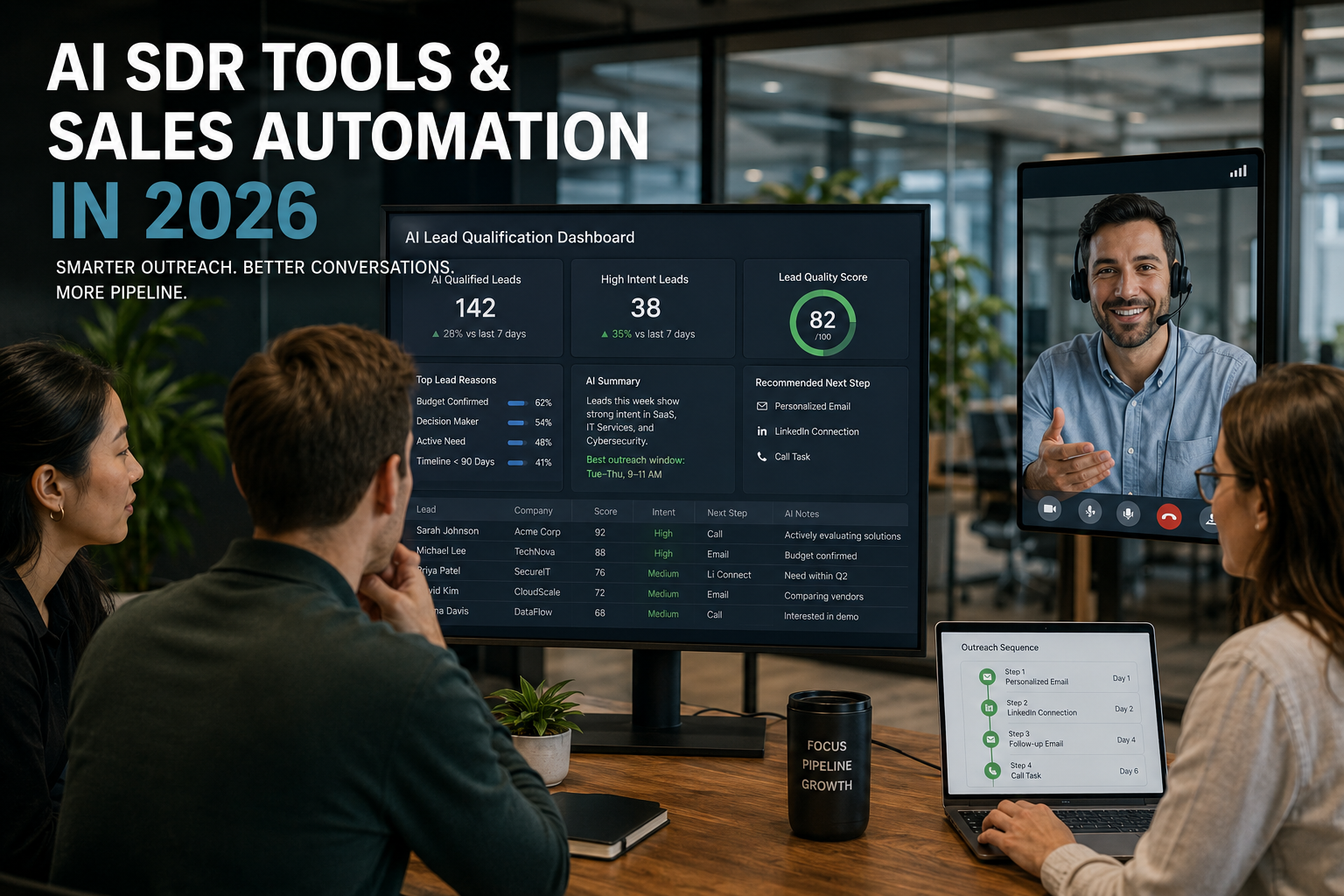
The hybrid model that’s producing this result looks specific. AI handles the volume work — monitoring buying signals across target accounts (funding rounds, leadership changes, job postings, technology adoption), researching prospects across multiple data sources, drafting personalised first-touch messages and follow-up sequences. A human reviews and approves before anything goes out, or at minimum reviews the responses and makes the qualification call.
Amplemarket’s Duo platform exemplifies this architecture: a Signal agent monitoring buying triggers, a Research agent enriching prospect context, a Sequence agent drafting personalised campaigns — with humans in the loop for message review and approval. The company’s positioning is explicit: “the best results come from AI and humans working together,” not AI replacing humans.
The documented outcomes from this hybrid approach are specific and credible. Checkr saw a 1.5x increase in qualified meetings. Questex generated $1M+ pipeline within three months. Gupshup reported 50% more SQLs (sales-qualified leads) per SDR. Canibuild generated $1M+ pipeline in its first three months using a hybrid AI/human model.
The pattern across all of these: AI did the work that doesn’t require judgment — research, drafting, monitoring, scheduling. Humans did the work that does — qualifying nuanced responses, building relationships, closing.
What’s Happening to the SDR Role Itself
SaaStr’s 2026 predictions describe a bifurcation in sales roles that’s already visible. AI agents are predicted to handle 40-60% of initial customer and prospect interactions by the end of 2026 — a number that was unthinkable two years ago. AI-native companies have 50% higher close rates than traditional companies, according to ICONIQ’s GTM benchmarking study.
But the headcount implication isn’t simple replacement. The “traditional WFH mid-pack inside sales rep” — the role that does moderate-volume, moderate-personalisation outbound — is the role under the most pressure, because AI now does that work adequately at near-zero marginal cost. The roles that are growing: highly compensated reps handling complex enterprise deals where relationship and judgment matter enormously, field sales roles using AI for coaching and preparation rather than replacement, and a smaller number of “AI-powered rep” roles that handle transactional deals end-to-end with AI support — essentially a hybrid role that didn’t exist before.
Vercel’s example — running nearly all of outbound with one human and AI agents — represents the extreme version of this hybrid model at a specific kind of company: high product-led-growth motion, technically sophisticated buyers, where the AI agents are doing genuinely well-targeted work because the ICP (ideal customer profile) is narrow and well-understood.
That last detail matters for any business evaluating AI SDR tools: fully autonomous models work best with clear ICPs, tested messaging, and high-volume needs. If your business doesn’t have a well-defined, narrow ideal customer profile and messaging that’s already been tested and refined by humans, AI SDR tools will scale whatever ambiguity exists in your targeting — at volume, and badly.
The Practical Guide for Choosing
If you’re evaluating AI sales tools in 2026, the question isn’t “which AI SDR should we buy” — it’s “what specific part of our sales process has the clearest signal-to-noise ratio for AI to operate on.”
Buying signal monitoring — tracking funding announcements, job changes, technology adoption across target accounts — is high-volume, well-structured, and exactly the kind of task AI handles reliably without judgment risk. Start here.
Prospect research and enrichment — pulling together context on a prospect before outreach — is similarly well-suited. AI can assemble the research; a human decides what to do with it.
First-draft message generation, with human review before sending — gets you the speed benefit without the “prospects can tell” problem, because a human is still making the final call on tone and relevance.
Full autonomous outreach without human review — only consider this if you have a genuinely narrow, well-tested ICP and messaging, high enough volume that the economics work even with elevated unsubscribe and complaint rates, and realistic expectations about the 50-70% churn rate in this category — meaning don’t sign a multi-year contract on your first attempt.
The honest bottom line: AI has genuinely changed what a sales team can accomplish with the same headcount. It has not, despite the early pitches, eliminated the need for the headcount. The companies getting the 2.8x pipeline numbers are the ones that figured out the boundary between what AI does well and what still needs a human — and built their process around that boundary rather than around the marketing promise.