The same platforms where AI-powered marketing delivers 30% higher ROI are starting to penalise content that looks AI-generated. Marketers using AI well in 2026 aren’t the ones generating the most content — they’re the ones whose AI-assisted content doesn’t read as AI-assisted. Here’s the honest state of AI in marketing right now.
There’s a tension at the centre of AI marketing in 2026 that most “AI marketing trends” articles skip past, and it’s worth sitting with because it changes how you should actually use these tools.
On one hand: marketing teams using AI-powered optimisation see 30% higher ROI on advertising spend compared to manual optimisation. 84% of marketers use AI for real-time personalisation. 96% of marketers use marketing automation and report an average 5x return. The global AI marketing market, valued at $47.32 billion in 2026, is projected to reach $107.5 billion by 2028 — a 36.6% annual growth rate that reflects accelerating, not flattening, enterprise spending.
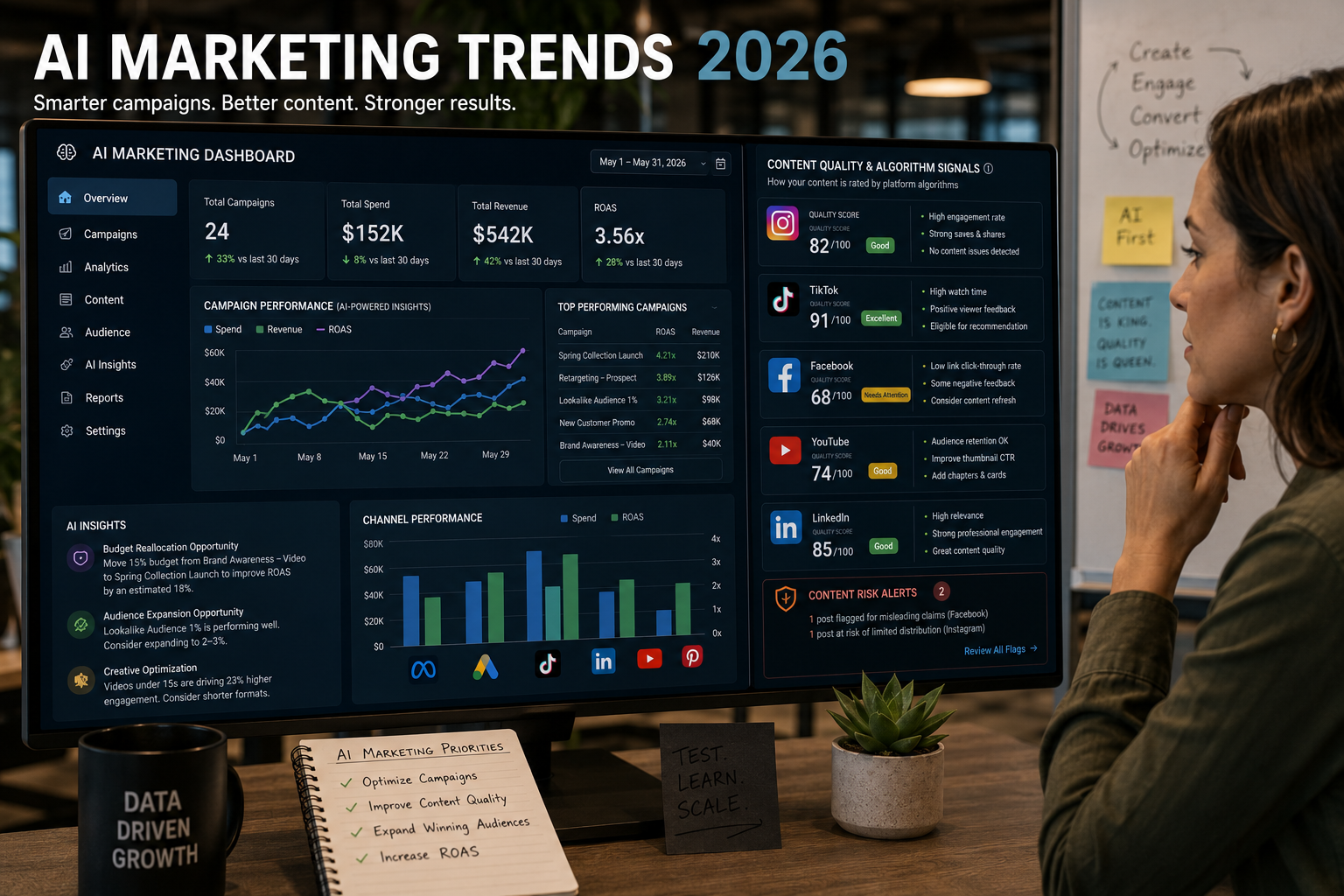
On the other hand: Meta, TikTok, and Google are quietly down-ranking obvious AI-generated creative in their 2026 algorithm updates — a pattern confirmed across multiple agency performance studies. The platforms where AI delivers its biggest optimisation wins are simultaneously penalising the AI-generated content itself.
This isn’t a contradiction once you understand what’s actually being optimised versus what’s being penalised. But it’s a distinction that a lot of businesses rushing into AI marketing are missing — and the businesses that get it right are pulling significantly ahead of the ones that don’t.
What’s Being Rewarded vs What’s Being Penalised
The 30% ROI improvement and the 5x automation returns are coming primarily from optimisation — AI managing the mechanics of campaigns: budget allocation across channels and creative variants, bid management, audience targeting, timing, and the continuous reallocation of spend toward what’s working.
58% of paid search campaign optimisation in 2025 was driven by Google’s Performance Max — Google’s AI system for automated campaign management. AI-driven PPC bid management reduces wasted ad spend by 37% and increases ROI by up to 50% compared to manual bidding. This is AI doing what AI is structurally good at: processing enormous amounts of performance data continuously and reallocating resources faster than any human team could.
The penalty is being applied to a different layer: the creative itself. “Obvious AI-generated creative” being down-ranked means content that has the recognisable texture of AI generation — the slightly-too-smooth imagery, the generic stock-photo-adjacent compositions, the copy that reads as competent-but-characterless.
The platforms have a structural incentive to do this. Their algorithms exist to surface content that engages users. If AI-generated creative is, on average, less engaging than human-made creative — which the early 2026 data suggests, since users have become attuned to spotting it — then down-ranking it is simply the algorithm doing its job. It’s not an anti-AI policy. It’s an anti-low-engagement policy that happens to correlate with AI-generated content right now.
The Practical Implication: Use AI for the Machine, Not the Message
The marketers winning in 2026 have effectively split their AI usage into two categories with very different rules.
For the optimisation layer — let AI run. Budget allocation, bid management, audience segmentation, timing, A/B test analysis, attribution modelling — these are mechanical, data-processing tasks where AI’s speed and scale advantages are pure upside with no creative authenticity penalty. The autonomous marketing agents now managing entire ad accounts across Google, Meta, and LinkedIn without human intervention are operating in this layer, and the results — companies seeing 50% increase in leads and appointments from AI-driven sales and marketing — reflect genuine optimisation gains.
For the creative layer — use AI as a starting point, not an endpoint. AI-generated first drafts of ad copy, AI-generated initial concepts for visuals, AI-assisted ideation for campaign angles — all useful. AI-generated final creative that goes live without meaningful human refinement — increasingly risky, both for the algorithm penalty and because audiences are developing the same “this feels AI-made” instinct the platforms are encoding into their algorithms.
The MarTech stack consolidation trend reinforces this split. Companies that consolidate their marketing technology stack around AI-capable platforms report 50-77% reductions in technology costs, with documented cases of up to 2,101% ROI improvement from consolidation alone — driven substantially by eliminating the 44% of SaaS marketing licences that are currently underutilised or completely unused. That consolidation is happening primarily in the optimisation and operational layer — the platforms doing budget management, attribution, and campaign execution — not in wholesale replacement of creative production.
The Revenue Attribution Story: Delta’s $30 Million
The clearest example of AI marketing ROI done right comes from Delta Air Lines, which attributed $30 million in ticket sales to AI optimisation during a defined campaign period. This is the gold standard for measuring AI marketing impact: a specific, time-bound, attributable revenue outcome — not a vague “AI helped our marketing.”
The methodology that produces measurable results like this involves tracking incremental revenue generated by AI-optimised campaigns relative to control groups or historical baselines — essentially running the AI-optimised approach alongside a non-AI-optimised comparison and measuring the difference. This is more rigorous than most businesses’ approach to measuring marketing AI, which tends to be “we turned it on and our numbers went up” without controlling for seasonality, market conditions, or other simultaneous changes.
For businesses without Delta’s scale or data infrastructure, the principle still applies at a smaller level: before fully committing to an AI marketing platform, run it alongside your existing approach for a defined period on a defined segment, and measure the actual difference — in cost per acquisition, lead quality and lead-to-close rates, and time to market for content and campaigns.
The Autonomous Agent Frontier — and Its Limits
The most significant 2026 development is the emergence of genuinely autonomous marketing agents — tools that manage entire ad accounts across multiple platforms without human intervention, content agents that produce and distribute multi-format campaigns from a single brief, and AI SDR agents handling outbound pipeline (a topic with its own honest complications, covered separately).
The framing that’s emerged: the frontier moved from “AI helps you do marketing tasks faster” to “AI runs the marketing function while you supervise.” That’s a genuine shift in what’s operationally possible, and the 96% adoption rate with 5x reported returns suggests it’s delivering value at scale.
The limit, consistent with the creative-penalty dynamic above, is that “AI runs the marketing function” works best for the parts of marketing that are genuinely mechanical — campaign management, budget optimisation, performance monitoring, reporting — and works least well for the parts that require genuine creative judgment, brand voice consistency, and the kind of cultural awareness that determines whether a piece of creative lands or falls flat.
The businesses extracting the most value from autonomous marketing agents in 2026 are using them to run the machine — campaigns, budgets, optimisation, reporting — while keeping a human (or a small creative team) accountable for the actual creative output that the machine distributes. The businesses struggling are the ones that handed the entire function — including the creative — to the agent, and are now watching their content quietly sink in algorithmic visibility while their competitors’ more human-refined content rises.
The 36.6% annual growth in the AI marketing market isn’t slowing down, and the ROI numbers are real. But “AI marketing” in 2026 isn’t one thing — it’s a layered system where the machine layer rewards full automation and the creative layer punishes it. Knowing which layer you’re operating in, for any given task, is the difference between the 30% ROI improvement and the algorithm quietly burying your campaign.