Most companies deployed an AI chatbot, saw it handle FAQs, and called it done. The data on what’s actually possible is dramatically different — 285% higher customer lifetime value AND 67% lower support costs, simultaneously, at companies that went further. Here’s what separates the basic deployment from the one that actually moves the business.
Here’s a number that should worry any business that deployed an AI chatbot and considers the project finished: basic chatbots only resolve 23% of issues without human handoff. 73% of customers abandon chat sessions with basic bots. And customer satisfaction drops 34% when chatbots fail to escalate properly.
If your AI customer service deployment is a rules-based bot that handles FAQ questions and falls over on anything else, you’re probably living somewhere in those numbers — and the 34% satisfaction drop on failed escalations may be quietly undoing whatever cost savings the bot is generating on the easy tickets.
Now here’s the other number, from an analysis of 200+ DTC brands implementing more advanced AI customer service strategies: 285% higher customer lifetime value and 67% lower support costs, achieved simultaneously.
The gap between these two outcomes — basic bot versus sophisticated system — is one of the largest “you’re leaving money on the table” gaps in the entire AI-for-business landscape. Here’s what’s actually different between the two.
Why “85% of Inquiries Need Context” Is the Whole Story
The single statistic that explains the gap: 85% of customer inquiries require context beyond FAQ responses.
A basic chatbot is built around a knowledge base of articles and a decision tree: if the customer’s message contains certain keywords, return a matching article. This works for the 15% of inquiries that are genuinely FAQ-shaped — “what are your hours,” “how do I reset my password,” “where’s my order.”
The other 85% require the system to know something about the specific customer, the specific situation, or both. “I ordered this two weeks ago and it still hasn’t arrived, and I emailed about it last week and never heard back” is not an FAQ question. It requires the system to look up the order, check the shipping status, find the previous email thread, understand that this is now an escalated situation because of the prior unanswered contact, and respond accordingly — or recognise that this needs a human and hand off with all of that context already assembled.
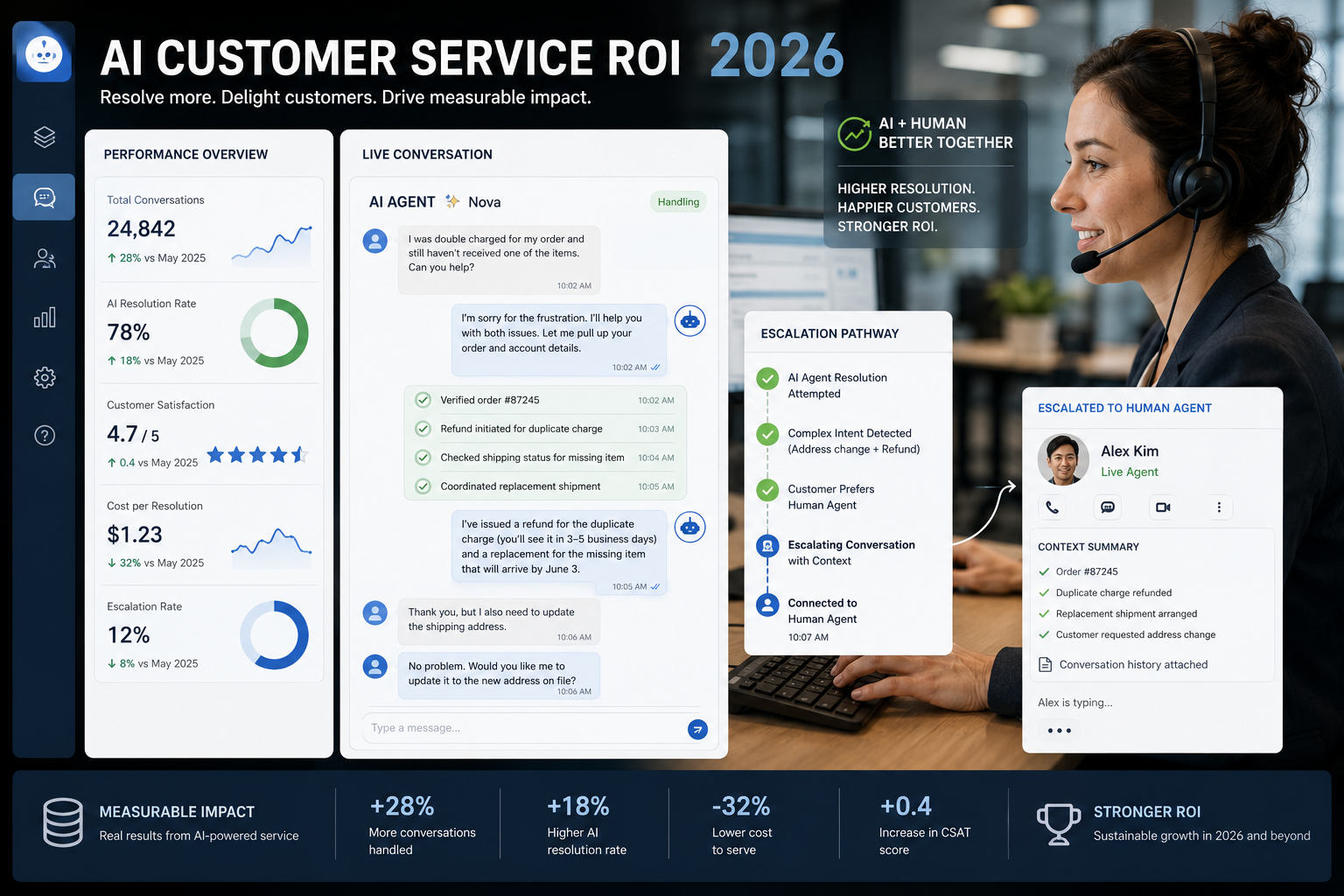
A basic chatbot handles the 15%. A sophisticated AI system handles a meaningful chunk of the 85% by actually integrating with the systems that contain the context — the order management system, the CRM, the previous conversation history — and either resolving the issue directly or escalating with full context so the human agent doesn’t have to ask the customer to repeat everything.
That second scenario — escalating with context — is where a huge amount of the satisfaction difference comes from. The 34% satisfaction drop from failed escalation isn’t just about the bot failing. It’s about the customer having to explain their problem from scratch to a human after already explaining it to the bot. Context-aware escalation eliminates that specific frustration, and it’s one of the cheapest improvements available if your current system doesn’t do it.
The Numbers That Matter for Your Business Case
The aggregate ROI data on AI customer service is consistently strong: companies report an average 340% first-year ROI, with $3.50 returned for every $1 invested. The per-interaction cost drops from roughly $20-25 for a human agent to $0.50-0.70 for an AI system — not a marginal efficiency gain, but a structural repricing of every routine support conversation.
Specific company results worth knowing: NIB Health Insurance saved $22 million and cut costs by 60%. Vodafone reduced cost-per-chat by 70%. Klarna’s AI generated $40 million in profit improvement in a single year. These aren’t outlier marketing claims — they’re documented outcomes from companies operating at scale.
The 2023-to-2026 benchmark shift for SaaS support specifically tells the maturation story clearly. Ticket resolution by AI has gone from 30-40% (scripted bots, static flows) to up to 85% (autonomous, context-aware agents). Average handling time dropped from 8-12 minutes for human-handled tickets to 2-3 minutes for agentic AI. CSAT improved from a 65-75% range to 70-85%. And the break-even timeline for the investment shrank from 12-18 months to 4-7 months.
That last number — break-even time roughly halving — is the practical signal that the technology has moved past the “expensive experiment” phase. A 4-7 month break-even is a business case that most finance teams will approve without much debate, assuming the implementation is scoped correctly.
What “Sophisticated” Actually Means in Practice
The 285% CLV improvement from the DTC brand analysis isn’t just about resolution rates. It comes from AI customer service systems that do things basic chatbots structurally can’t:
Proactive intervention. Instead of waiting for the customer to report a problem, the system identifies signals — multiple failed login attempts, an item sitting in a cart for an extended period, a shipment that’s been stuck in transit longer than normal — and reaches out first. A proactive “we noticed your order is delayed, here’s what’s happening and here’s a credit for the inconvenience” message prevents the angry support ticket entirely, and often improves the customer relationship rather than just neutralising a complaint.
Sentiment-aware escalation. Sophisticated systems don’t just escalate based on keyword triggers (“I want to speak to a manager”). They detect frustration building across a conversation — repeated rephrasing of the same question, increasingly short responses, language patterns associated with dissatisfaction — and escalate before the customer explicitly asks, often with a note to the human agent about the emotional context.
Cross-system resolution. The highest-value AI customer service deployments can actually take action — issue a refund within policy limits, update a shipping address, apply a discount code, reschedule a delivery — rather than just providing information. This is the difference between “here’s how you would go about getting a refund” and “I’ve processed your refund, you’ll see it in 3-5 business days.” The latter resolves the issue in the same interaction; the former generates a follow-up.
Revenue protection, not just cost reduction. The CLV improvement in the DTC analysis comes substantially from churn prevention — customers who had a frustrating experience that AI caught and fixed before it became a cancellation. This value doesn’t show up in a “cost per ticket” calculation, which is part of why companies measuring AI customer service purely on cost savings often understate its actual business impact.
The Honest Implementation Path
If your current AI customer service is a basic chatbot living in the 23% resolution / 73% abandonment world, the path to the more sophisticated outcomes doesn’t require ripping everything out and starting over.
Start by connecting the bot to the systems that hold context — order history, account status, previous conversation logs — even if the bot’s conversational logic doesn’t change immediately. Context-aware escalation alone, even without improving the bot’s resolution capability, addresses a meaningful chunk of the satisfaction problem.
Audit what the bot currently fails on. Most platforms log the conversations that get escalated or abandoned. Reviewing even a few hundred of these reveals patterns — specific question types, specific customer segments, specific products — where targeted improvements produce outsized returns rather than trying to improve everything at once.
Add proactive triggers for your highest-frequency, highest-frustration scenarios first. If shipping delays are your most common complaint, build the proactive notification for that scenario before trying to cover every possible issue.
Measure CLV and retention impact, not just resolution rate and cost per ticket. The companies getting the 285% CLV outcomes are measuring the right thing. If your AI customer service metrics dashboard only shows cost savings, you’re probably underselling — or under-investing in — what the system is actually capable of contributing.
The gap between 23% and 85% resolution, between a 34% satisfaction drop and a 285% CLV improvement, is not primarily a technology gap in 2026. The technology to do the sophisticated version exists and is accessible to businesses well below enterprise scale. The gap is implementation depth — and for most businesses still living in the basic-chatbot world, the upgrade path is more incremental, and more achievable, than it looks from the outside.