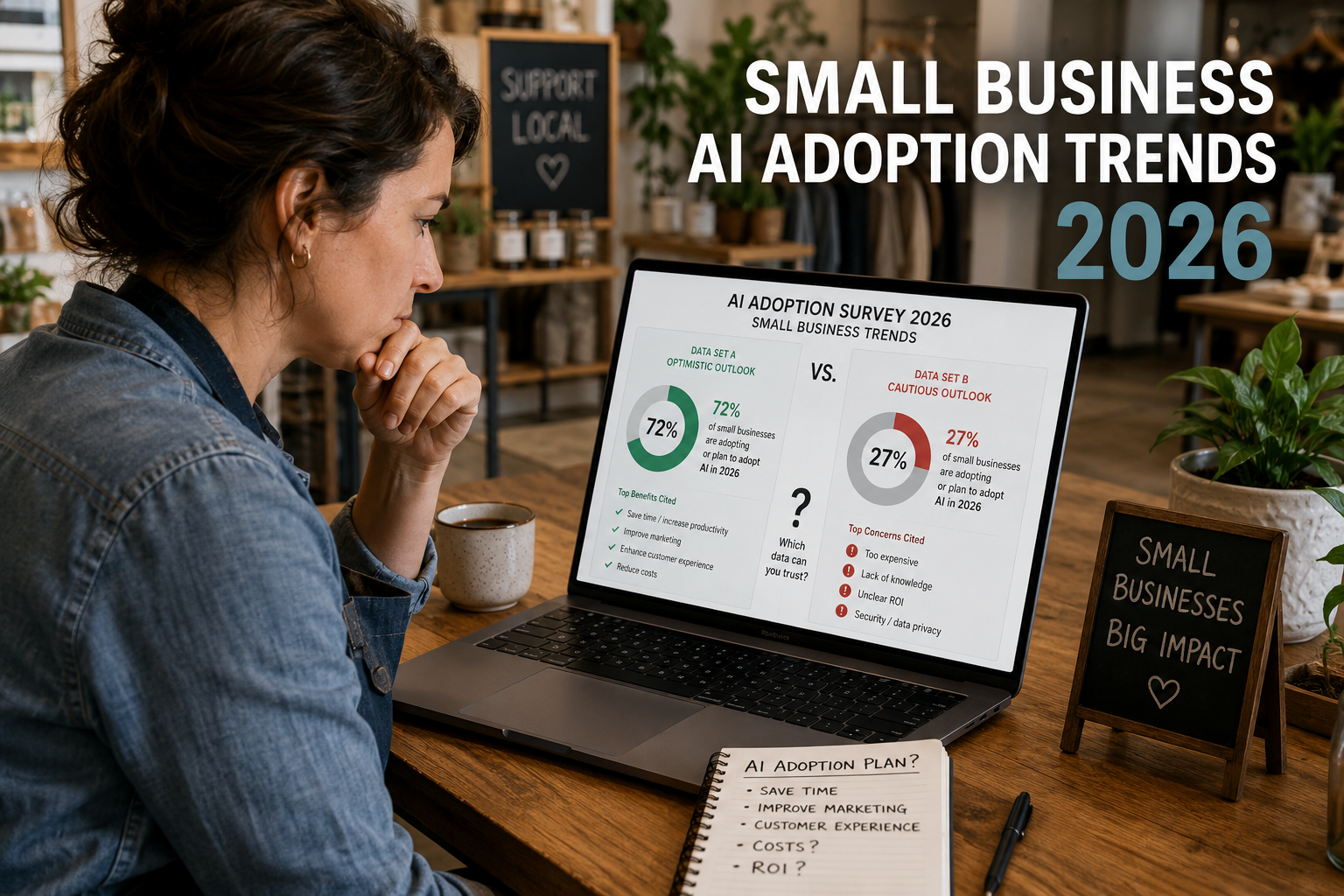
QuickBooks says 68% of small businesses use AI regularly. NEXT’s survey says adoption dropped from 42% in 2024 to 28% in 2025. These can’t both be true — except they kind of are. Here’s what’s really happening underneath the contradictory headlines.
I spent an afternoon recently reading through every small business AI adoption survey published in the past six months, and I came away genuinely confused — in a useful way.
QuickBooks says 68% of US small businesses use AI regularly, saving $500-2,000 a month and 20+ hours a week. The US Chamber of Commerce says 58% have adopted generative AI, up from 40% in 2024. The Federal Reserve found adoption among companies with 10-100 employees jumped from 47% to 68% in a single year. The SBE Council’s 2026 survey found 82% of small business employers have invested in AI tools.
Then NEXT surveyed 1,500 small business owners and found adoption dropped from 42% in 2024 to just 28% in 2025. Independent operators were “dialing back.”
Both sets of numbers come from credible sources, surveying real small business owners, in roughly the same period. So what’s going on?
The Explanation Nobody’s Giving You
Here’s my honest read after sitting with this for a while: both surveys are measuring real things, but they’re measuring different populations and different definitions of “using AI.”
The high-adoption surveys are largely capturing businesses that have integrated AI into specific, named tools — Gemini in Gmail, Copilot in Microsoft 365, the AI summarisation feature in their accounting software, the chatbot their website builder added automatically. A huge amount of “AI adoption” in 2026 is passive: AI capabilities arriving inside tools small businesses were already using, without the owner making an active decision to “adopt AI.”
The declining-adoption survey is likely capturing something different: small business owners who tried a dedicated AI tool — a ChatGPT subscription, a specific AI marketing platform, an AI scheduling assistant — made an active decision about it, and then stopped using it or let the subscription lapse.
NEXT’s own framing supports this: cost and complexity are the barriers keeping people out. A $20/month subscription doesn’t sound like much until you’re a sole proprietor running on thin margins, and the tool requires 30 minutes of setup time you don’t have, produces outputs you have to heavily edit anyway, and doesn’t connect to the three other systems you’re already using.
The honest summary: small businesses are using AI more than ever in the tools they already pay for. They’re abandoning standalone AI subscriptions at a meaningful rate. Both things are true simultaneously, and the gap between them is exactly where the opportunity and the risk both live.
What the Businesses That Stuck With It Are Doing Differently
The productivity data from businesses that have successfully integrated AI is genuinely impressive: AI-using companies report 26-55% productivity gains in the functions where AI is deployed. AI-enabled small business owners are nearly twice as likely to report revenue growth. The typical AI-using small business now runs a median of five AI tools — not one experiment, but an actual operational stack.
That stack number is the tell. The businesses getting real value aren’t the ones that bought one AI subscription and hoped. They’re the ones running AI across content, customer service, scheduling, analytics, and workflow automation — tools working separately but adding up to something that changes how the business operates.
The use case mix has shifted too. Early adopters were doing content generation: drafting emails, writing product descriptions, generating social posts. By 2025-2026, the applications became operational — scheduling, inventory forecasting, customer service routing, financial reporting. The businesses that moved from “AI helps me write things” to “AI runs parts of my operations” are the ones in the high-adoption, high-satisfaction numbers.
The businesses in the declining-adoption numbers are disproportionately the ones that got stuck at the first stage — tried AI for content, found the outputs needed heavy editing, didn’t see it save meaningful time, and quietly stopped.
The Industry Pattern That Matters Most
AI adoption by industry tells its own story. Retail, professional services, and healthcare — all sectors with high-volume, repetitive customer interactions and document processing — are where small businesses report the clearest, fastest returns. Marketing is where most small businesses see the earliest wins: content creation, marketing and sales support, and workflow automation deliver immediate ROI in time savings and customer reach.
The businesses where AI adoption has been weakest are the ones where the work is highly variable, relationship-dependent, or physically hands-on in ways that don’t generate the kind of structured data AI tools work with. A specialty contractor doing custom renovation work has fewer obvious AI entry points than a retail business processing thousands of similar customer inquiries.
This isn’t a permanent state — agentic AI and computer-use capabilities are starting to extend into more variable, judgment-heavy work. But for 2026, the pattern is clear: businesses with repetitive, high-volume, document- or text-heavy operations are the early winners. Businesses without that profile need a different starting point, and probably a longer timeline.
What This Means If You’re Deciding Whether to Bother
If you’re a small business owner reading the conflicting headlines and trying to decide what to do, here’s the honest framework.
Start with what’s already inside the tools you pay for. Before subscribing to anything new, check what AI capabilities are already built into your accounting software, your CRM, your email platform, your point-of-sale system. A huge amount of value is sitting unused inside subscriptions you’re already paying for — Microsoft Copilot inside Microsoft 365, Gemini inside Google Workspace, the AI features inside QuickBooks or Xero that most small business owners have never turned on.
Pick one operational workflow, not a content task. The 26-55% productivity gains are coming from operational use cases — scheduling, customer service routing, inventory forecasting — not from “help me write a social post.” If your only AI use case is content generation, you’re in the category most likely to abandon it within a year.
Budget for the learning curve, not just the subscription. The $20/month tool isn’t the real cost. The real cost is the hours of figuring out how to prompt it effectively, how to integrate it into your actual workflow, and how to train any staff who’ll use it. Businesses that budget time for this — even just a few hours in the first month — see dramatically better outcomes than those that expect immediate value from day one.
Don’t measure success by whether you “use AI.” Measure it by whether a specific task takes less time, costs less, or produces better results than it did before. The businesses dropping out of the adoption numbers are often the ones that adopted AI as a category rather than as a solution to a specific problem they could measure.
The contradiction in the survey data isn’t really a contradiction. It’s a snapshot of a technology that’s becoming infrastructure for some businesses and a forgotten subscription for others — and the difference between the two groups has very little to do with the technology itself.