Recruiting has always been about relationships. AI is now handling everything that gets you to the relationship faster. Here’s how leading businesses are using AI to hire better — without the legal exposure and bias risks that are already producing headlines.
There’s a number that should immediately reframe how you think about your hiring process: the average cost of employee turnover is now $10,200 to $23,012 per person. Voluntary separations rose from 42% to 51% year over year, according to Paychex’s 2026 Business Leaders report. Every bad hire is expensive. Every slow hire that loses a candidate to a faster competitor is expensive. And the time your HR team spends on administrative screening — which can represent the majority of their working hours — is expensive.
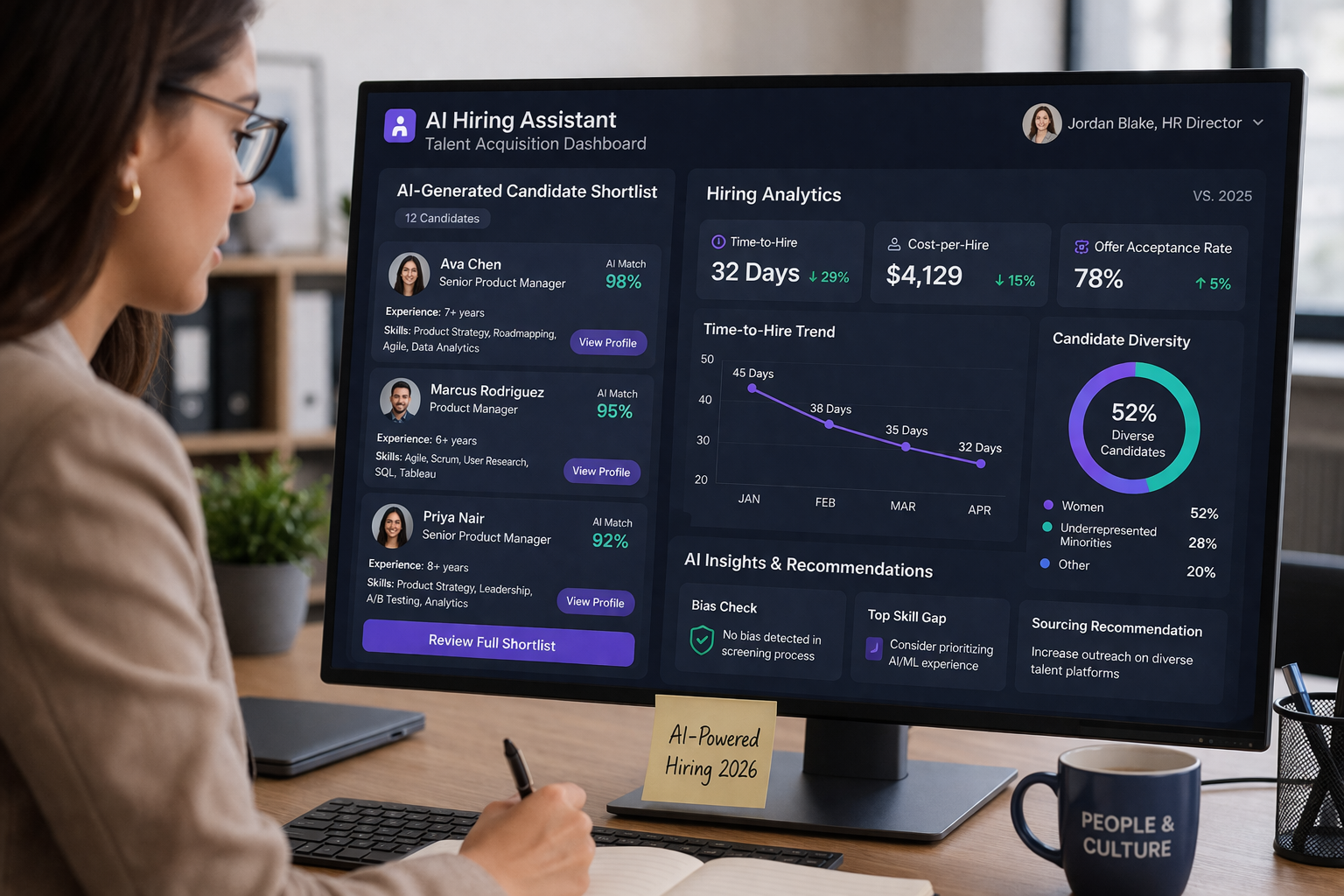
AI is directly addressing all three problems. Companies using AI recruiting tools are seeing 33% faster time-to-hire, 30% reduction in cost-per-hire, and measurably better quality-of-hire scores. AI use across HR tasks climbed to 43% in 2026, up from 26% in 2024 — crossing from experiment to standard practice.
But AI recruiting also has a documented bias problem, a growing regulatory compliance landscape, and a failure mode that can quietly damage your employer brand. The businesses winning with AI recruitment in 2026 are the ones who understand all of this — not just the upside.
This guide covers both sides honestly.
What AI Is Actually Doing in Recruiting Right Now
AI touches virtually every stage of the hiring process in 2026. Understanding which stages deliver the clearest value — and which carry the most risk — is the starting point for any implementation.
Sourcing: AI tools mine job boards, LinkedIn, professional networks, and your own ATS (applicant tracking system) to surface candidates who match your criteria, including passive candidates who aren’t actively applying. Tools like Fetcher and Phenom do this automatically, building talent pools based on historical hiring data and role requirements. The practical result: recruiters spend less time searching and more time engaging candidates who are actually relevant.
Resume screening and ranking: This is both the highest-volume use case and the one with the most documented risk (more on that below). AI screens applications based on defined criteria, ranks candidates, and surfaces the most relevant profiles for human review. A human recruiter can realistically review 100-150 resumes per day; an AI system screens tens of thousands in minutes.
Candidate outreach: AI generates personalised outreach messages for recruiter contact. LinkedIn data shows companies using AI-assisted recruiter messaging are 9% more likely to make a quality hire than low users — presumably because the messages are more targeted and response rates are higher.
Interview scheduling: A task that consumed enormous recruiter time — the back-and-forth of finding mutual availability — is now handled automatically by AI scheduling tools. Candidates pick from available slots; the calendar updates; no human coordinator required.
Interview support: AI tools can generate role-specific interview questions, provide guidance during video interviews, and produce structured feedback templates that reduce interviewer subjectivity. This is an area of rapid development in 2026, with tools like HireVue moving from basic video analysis toward more sophisticated assessment.
Onboarding: AI handles the administrative elements of new hire onboarding — paperwork routing, system access setup, FAQ response — freeing HR to focus on cultural integration and relationship building.
The companies seeing the strongest results from AI recruitment treat it as a system, not a collection of individual tools. Each stage connects to the next, data flows between platforms, and the human recruiter’s time is progressively concentrated on higher-judgment activities.
The ROI Numbers That Justify the Investment
86.1% of recruiters using AI report that it accelerates the hiring process. 85% of employers using automation say it saves them time and increases efficiency. In specific implementations:
Aeon Hire’s platform, which automates repetitive tasks while keeping humans in control of strategic decisions, saves recruiting teams an average of 23 hours per week. Organisations applying AI-driven HR analytics improved hiring efficiency by approximately 35% in 2025, according to Eman Research Academic. A B2B software company automated 78% of onboarding questions, cutting time-to-value for new customers by 40% and reducing churn by 18%.
The financial case is clear: 30% reduction in cost-per-hire plus 33% faster time-to-hire plus improved quality-of-hire scores equals a compelling ROI on a reasonable investment in AI recruiting tools. For a business that hires 20 people per year at an average cost of $15,000 per hire, a 30% reduction in cost-per-hire represents $90,000 in annual savings — typically more than the cost of the tools by a significant margin.
The Bias Problem: What You Need to Know Before Deploying
This section is not optional reading. Skip it and you are taking on legal and reputational risk that is already materialising in court cases.
The University of Washington found in 2025 that AI resume screening systems favoured white-associated names 85.1% of the time. This isn’t a bug in one tool — it’s a pattern across AI hiring systems trained on historical hiring data that reflects historical bias.
The legal landscape is responding. The EU AI Act obligations for AI in hiring began in August 2026, introducing compliance requirements for employers. New York City’s Local Law 144 requires annual bias audits and candidate notices before using automated employment decision tools. Similar legislation is moving through legislatures in multiple US states and EU member countries.
Only 26% of job applicants trust AI to evaluate them fairly, according to Gartner. That trust deficit affects employer brand — candidates who feel they were filtered out unfairly by an algorithm are significantly more likely to share that experience publicly.
The practical guidance for businesses deploying AI in recruiting:
Audit the tools before deployment. Any AI recruiting tool you use should be able to provide evidence of bias testing across protected characteristics. Ask for it. If the vendor can’t produce it, that’s a signal.
Strip identifying information from screening inputs. AI tools that remove names, schools, graduation years, and other proxies for protected characteristics produce more consistent screening quality and reduce bias exposure. This is increasingly standard in reputable tools.
Keep humans in the loop on all consequential decisions. AI can surface candidates and generate rankings. Humans should make all advancement and rejection decisions, informed by — not replaced by — AI recommendations.
Document your process. In any regulatory environment, being able to show what AI did, what data it used, and what human review occurred protects you. Build audit trails from the start.
The Implementation Roadmap: What to Prioritise First
Not all AI recruiting applications carry equal risk or deliver equal return. Here’s a sensible sequence.
Start with scheduling and administrative automation. Zero bias risk. Immediate, measurable time saving. Easy to implement, easy to measure. Interview scheduling tools like Calendly AI or Paradox’s Olivia pay for themselves in the first month for most recruiting teams.
Add AI sourcing. Lower risk than screening — you’re expanding your candidate pool rather than narrowing it. Tools that surface previously overlooked candidates often improve diversity outcomes as a side effect. Measure candidate quality (how many sourced candidates advance to offer stage) against your baseline.
Implement AI-assisted outreach messaging. Use AI to draft personalised outreach messages for recruiter review before sending. This gives you the efficiency benefit while maintaining human judgment on tone and relationship.
Add screening support — cautiously. If you implement AI resume ranking, treat it as a first-pass prioritisation tool, not a decision-making system. Every rejection should involve human review. Bias-audit your specific tool on your specific data before scaling.
Consider interview support tools last. This is the most sensitive area — candidates are aware that video analysis exists and largely don’t trust it. If you use it, be transparent. “Our initial review includes an AI assessment of interview responses” is better than hiding the process.
The Human Element That AI Can’t Replace
The companies winning the talent war in 2026, as MSH’s research puts it, “aren’t those with the most advanced AI — they’re the ones using AI most intelligently.”
What does that mean practically? It means using AI to compress the time from application to the point where a human recruiter can have a meaningful conversation with a genuinely strong candidate. The relationship-building, the candidate experience, the assessment of cultural fit, the negotiation and close — all of that still belongs to humans. And it always will, because that’s what candidates expect and what builds the employer brand that makes great people want to work for you.
The recruiter’s role is shifting from process coordinator to strategic talent advisor. AI handles volume, routing, and administrative work. The human brings judgment, relationships, and the ability to make someone feel genuinely seen in a hiring process.
That shift doesn’t eliminate recruiter roles. It makes them more valuable — and more interesting. The recruiters who understand both what AI can do and where human judgment is irreplaceable are the ones with the strongest career prospects in this environment.