When Sarvam AI released its Vision OCR model in February 2026, it scored 84.3% on the standard benchmark — beating Gemini 3 Pro at 80.2% and ChatGPT at 69.8%. On Hindi. The story of India’s AI ecosystem isn’t “catching up to the US.” It’s building something the US never had to build: AI infrastructure for a billion people who don’t primarily speak English.
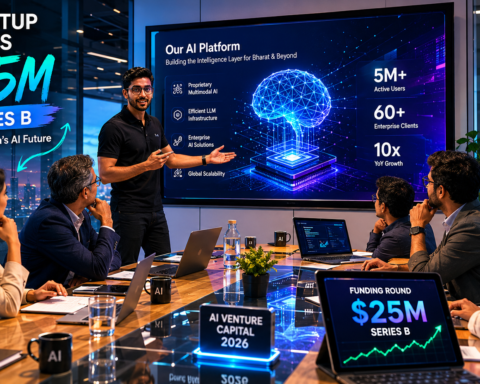
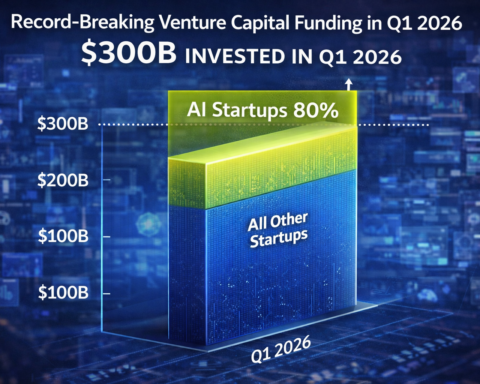
There’s a specific kind of Western tech coverage that describes India’s AI ecosystem in terms of catching up. It counts the number of startups (4,500 as of 2026, third-largest globally after the US and China), notes the venture capital inflows ($1.48 billion in Q1 2026 alone), and frames it as a developing market building toward the capability level that American labs already have.
That framing misses what’s actually happening.
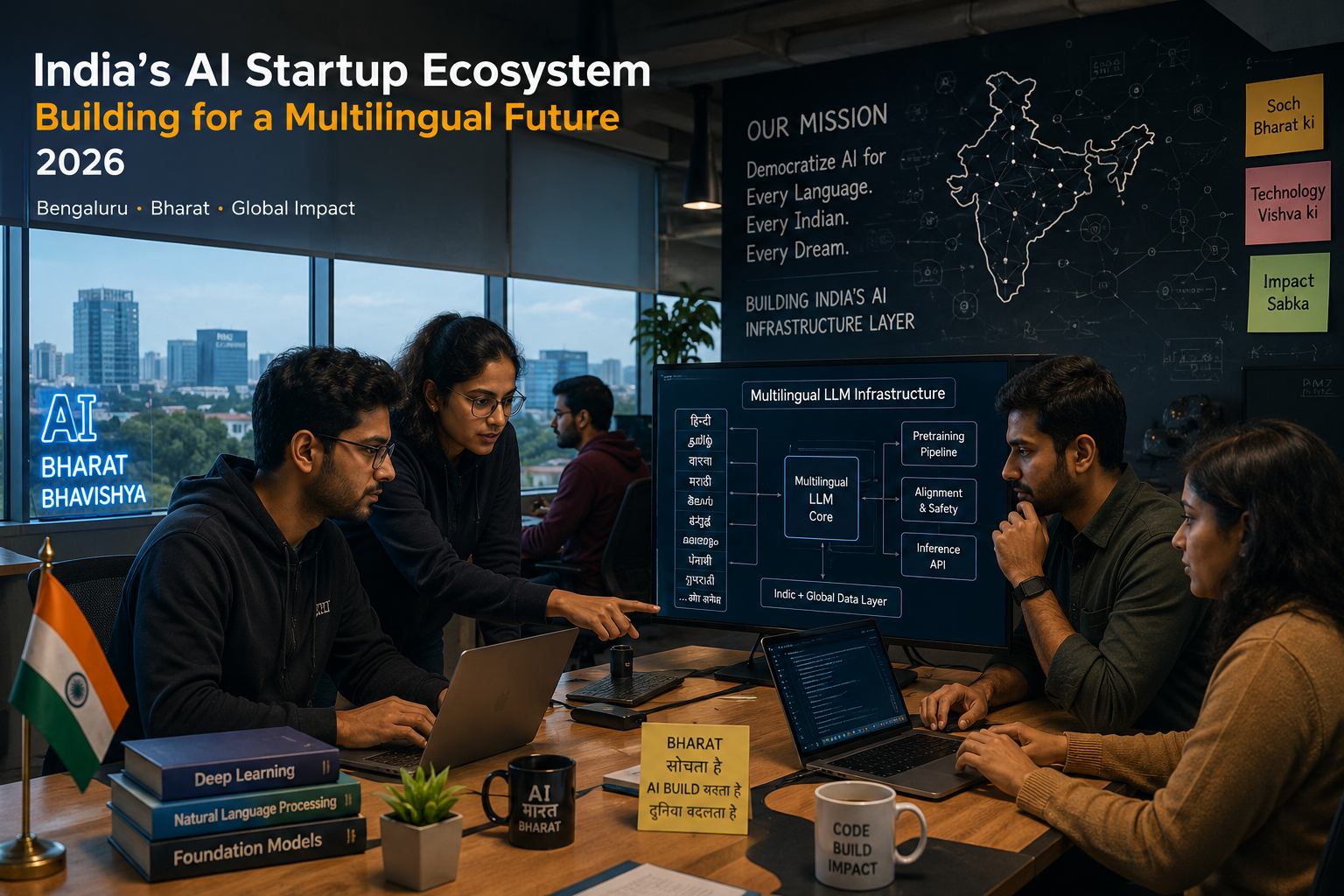
India is not building a smaller version of OpenAI. It’s building the foundational AI infrastructure for a specific problem that OpenAI has essentially no incentive to solve well: making AI genuinely useful for people who speak Hindi, Tamil, Telugu, Kannada, Bengali, Marathi, and the seventeen other official languages in which Indians think, work, and conduct their daily lives.
About 600 million Indians are not comfortable reading or writing in English — the language in which virtually all frontier AI training data is concentrated. For these people, GPT-5.5 is not a productivity tool. It’s a foreign language classroom they can’t access. The Indian AI startups that understand this and are building for it are not working on a derivative problem. They’re working on the primary problem for AI’s next billion users.
Sarvam AI: When Open Source Beats the Giants on Their Own Benchmark
Sarvam AI’s 14-day launch streak in February 2026 was a specific kind of flex. The Bengaluru-based company released a series of AI capabilities in rapid succession: Vision OCR, the Bulbul V3 voice AI with 35+ voices across 11 languages, Sarvam Audio for automatic speech recognition across 22 Indian languages, and the announcement of two new large language models — Sarvam-30B and Sarvam-105B.
The Vision OCR results are the ones worth examining carefully. On olmOCR-Bench, the standard benchmark for optical character recognition, Sarvam scored 84.3%. Gemini 3 Pro scored 80.2%. ChatGPT scored 69.8%. A Bengaluru startup with $53.8 million in total funding outperformed two of the most capable AI systems in the world, built by companies that have spent tens of billions on AI development.
The qualifier matters: this is a benchmark specifically testing Hindi and other Indic script recognition. The Google and OpenAI models are general-purpose systems that weren’t optimised for this specific task. But that’s precisely the point. General-purpose AI systems optimised primarily on English are not general-purpose for a country where English is a second or third language for most of the population. Sarvam is purpose-built for the use cases that matter in India.
The government has recognised this strategic importance. In April 2025, the Indian government selected Sarvam AI under the IndiaAI Mission to build India’s first homegrown sovereign large language model. The Mission provided Sarvam with 4,096 NVIDIA H100 GPUs — a massive compute allocation for a company at this stage, and a signal of the government’s view that Sarvam is building critical national infrastructure.
The IndiaAI Mission’s overall compute commitment — ₹4,564 crore (roughly $550 million) to create a public AI compute infrastructure featuring over 10,000 GPUs — reflects a strategic decision to ensure that India’s AI development doesn’t depend entirely on US cloud providers for the computational substrate. This is the sovereign AI argument being enacted: not just building Indian AI models, but building Indian AI compute infrastructure on which those models run.
Krutrim: India’s First AI Unicorn, Built in One Year
Bhavish Aggarwal is not someone who does things quietly. He built Ola into India’s dominant ride-hailing company and Ola Electric into the country’s largest EV manufacturer. When he turned his attention to AI in 2022, the expectation was that he’d move fast and aim for scale.
Krutrim reached a $1 billion valuation — India’s first AI unicorn — within one year of founding. The name means “artificial” in Sanskrit. The product is a full-stack sovereign AI play: Krutrim-2, a 12-billion parameter multilingual model; the Kruti agentic assistant supporting 13 Indian languages; and its own GB200-powered GPU infrastructure.
The chip play is the most ambitious and the most strategically interesting. Krutrim has plans to develop India’s first homegrown family of chips for AI, general compute, and edge deployment. It has partnered with Lenovo to build a supercomputer. If these plans materialise, Krutrim would be the only Indian company with a vertical stack from silicon to application — the same kind of hardware-software integration that gives Apple its competitive advantage in consumer devices.
The rationale is strategic rather than purely economic. India’s AI ambition, like China’s, involves not being dependent on foreign hardware for the computational substrate of its digital economy. NVIDIA export controls — the US government’s attempt to limit China’s access to advanced chips — are a reminder that AI infrastructure dependency on foreign hardware is a geopolitical vulnerability. Krutrim’s chip ambitions are India’s response to that lesson, applied before the vulnerability becomes acute.
With $74 million in funding from backers including Z47 (formerly known as Target Global), Krutrim is well-capitalised for its current stage. The valuation trajectory and the government’s evident appetite for supporting sovereign AI infrastructure suggest the next round will be substantially larger.
The Infrastructure Layer Nobody Talks About
Neysa, the AI infrastructure startup backed by Blackstone with a $600 million commitment, occupies a different strategic position than Sarvam or Krutrim. It’s not building models or consumer-facing AI products. It’s building the compute infrastructure on which Indian AI runs.
Blackstone’s $600 million commitment to a company focused on AI infrastructure in India is a notable data point. It signals that institutional private equity — which moves more slowly and more conservatively than venture capital — sees the Indian AI infrastructure build-out as a durable investment thesis rather than a speculative bet.
The infrastructure layer matters because it determines the economics of AI development for every startup in the ecosystem above it. Access to affordable, reliable compute within India means Indian startups can train and fine-tune models without routing everything through US cloud providers, reducing both cost and latency for the specific use cases — voice AI in Indic languages, for example — where inference must be fast to be usable.
Haptik, with JioMart as a distribution channel reaching 200 million-plus users, demonstrates what happens when conversational AI infrastructure is combined with genuine distribution at India’s scale. Haptik’s platform now has the largest captive deployment of any Indian AI product — not because of technical superiority, but because Jio’s distribution infrastructure gives it access to a user base that no startup could build from scratch.
This is the strategic logic that differentiates India’s AI ecosystem from a simple copy of the US model: the distribution infrastructure already exists, and the companies that connect frontier AI capabilities to that distribution will capture value at a scale that’s hard to achieve anywhere else.
The $2.9 Billion Question: Is This Durable?
The top 10 Indian AI companies have accumulated $2.9 billion in funding. More than 1,700 AI-focused companies and startups are active. The ecosystem is real, the capital is real, and the government commitment is real.
The structural question is whether the India AI ecosystem builds genuinely durable companies or whether it produces a wave of infrastructure and early-stage innovation that gets captured by the same US and Chinese hyperscalers that dominate everywhere else.
Three things give me reason to think this cycle is different from previous India tech booms.
First, the specific problems Indian AI companies are solving — Indic language models, voice-first interfaces for low-literacy populations, AI at the constraints of India’s network infrastructure — are problems where global platforms have no competitive advantage and limited incentive to invest. Sarvam beating Gemini on Hindi OCR is not a fluke. It’s what happens when a team with deep linguistic and cultural knowledge focuses entirely on a problem that a general-purpose lab treats as a low-priority capability.
Second, the government’s IndiaAI Mission is providing genuine infrastructure — compute allocations, policy frameworks, and procurement commitments — that create a domestic market for Indian AI capabilities. Government as customer is a durable distribution channel that doesn’t depend on competing with US companies on their home turf.
Third, India’s engineering talent pool is genuinely extraordinary, the diaspora network connecting Indian-origin researchers at US labs to Indian startups creates knowledge transfer that’s hard to replicate, and the cost structure of building in India creates runways that US-based startups at equivalent valuation could not maintain.
The 2026 AI startup IPO pipeline in India is described as “very active” by analysts. If two or three significant AI companies list in 2026-2027, they’ll establish public market benchmarks that legitimise the entire sector and catalyse the next generation of founders.
India’s AI ecosystem is not catching up. It’s building something different. And the $2.9 billion that has flowed to its top companies is a bet on the proposition that “different” turns out to be worth more than “similar.”