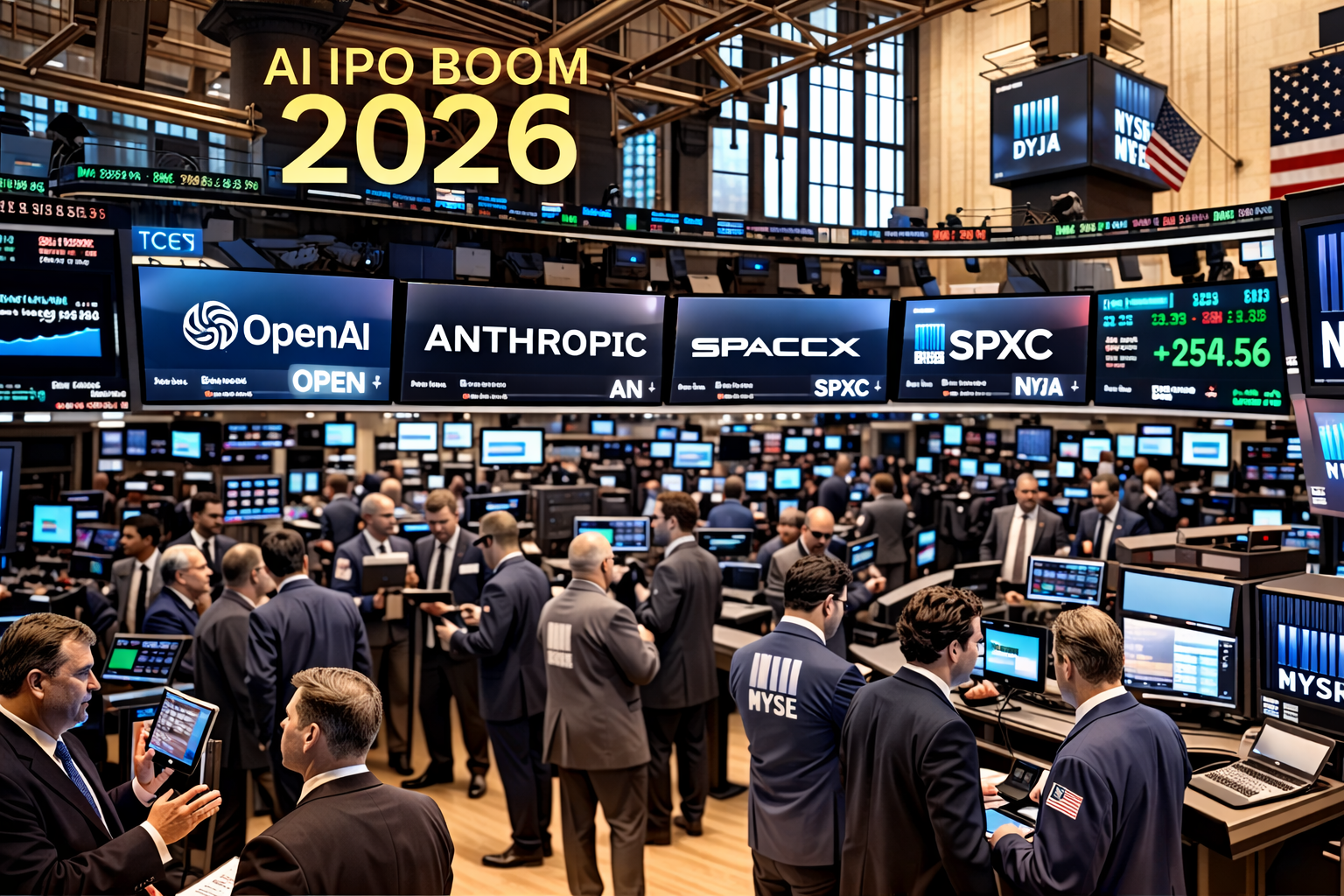
Three of the most valuable private companies in history are eyeing public listings in 2026. The IPO window is open. The appetite is real. But the worry among bankers and founders is that three companies this enormous could suck all the oxygen out of the room while thousands of other startups wait years longer.
Here’s something that gets lost in the excitement around the OpenAI and Anthropic IPO race: there are roughly 1,700 unicorns on the Crunchbase board right now. Of those, only about 40 have raised new funding or had their valuations updated since the beginning of 2024. The other 60% are sitting on valuations from a previous cycle, waiting for an IPO market that reopens long enough to let them out.
That’s the context in which SpaceX filed confidentially for a June 2026 IPO, Anthropic is reportedly targeting October, and OpenAI is preparing for Q4. The IPO window hasn’t been fully open since 2021. These three companies could be the key that unlocks it — or they could absorb so much capital and attention that everything else has to wait another 18 months.
Both outcomes are plausible. The data supports both. Let’s work through what we actually know.
The Three Companies at the Centre of It
SpaceX filed confidentially for its IPO with the SEC on April 1, 2026, targeting what could be the largest public debut in history — potentially a $1.75 trillion valuation, which would surpass Saudi Aramco’s $1.7 trillion 2019 listing. The company’s AI credentials come primarily through Starlink (10 million subscribers providing global connectivity infrastructure) and xAI’s integration with SpaceX operations. The combined xAI-SpaceX entity, if merged or treated together for valuation purposes, represents perhaps the most extraordinary combination of physical infrastructure, data access, and AI development in a single organisation.
Anthropic is targeting October 2026, aiming to raise over $60 billion at a $380 billion valuation. The underwriting team is taking shape: Goldman Sachs, JPMorgan, and Morgan Stanley as primary candidates. Former Microsoft CFO Chris Liddell has joined the board. The employee stock tender offer has launched. These are not rumours — they’re observable corporate actions that precede IPOs. If Anthropic lists before OpenAI, it claims the status of first publicly traded large language model company and sets the valuation benchmark for the category.
OpenAI is targeting Q4 2026 at a valuation approaching $1 trillion, but the path there is contested internally. The Information reported tension between CEO Sam Altman, who wants the Q4 timeline, and CFO Sarah Friar, who has raised concerns about operational readiness and revenue trajectory. The company began running ads for non-premium users in February 2026 as a visible step toward demonstrating profitability paths. With 900 million weekly active users and $24 billion in annualised revenue, the revenue case is real. The question is whether the public markets price the company at revenue multiples that justify the near-trillion valuation, or whether reality lands somewhere more moderate.
The Precedent: When Big Companies Go Out First
The conventional wisdom in the IPO market is that large, high-profile listings create energy that lifts the broader market. When a company like Alibaba or Saudi Aramco lists at massive scale, institutional investors come off the sidelines, retail excitement drives demand, and the visibility of the success encourages other companies to file.
This conventional wisdom is real. It’s also incomplete.
Gené Teare, research lead at Crunchbase and one of the most credible analysts of private market dynamics, describes the current situation as “between two worlds.” On one side, highly valued SaaS-era unicorns that look ready on revenue but can’t convincingly demonstrate AI-driven growth. On the other, native AI companies posting huge early numbers that may still be too volatile for public market pricing.
The concern she articulates: OpenAI, Anthropic, and SpaceX are “so huge, and they’re very much outliers.” When three companies of that scale list in the same year, they may generate energy for their own listings while absorbing institutional allocation capacity that would otherwise go to smaller AI companies also waiting in the queue.
Large institutions have AI portfolio allocations. If those allocations are filled by three enormous liquid positions in OpenAI, Anthropic, and SpaceX, there may be less appetite for the smaller AI IPOs that also need public market exits to unlock founder and investor liquidity.
What Cerebras Filing Tells You
While the three giants attract most of the attention, the Cerebras IPO filing is the more instructive data point about where the market actually is.
Cerebras, which builds AI-specific chip infrastructure, reported $510 million in revenue in 2025 — up nearly 76% from 2024 — and net income of $87.9 million, a sharp reversal from a $481.6 million net loss the year before. The company has a $20 billion commercial relationship with OpenAI (agreed to pay for chip-powered servers over three years) and received a $1 billion loan from OpenAI to build data centre infrastructure.
What Cerebras represents in the IPO story: the hardware and infrastructure layer supporting frontier AI is potentially more reliably profitable than the frontier AI applications themselves. The company has clear customers, clear revenue, and a demonstrated path to positive net income. That’s a cleaner story for public investors than “we’re training the next generation of models and spending tens of billions to do it.”
Public investors will have to decide: does the market’s enthusiasm for AI software extend to the capital-heavy businesses building the chips and data centres that run it? Cerebras is the first real test of that question.
The Valuation Reality Check
The numbers deserve honesty about what they do and don’t mean.
OpenAI at $852 billion post-money trades at roughly 35x its current annualised revenue. That is a premium valuation that prices in significant continued growth. GPT-5.4, Codex, and the emerging SuperApp strategy need to produce the compounding revenue growth that justifies that multiple — or the IPO lands well below $1 trillion.
Anthropic at $380 billion (or the $800 billion that secondary markets have priced in) faces the same scrutiny. Its $30 billion annualised revenue, with the caveat about accounting methodology, suggests a revenue multiple in a similar range. The profitability challenge — 40% gross margins on enormous compute costs — is the number that public market investors will stress-test.
SpaceX’s $1.75 trillion target is grounded in Starlink’s $7 billion in annualised revenue and growth trajectory, plus the inherent valuation of being the dominant private space infrastructure company. The AI components — Starlink as connectivity backbone, xAI integration — are supportive but not central to the valuation story.
One principle that VCs keep repeating in their 2026 advice to portfolio companies: investors are no longer buying growth at all costs. They want a clear path to profitability and proven scale. OpenAI’s ad pilot, Anthropic’s enterprise margin story, SpaceX’s Starlink subscriber count — all of these are the company-specific answers to the “what’s your path to profit” question that every public market investor will ask.
What the Rest of the Startup Ecosystem Should Watch
For the thousands of AI startups that are not OpenAI, Anthropic, or SpaceX, the 2026 IPO developments matter in three specific ways.
M&A is the more likely exit path for most. Q1 2026 startup M&A was the third-highest quarter since the 2022 downturn, with exits cumulatively valued above $56.6 billion. OpenAI has made six acquisitions already in 2026, nearly matching all of 2025. When large companies need capabilities quickly and can’t or won’t build them, they acquire. The M&A market is functioning even when the IPO market is selective.
Public market valuation benchmarks ripple down. If OpenAI’s IPO lands at $800 billion rather than $1 trillion, that repricing affects how investors think about earlier-stage AI companies at current private valuations. The direction of the AI IPO multiples matters for every company in the ecosystem raising its next round.
The institutional allocations are finite. If the mega-listings absorb most of the AI-specific institutional portfolio allocation for 2026, smaller AI companies that could go public may face a window that’s narrow even after the giants list. The advice for founders watching this: don’t wait for “after OpenAI lists” as a guaranteed moment of easier access. Position the company, not the calendar.