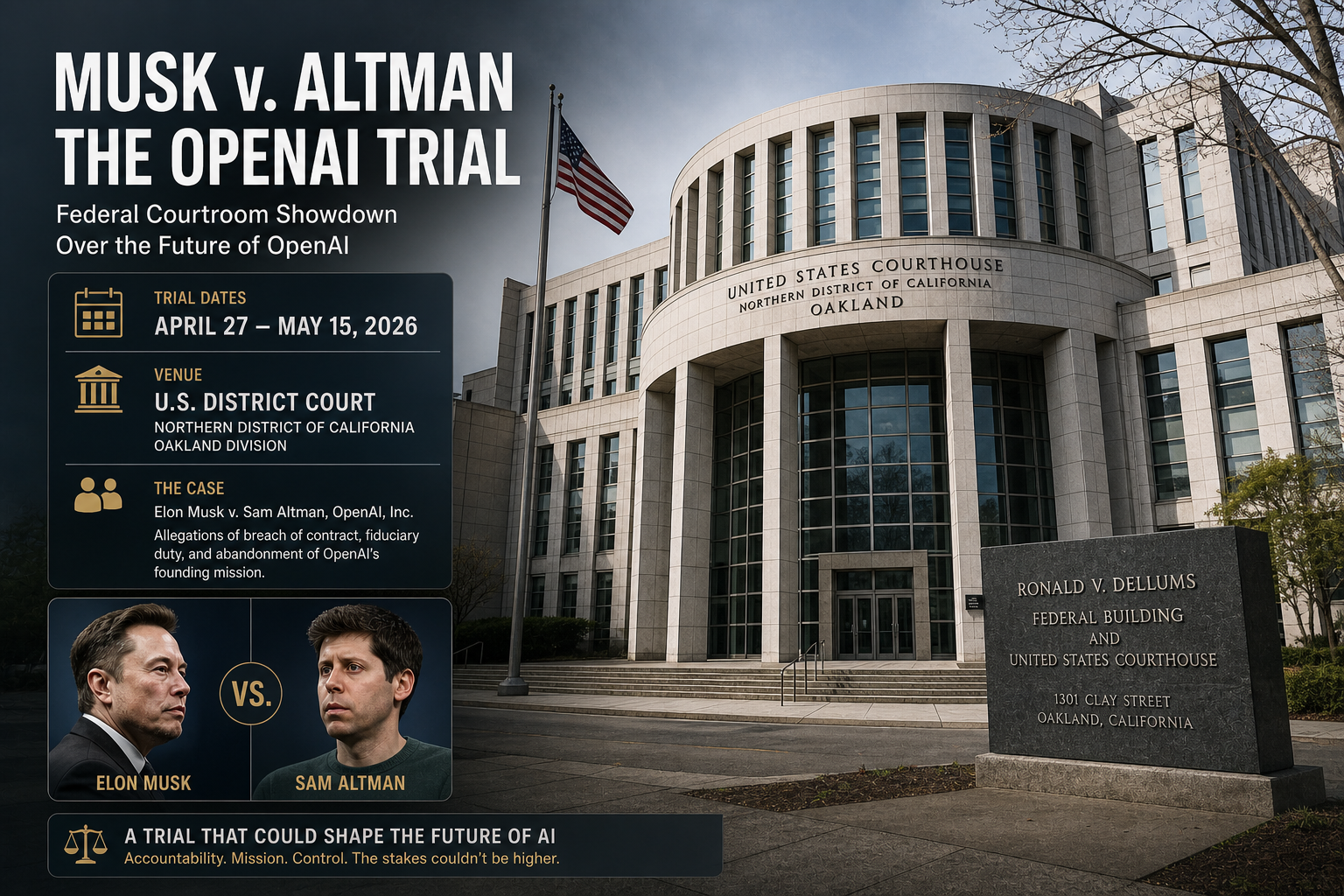
The trial everyone in tech has been dreading and secretly fascinated by is actually happening. Elon Musk, Sam Altman, and Greg Brockman are sitting in a courtroom in Oakland, California, being cross-examined under oath. The judge corrected Musk’s legal analysis from the bench. This is worth following carefully.
Let me describe the scene, because the reporting makes it vivid.
It’s a federal courthouse in Oakland, California. Long line of press, lawyers, and members of the public waiting outside. Inside: nine jurors seated for what is expected to become the most consequential AI legal proceeding in history. At one table, Elon Musk — the world’s richest person — flanked by lawyers and stacks of binders. A few feet away, Sam Altman, holding a small notebook and a pen. Greg Brockman beside him. All three in suits and ties.
The judge, Yvonne Gonzalez Rogers, has already needed to remind Musk that he is not, in fact, a lawyer. When Musk accused OpenAI’s lead attorney William Savitt of asking “definitionally complex, not simple” questions — insisting, “It is a lie to say they are simple” — Gonzalez Rogers told the jury that Musk is “not a lawyer and has not taken a class in evidence.” Musk responded that he has “technically” taken “law 101,” which drew laughter from the courtroom.
This is actually a landmark legal case. The laughter is real, but so are the stakes.
What the Case Is Actually About
The original Musk lawsuit, filed in 2024, contained 26 separate claims. By the time the trial opened, most had been dropped or dismissed. Of the 26 claims Musk originally asserted, only two remain: unjust enrichment and breach of charitable trust.
Those two claims, however, contain an enormous amount of legal territory.
The core argument Musk’s lawyers are making is that OpenAI was founded as a nonprofit with specific charitable commitments — to develop AI for the benefit of humanity and to keep research open — and that when it converted to a for-profit structure, it breached those commitments in ways that unjustly enriched Altman, Brockman, Microsoft, and others who benefited from the conversion.
Musk’s lawyers told the jury their client should receive up to $134 billion in “wrongful gains.” That number represents Musk’s lawyers’ estimate of the value improperly captured from what should have remained a public benefit.
OpenAI’s counter-argument is equally direct. OpenAI’s lead attorney Savitt told the jury in his opening statement: “We are here because Mr. Musk didn’t get his way at OpenAI. That’s what happened. He quit, saying they would fail for sure. But my clients had the nerve to go on and succeed without him.”
That framing — Musk as a sore loser who left and then watched his competitors succeed — is the essential OpenAI narrative for this case. Whether the jury finds it more persuasive than Musk’s narrative of betrayed charitable promises is what the verdict will turn on.
What Happened During Musk’s Testimony
Musk took the witness stand as the first witness called. The testimony has been dramatic enough to generate its own news cycle.
During cross-examination, Savitt probed Musk about discussions he had with Altman, Brockman, and Ilya Sutskever about establishing a potential for-profit subsidiary, and pulled up exhibits highlighting Musk’s intended control of the majority of the capitalisation table and board seats. Musk pushed back, arguing that his control would have decreased over time as he met demands from future investors.
The most damaging exhibit for Musk’s case came from Microsoft’s lawyer, Russell Cohen. Cohen pointed to a September 2020 post on X in which Musk wrote that “OpenAI is essentially captured by Microsoft” — evidence, he argued, that Musk knew about the Microsoft relationship years before filing his lawsuit, raising questions about the statute of limitations on Musk’s claims.
Musk’s response to the timeline argument: he acknowledged knowing something was wrong in 2018, but compared it to suspecting someone might steal your car — you have concerns before you have proof. The actual theft, in his framing, didn’t materialise until the for-profit conversion completed.
Savitt finished his cross-examination of Musk by asking about various initiatives at the OpenAI nonprofit. “I don’t know everything they’ve done,” Musk testified. “I don’t know what’s going on at OpenAI.” OpenAI’s lawyers will likely return to this admission as evidence that Musk’s claims are speculative rather than grounded in specific knowledge of wrongdoing.
One particularly colourful exchange: Savitt asked Musk about his ambition to build an AI “robot army,” and Musk clarified that he did not mean an army in a military sense.
The Structural Legal Stakes
This case is not just about Musk and Altman personally, though the personal animosity between them is real and documented. The legal questions it raises have significant implications for how AI organisations structure themselves and how nonprofit-to-for-profit conversions are governed.
The deeper question in the charitable trust claim is whether donors and early supporters of a nonprofit AI lab have legally enforceable rights when that organisation converts to a for-profit structure. If the court finds they do — and that OpenAI’s conversion breached those obligations — it establishes a precedent with implications for every AI lab that has operated under similar hybrid or nonprofit structures.
Microsoft is also named as a defendant. Microsoft’s lawyer argued in his opening statement that Microsoft did not and could not have aided OpenAI’s alleged breach of a charitable trust, and argued that Musk’s suit exceeded the statute of limitations. The stakes for Microsoft are direct: any finding that it aided and abetted the breach could affect its current 27% economic interest in OpenAI’s public benefit corporation and its IP licensing deal through 2032.
Legal analysis anticipates a mixed verdict by mid-May 2026. Judge Gonzalez Rogers is expected to find that OpenAI breached fiduciary duties to the original donor base on at least one count while declining to order the full unwinding of the public benefit corporation. Expect a damages award in the low tens of billions, paid into a remediation trust rather than directly to Musk.
If that analysis is correct: OpenAI continues operating in its current form, pays a significant but survivable damages award, and files an immediate appeal. The case moves to the Ninth Circuit in late 2026 or early 2027, probably with a stay of any structural relief during appeal.
Why This Is the AI Governance Story of 2026
The trial is personally dramatic. It’s also a proxy for a much larger question that the AI industry hasn’t been forced to confront in a legal setting before: when an organisation raises money, talent, and public credibility on a “safety-first, open, for humanity” mission and then converts to commercial operations worth hundreds of billions of dollars, who has the right to hold them accountable?
The law’s answer to that question — delivered by Judge Gonzalez Rogers in the weeks ahead — will shape how the next generation of AI labs structures themselves. The organisations watching most closely are not Musk’s lawyers and Altman’s PR team. They’re the governance researchers, nonprofit attorneys, and AI safety advocates trying to understand whether existing legal structures can meaningfully constrain what AI companies do with the power they accumulate.
Whatever the verdict, the Musk v. Altman trial is the moment where AI governance stopped being a theoretical concern and became a courtroom argument with real legal consequences.
That’s worth paying attention to, even if the courtroom drama occasionally produces lines that sound like they were written for television.