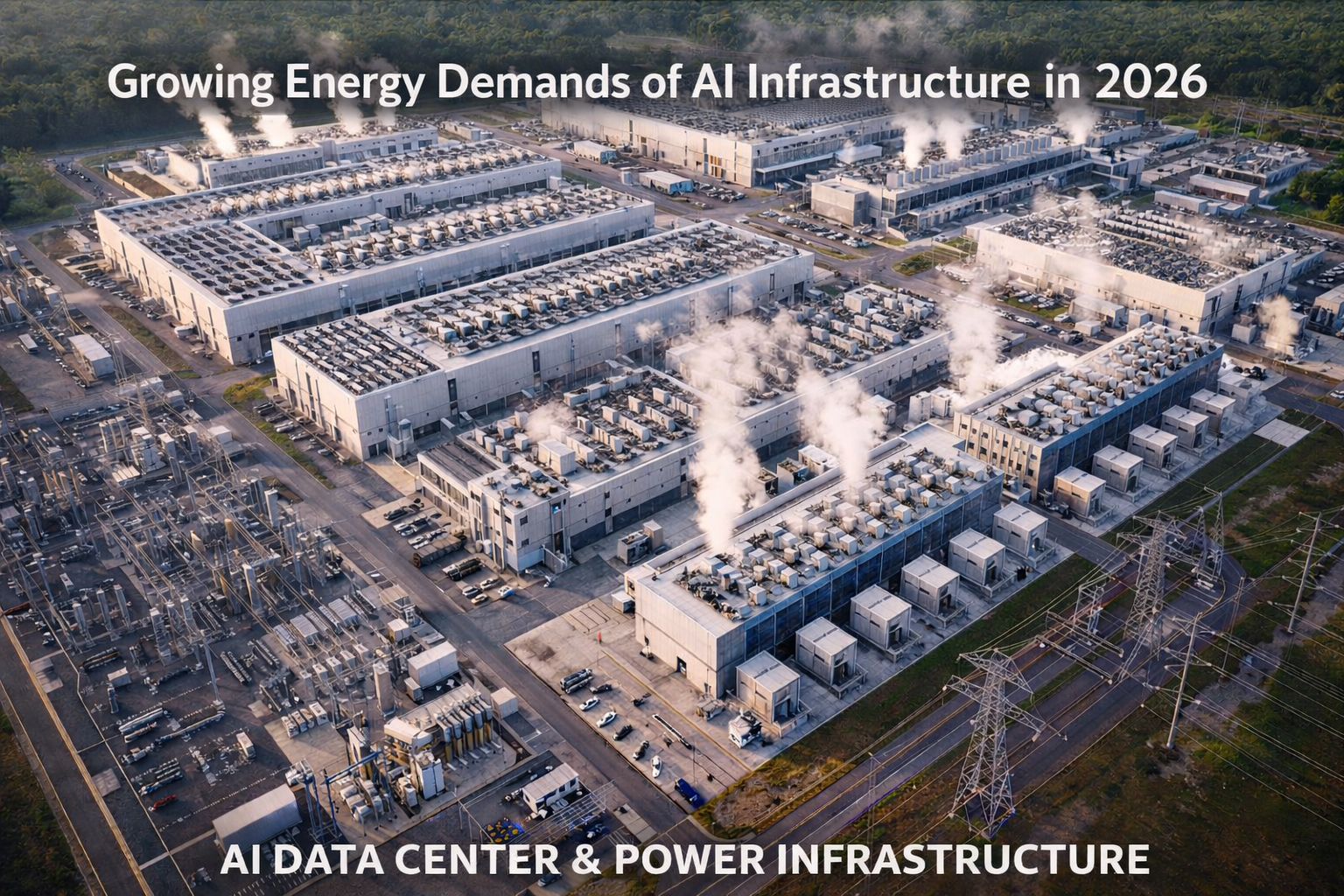
The AI industry needs more power than the electrical grid can currently supply. Half of planned US data center builds are delayed or cancelled due to grid constraints. Electricity prices are rising in communities hosting these facilities. This is the infrastructure story that shapes everything else about the AI race in 2026.
Here is a fact that should appear in every article about AI in 2026 but frequently doesn’t: approximately half of all planned US data centre builds this year are projected to be delayed or cancelled. Not because demand has softened. Not because the money isn’t there. Because the electrical grid cannot support them.
Alphabet, Amazon, Meta, and Microsoft are expected to spend more than $650 billion in 2026 to expand AI capacity. The physical infrastructure to power that ambition — the transformers, switchgear, and grid connections — simply doesn’t exist at the pace required. Lead times on critical components now stretch to five years in an industry where deployment cycles run under 18 months.
The AI race has collided with a power grid built for a different era. What follows is not a technology story. It’s a governance, economics, and infrastructure story — and it affects everyone who pays a utility bill.
The Numbers, Because They Shock Even People Who Follow This
The International Energy Agency now projects that global data centre electricity consumption will exceed 1,000 terawatt-hours by the end of 2026. One terawatt-hour is one trillion watt-hours. One thousand of them is the entire annual electricity consumption of Japan. The entire country.
In the US specifically, Bloom Energy estimates total data centre energy demand will nearly double from 80 gigawatts in 2025 to 150 gigawatts by 2028. For scale: a large nuclear power plant produces approximately 1 gigawatt.
Of around 140 large-scale data centre projects representing approximately 12 gigawatts of planned capacity that were supposed to come online in the US in 2026, only a third are under construction.
A single AI server — the kind used for model training and inference — draws approximately 10,200 watts during normal operation. A standard CPU server draws about 1,000 watts. You don’t need to do the math precisely to understand the magnitude of the shift: the hardware that runs AI requires roughly 10 times the power of the hardware it’s replacing.
And inference — running AI models for end users — has now surpassed training as the dominant energy consumer at fleet scale. Every time someone asks ChatGPT a question, runs a Gemini search, or uses an AI assistant, that request consumes compute. Hundreds of millions of requests per day, across millions of users, adds up to something that looks nothing like previous internet infrastructure.
What This Is Doing to Your Electricity Bill
This is where the story stops being abstract.
PJM Interconnection is the regional grid operator serving over 65 million people across 13 states, from New Jersey to Illinois. Capacity market prices in PJM — the mechanism utilities use to pay for backup power — jumped from approximately $60 per kilowatt-hour in 2024 to more than $300 per kilowatt-hour in 2025. That’s a nearly fivefold increase in a single year.
In one service territory, retail electricity increases above 15% have been reported. Goldman Sachs projects that data centre power consumption will boost core inflation by 0.1% in both 2026 and 2027.
Retail electricity prices have risen 42% since 2019, outpacing the 29% increase in the Consumer Price Index over the same period. Not all of that is AI. Natural gas prices, utility capital expenditure on aging infrastructure, and climate-related damage all contribute. But data centres are now a meaningful factor in a way they weren’t five years ago.
In West London, the allocation of power to a new cluster of data centres has created an electricity shortage that has delayed housing and commercial projects by up to ten years. The AI infrastructure buildout is competing for grid capacity with homes, hospitals, and businesses that also need power.
This is not a theoretical concern. It is happening in real communities, to real people’s bills, right now.
The Political Response: A Voluntary Pledge With No Teeth
In response to growing public backlash, President Trump convened tech executives at the White House earlier this year. The outcome was the “Ratepayer Protection Pledge” — a voluntary agreement by Microsoft, Meta, OpenAI, Amazon, and others to secure their own power for data centres, pay for necessary grid infrastructure upgrades, and hire locally.
The pledge has few specifics and no enforcement mechanism. It is, as one analyst put it, a public relations response to a structural problem.
The structural problem: when a data centre connects to the grid, the cost of upgrading transmission infrastructure to accommodate it is typically socialised across all ratepayers in the utility’s service area. The data centre gets cheap power. The residents of northern Virginia pay slightly higher bills to fund the transmission upgrades that enable it.
Several states are now moving toward legislation requiring data centres to pay grid impact fees proportional to their consumption. California has been active here, and other states are watching what happens. The question of whether AI’s infrastructure costs should be paid by the companies building that infrastructure or by the general public is increasingly a political one, and it’s heading toward resolution — whether through legislation, regulation, or utility commission decisions.
Legislators from both parties are involved in this debate, which is unusual. Senator Bernie Sanders has been outspoken about requiring tech companies to fund grid upgrades. Florida Governor Ron DeSantis has raised concerns about data centres’ community impacts. It’s one of the few AI policy issues generating genuine bipartisan concern.
What Big Tech Is Actually Doing About It
There are serious, large-scale responses underway — they just aren’t moving fast enough to solve the 2026 problem.
Nuclear power. Microsoft announced plans to reopen Three Mile Island. Google, Microsoft, and Amazon have all signed nuclear power purchase agreements and are investing in small modular reactor development. Nuclear is increasingly viewed as the only scalable clean power solution for baseload AI computing because it provides reliable, high-density, low-carbon power regardless of weather.
Geographic diversification. Operators are moving to second-tier locations with available power — away from Virginia (which hosts 35% of US data centre capacity and is approaching grid saturation) toward states with more headroom.
On-site power generation. Some operators are pursuing on-site gas generation to bypass grid connection requirements entirely. This solves the individual operator’s problem while externalising the carbon consequences.
Efficiency improvements. NVIDIA, AMD, and Intel are genuinely improving computational efficiency — newer GPU architectures deliver dramatically more AI operations per watt than their predecessors. But workload growth is still outpacing efficiency gains at the fleet level.
Liquid cooling. Direct-to-chip cooling and immersion cooling promise to reduce water consumption by 30-50% compared to traditional evaporative cooling and allow denser rack configurations. Widespread adoption is still several years away for most operators.
In Minnesota, Google inked a deal with Xcel Energy to fund wind turbines, solar panels, and battery storage along with grid infrastructure upgrades — fully funding the clean energy expansion its data centres require. In Louisiana, Meta signed a deal to help fund the construction of seven natural gas plants and 200 miles of transmission lines. These are the models that could become templates, or could become cautionary tales about locking in fossil fuel infrastructure for the sake of AI speed.
The Harder Question Underneath All of This
Every article about AI energy consumption includes a version of this disclaimer: “Yes, AI uses a lot of energy, but it also creates enormous value.” Both statements are true. The value creation is real. The energy consumption is real.
The question that doesn’t have a clean answer yet: who bears the costs of the consumption, and who captures the value?
The value from AI currently accrues primarily to technology companies and, increasingly, to businesses and individuals who use AI tools effectively. The cost of the energy consumption is distributed across ratepayers, grid infrastructure, water supplies, and carbon budgets.
A 42% increase in retail electricity prices since 2019, during a period when AI infrastructure has expanded dramatically, is not a smoking gun. But it’s a signal that the distribution of costs and benefits deserves explicit examination — not as an argument against AI development, but as an argument for policy frameworks that ensure the parties creating the demand also fund the infrastructure it requires.
The Ratepayer Protection Pledge is, at minimum, an acknowledgment that this question exists. What happens when voluntary commitments prove insufficient will determine whether the energy infrastructure story of 2026 becomes the defining constraint on AI development — or a problem that got solved before it became a crisis.
Right now, it’s somewhere between the two. And the gap between where grid capacity is and where AI ambition wants to go is not closing fast enough to be comfortable.