OpenAI is releasing models faster than most companies ship software updates. GPT-5.5 dropped April 23 — six weeks after GPT-5.4. A day later, Microsoft’s seven-year exclusive lock on OpenAI ended and GPT-5.5 went live on Amazon Bedrock. Here’s what changed, what it means, and why Greg Brockman’s phrase “a new class of intelligence” is both true and worth challenging.
There’s a particular kind of exhaustion that has settled into the AI coverage space, and OpenAI’s release cadence in 2026 is a direct cause of it. GPT-5.4 launched in early March. GPT-5.5 launched April 23 — six weeks later. The LLM Stats tracker has logged 59 major model releases across providers since the start of the year. At some point, your brain simply stops recalibrating what “state of the art” means because it’s changed again by the time you finish reading about it.
OpenAI’s own president Greg Brockman acknowledged this in the GPT-5.5 press briefing. “There are enough model releases that it’s probably getting hard to distinguish one from another,” he told reporters. He then argued that GPT-5.5 is different — not just smarter, but meaningfully more autonomous and intuitive. His exact phrase: “a new class of intelligence.”
That phrase deserves examination. Because in this particular case, the model release happened on the same day as a second, arguably more consequential announcement: after seven years, the Azure exclusivity deal is dead, and GPT-5.5 is now running on Amazon Bedrock.
Let’s take both developments seriously.
What GPT-5.5 Actually Does Differently
OpenAI’s framing for this release is deliberate and worth quoting directly. GPT-5.5 is designed to “understand what you’re trying to do faster and carry more of the work itself.” The company positions it not as a smarter question-answerer but as a model that can “take a messy, multi-part task and plan, use tools, check its work, navigate through ambiguity, and keep going.”
That’s the agentic framing. The benchmarks support it, specifically in the areas where agentic capability actually gets tested.
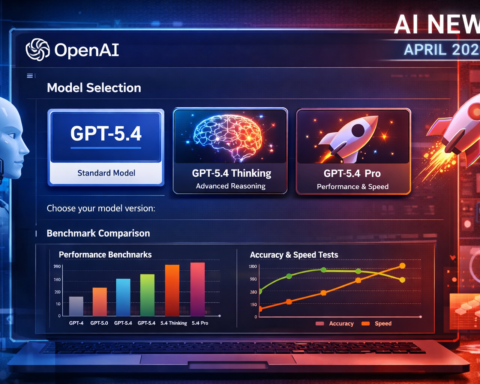
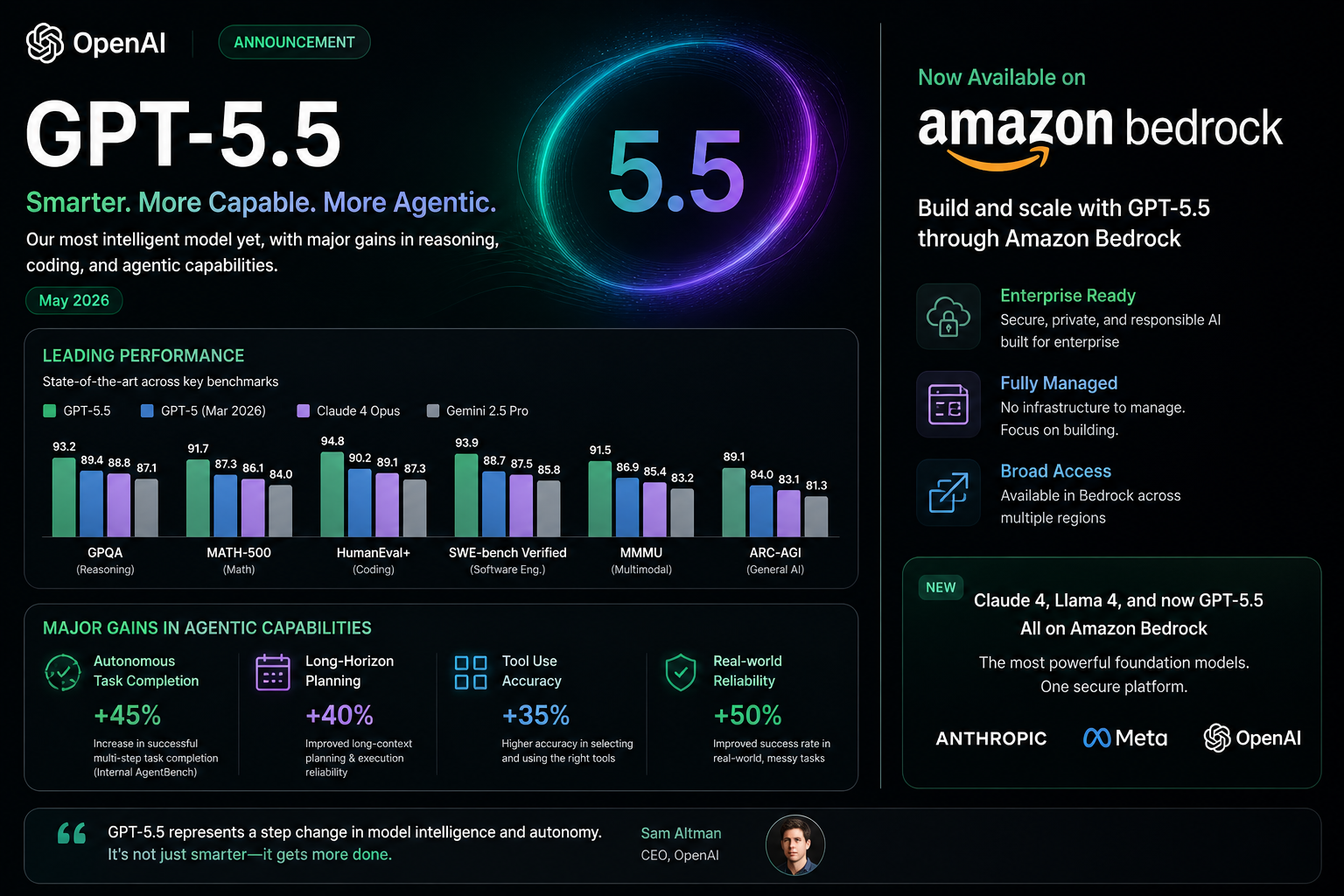
On Terminal-Bench 2.0, which tests complex command-line workflows requiring planning, iteration, and tool coordination, GPT-5.5 achieves 82.7% accuracy. On SWE-Bench Pro, which evaluates real-world GitHub issue resolution, it reaches 58.6%. These aren’t abstract reasoning benchmarks — they test what an AI agent actually does in an engineering environment over time.
GPT-5.5 Pro, OpenAI’s highest-capability tier, leads the list of publicly available models on BrowseComp, OpenAI’s agentic web-browsing benchmark, at 90.1%. That’s a practical measure of how well the model can research the web autonomously and synthesise findings.
Internally, OpenAI is already eating its own cooking at scale. More than 85% of OpenAI employees now use Codex every week across functions including software engineering, finance, communications, marketing, data science, and product management. The specific examples in their announcement are worth dwelling on: the communications team used GPT-5.5 in Codex to analyse six months of speaking request data and build a scoring framework that allows low-risk requests to be handled automatically; the finance team reviewed 24,771 K-1 tax forms totalling 71,637 pages with AI assistance, completing the task two weeks faster than the prior year.
Those aren’t demo use cases. They’re operational deployments in a company of roughly 3,000 people. The implied productivity per-employee is starting to become genuinely remarkable.
OpenAI president Greg Brockman called the model “a big step towards more agentic and intuitive computing” and pointed to a math professor who used GPT-5.5 and Codex to build an algebraic geometry app from a single prompt in 11 minutes.
The Pace of Release Is Now Itself the Story
Fortune’s framing of the GPT-5.5 launch is the most honest in the coverage: “AI model launches are starting to look like software updates.” That headline captures something real. The version number GPT-5.5 occupies is between major releases — “not GPT-6,” as Brockman said, “but a significant capability jump within the GPT-5 family.”
The naming choice is instructive about OpenAI’s strategy. They’re choosing not to trigger the narrative gravity of a “GPT-6” launch. Instead, they’re normalising a cadence where significant capability improvements ship as incremental version numbers, six weeks apart, with each one described as “the most capable model yet.”
For developers and enterprises, this creates a specific operational challenge. Anthropic shipped four major Claude updates in roughly 50 days during early 2026. The model you picked three months ago may already be outdated. If you’ve built production workflows on top of a specific model’s behaviours, you’re managing model drift as a continuous engineering concern rather than an occasional upgrade event.
The competitive response to GPT-5.5 is immediate. Claude Opus 4.7 is confirmed as the next Anthropic release. Grok 5 is targeting Q2-Q3 2026. Google’s Gemini Ultra just shipped with a 2-million token context window. The arms race is so accelerated that “state of the art” has effectively become a description of where any given model stood yesterday.
The Bigger Story: Azure Exclusivity Is Dead
On April 27, four days after GPT-5.5 launched, Microsoft and OpenAI announced the restructuring of their seven-year partnership. Microsoft and OpenAI have announced a new partnership agreement that ends the exclusive cloud arrangement that has been in place since 2019. OpenAI is now able to offer its products on any cloud provider instead of being limited to Azure.
The practical terms: Microsoft’s license to OpenAI IP for models and products continues through 2032, but is now non-exclusive. Microsoft will no longer pay a revenue share to OpenAI. Revenue share payments from OpenAI to Microsoft continue through 2030, subject to a total cap.
The next day, GPT-5.5 landed on Amazon Bedrock. OpenAI’s most powerful model, GPT-5.5, is now running on Amazon Web Services for the first time. AWS customers can now invoke GPT-5.5 through the same Amazon Bedrock APIs they already use for Anthropic, Meta, and Amazon’s own Nova family, with the option to apply usage to existing AWS spending commitments.
The rapid sequencing — Microsoft amendment on Monday, AWS preview on Tuesday — suggests the AWS integration was being prepared for months in advance. The announcement resolved a genuine legal problem: OpenAI’s initial agreement with Microsoft prevented OpenAI from selling its agent-making tool Frontier exclusively on AWS, and possibly prevented AWS from selling it at all. The restructured deal eliminates that exposure.
What it means for enterprises: AI is now procurable through any major cloud relationship. A company with significant AWS commitments can now apply that spend to OpenAI models alongside Claude and Meta’s Llama. This creates real competition for the enterprise AI wallet on cloud platforms, and it compresses the pricing power that Azure’s exclusivity had previously provided.
Anthropic is watching this closely. Bedrock already hosts Claude, Llama, Mistral, Cohere, and Amazon’s own Nova family; OpenAI joins a crowded competitive field, not an empty stage. The difference is that OpenAI is the most recognised consumer AI brand in the world, and enterprise procurement often follows brand recognition.
The Honest Caveats
The benchmark numbers are real. So are the caveats.
GPT-5.5 Pro pricing is steep: $30 per million input tokens and $180 per million output tokens. At that price point, the maths only work if the model’s superior agentic performance means fewer task iterations — which requires testing against your specific workflows before committing.
The release is initially limited preview on AWS, not general availability. Pricing through Bedrock may differ from OpenAI’s direct API rates.
And the pace of releases means that by the time production deployments are optimised for GPT-5.5, a credible argument exists that GPT-5.6 or a competitive Anthropic model will change the calculus again.
The honest version of the GPT-5.5 story is this: it’s a meaningful improvement over GPT-5.4 in agentic and coding tasks, it’s now available on multiple cloud platforms for the first time, and it’s being released into an environment where “most capable available model” is a title that changes hands faster than anyone can comfortably plan around.
That’s not a criticism. It’s just the reality of operating in 2026.