A third of finance leaders report little noticeable value from AI so far — usually because they tried to automate everything before their data was ready for any of it. Here’s the honest readiness framework that tells you whether to start with AI now, or spend three months on the unglamorous work first.
Dan Zhang, CFO of ClickUp, said something in a recent interview that captures the actual problem most finance teams face with AI in 2026: “The main challenge isn’t finding AI tools — it’s having too many. We replaced five separate AI note-taking tools with a native one built in ClickUp.”
That’s not the problem most coverage of AI in finance describes. The dominant narrative is about CFOs who haven’t started — 68% say they don’t know where to start, citing fear of the unknown, security and confidentiality concerns around sensitive compensation and forecast data, and insufficient training in prompting and workflow automation.
Both problems are real, and they’re often the same problem at different stages. The CFO who hasn’t started is afraid of ending up like the CFO drowning in five overlapping AI tools that don’t talk to each other, each promising to solve a slightly different problem, none of them integrated into how the team actually works.
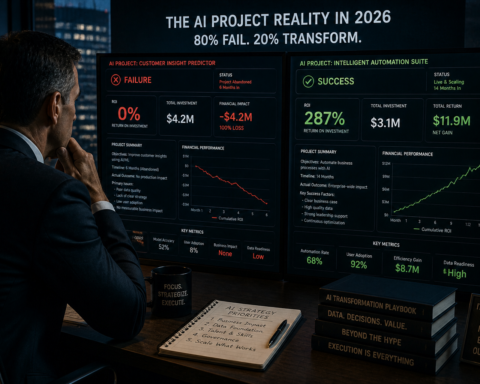
The honest data on outcomes explains why this caution is reasonable. BCG found the average AI ROI in finance is around 10% currently, against targets of 20%+. About a third of finance leaders report little noticeable value so far. The pattern, consistent with AI failures across every business function, is pilots that don’t make it to production, or production deployments that were never scaled consistently.
Here’s the readiness framework that determines which side of that line you’ll land on.
The Readiness Score
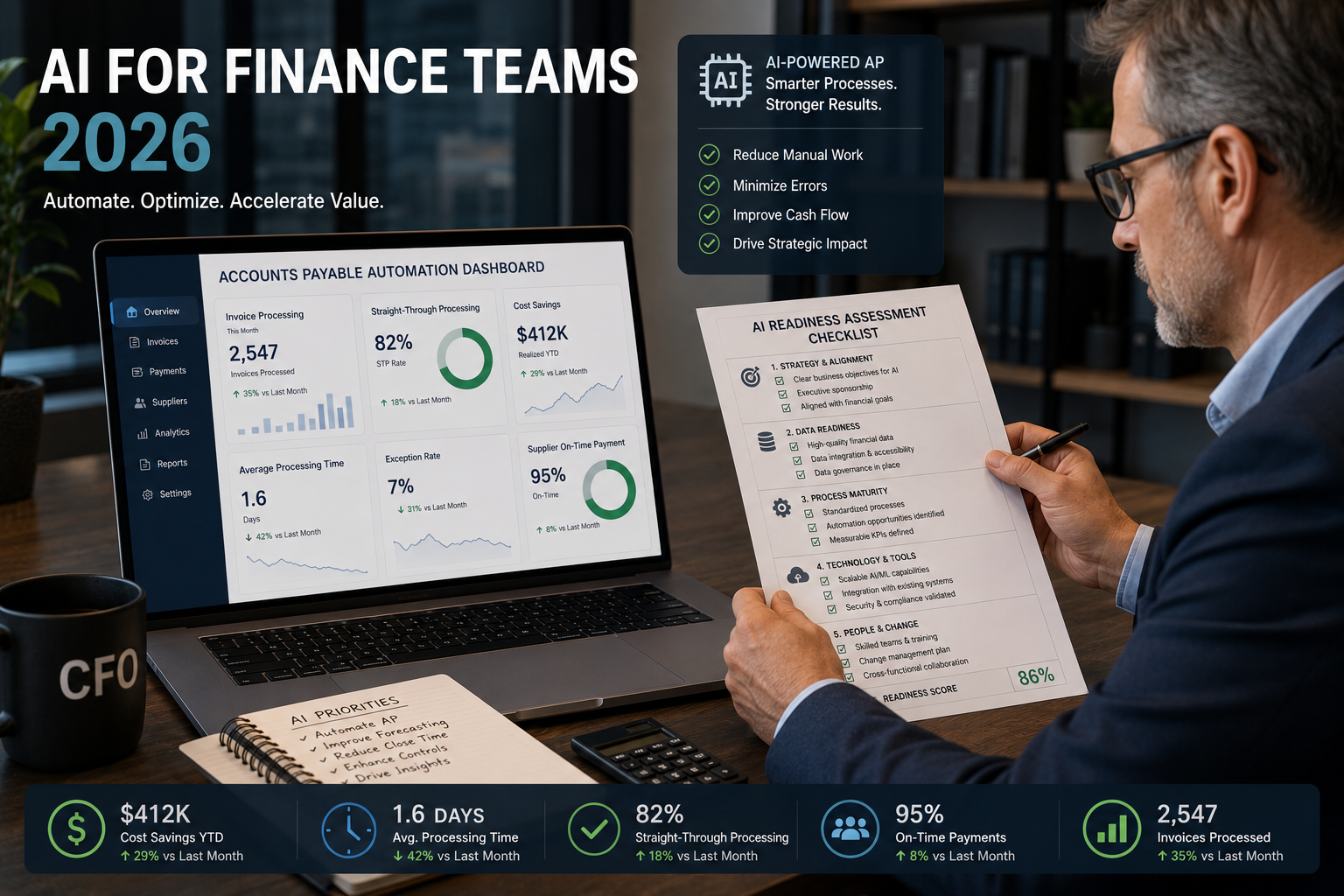
This framework, adapted from finance AI implementation guides circulating among CFOs in 2026, scores your organisation across two dimensions: process readiness and organisational readiness. Score 10 points for each statement that’s true.
Process readiness:
Your chart of accounts is structured and consistent, with well-defined categories rather than catch-all “miscellaneous” accounts that absorb everything that doesn’t fit elsewhere.
Your month-end close process is documented, with clear ownership of each step and defined deadlines — not “Sarah knows how to do it” institutional knowledge.
You have defined approval workflows for invoices and expenses — who approves what, at what threshold, through what channel.
Organisational readiness:
You have a finance leader — CFO, controller, or senior accountant — willing to actively champion the AI implementation, not just approve a budget line.
Management is committed and willing to allocate real time for change management, not just licence costs.
You have a specific, quantified problem you want AI to solve — not “automate accounting” as a category, but something like “reduce the 3-day invoice approval cycle to same-day.”
You have budget identified for the investment, including the implementation time, not just the subscription.
Scoring: 70-100 means you’re ready to implement — start with the highest-ROI use case (accounts payable automation or bank reconciliation are the standard entry points). 40-70 means prepare your data foundation for 3-6 months before proceeding — the chart of accounts cleanup, the documented close process, the approval workflow definition. 0-40 means you need basic accounting system implementation and process documentation before AI adds value — AI amplifies whatever process exists underneath it, including a disorganised one.
The framework is blunt, but it reflects something real: “Garbage in, garbage out — but with AI, the consequences are faster, more expensive, and harder to detect,” as one industry analysis put it. A finance team with messy categorisation and undocumented processes that deploys AI doesn’t get a cleaner version of their mess. They get the same mess, generated faster, with an AI-generated veneer of confidence that makes errors harder to catch.
Where to Actually Start: The Two Highest-ROI Entry Points
For organisations scoring in the “ready” range, the two consistently recommended starting points are accounts payable automation and expense management — both because they have the clearest ROI and because they’re the lowest-risk places to learn how AI fits into your specific finance workflows.
Accounts payable automation addresses one of the most universally tedious finance processes: invoices arrive in every conceivable format — PDFs, emails, scanned paper, vendor portals — and someone has to extract the vendor, amount, due date, and line items, match them against purchase orders, route for approval, and schedule payment. AI systems now automate the capture and processing of invoice data across this variety of formats, checking for duplicates, flagging discrepancies against purchase orders, and routing through approval workflows automatically.
The error reduction matters as much as the time savings. Manual invoice processing has documented error rates that compound — a miscoded invoice creates a downstream reconciliation problem at month-end, which creates a close delay, which creates reporting delay. AI-driven invoice processing with consistent extraction and matching reduces this error cascade.
Expense management is, as one guide put it, “small in relative cost but enormous in employee friction and administrative overhead.” The traditional process — submit receipts, fill out expense reports, wait for manager approval, wait for finance review, wait for reimbursement — generates frustration at every level and consumes finance team time on low-value review.
AI expense management lets employees photograph receipts; the system extracts vendor, date, amount, and category automatically, and checks the expense against company policy in real time — flagging a $600 dinner that exceeds a $100-per-person limit before the expense report is even submitted, rather than after finance has already processed it and has to claw it back.
Both of these use cases share a characteristic that makes them ideal starting points: the AI is augmenting an existing, well-understood process rather than replacing judgment. The finance team can validate the AI’s work against what they know the right answer should be, building confidence and catching errors during the learning period — before extending AI into areas where the right answer is less obvious.
The Forecasting Upgrade That Pays for Itself
Once the foundational automation is working, forecasting is where AI delivers the most direct, quantifiable financial benefit — and the math is concrete enough to put directly into a board presentation.
For a CFO managing working capital, the difference between a 70% accurate forecast and a 90% accurate forecast is the difference between drawing on a credit line unnecessarily and leaving cash idle unnecessarily. On a $2 million credit line at 7% interest, improving forecast accuracy from 70% to 90% can save $50,000-$100,000 per year in unnecessary borrowing costs alone.
That number — $50,000-$100,000 annually from forecasting accuracy improvement on a relatively modest credit line — is the kind of figure that justifies AI investment on its own, independent of any time-savings argument. For organisations with larger credit facilities or more volatile cash positions, the number scales accordingly.
AI-powered forecasting works by incorporating signals that traditional forecasting — built on historical averages and manual adjustments — can’t process at the same speed: real-time transaction data, seasonality patterns specific to the business rather than generic industry assumptions, and the compounding effect of multiple variables shifting simultaneously (a slow-paying customer combined with a delayed vendor payment combined with a seasonal dip).
The Skills Shift CFOs Are Actually Navigating
Workday’s research, cited in CFO Connect’s 2026 report, frames a structural change: finance leaders increasingly own AI strategy, governance, and risk management — not just for their own function, but across the organisation. CFOs are setting policies for automated decision-making, overseeing AI compliance, and coordinating initiatives across finance, technology, and the wider business. In many companies, the CFO is becoming a technology leader by necessity.
This connects to a statistic that surprises people outside finance: 75% of HR leaders expect AI to handle more than half of their routine administrative tasks by the end of 2026 — and finance is often the function setting the governance framework HR operates within, because finance already manages compensation data, benefits costs, and the compliance requirements that touch HR’s AI deployments.
The skills emerging across leading finance teams split into two categories. Technical skills — workflow automation literacy, prompt design for financial analysis, model validation (knowing when an AI-generated forecast or analysis is wrong and why) — are new requirements that most finance professionals haven’t been formally trained in. But the soft skills that have always mattered — curiosity, rigour, scepticism about numbers that look too clean — become more important, not less, because AI amplifies their importance: a finance professional who doesn’t ask “does this number make sense” is the weak link in an AI-augmented process, in a way they weren’t necessarily the weak link in a fully manual one.
The honest summary for any finance team starting this journey: the technology is mature enough that the 10% average ROI BCG documented isn’t a technology ceiling — it’s an implementation floor that reflects how many organisations skipped the readiness work. The ones hitting 20%+ targets did the unglamorous preparation first. The readiness score above is, in effect, a way of finding out whether you’re about to be one of them or one of the third still waiting for value that a clean chart of accounts would have unlocked months ago.