Amazon’s recommendation engine accounts for 35% of its revenue. An apparel retailer automated inventory decisions and saw a 300% sales lift. AI personalization increases average order value by up to 369%. The retail AI story isn’t just about giants — here’s what the technology actually does and how it’s accessible at scale.
There’s a moment every e-commerce operator has had — opening the analytics dashboard and staring at the cart abandonment rate, knowing that a significant percentage of the people who wanted to buy something left without doing it, and not having a clear way to reach them with the right message at the right moment.
That specific problem — knowing what customers want, when they want it, and personalising the experience to match — is exactly what AI in retail was built to solve. And the results, when you look at the specific numbers from specific implementations, are striking enough that they reshape how you think about competitive advantage in retail.
The global AI in retail market hit $18.4 billion in 2026. About 89% of retailers are actively using or testing AI applications. 89% report increased revenue and 95% report decreased operating costs after implementing AI. In customer service specifically, companies see an average return of $3.50 for every $1 invested.
Here’s what’s generating those numbers — and what it looks like in practice across the retailers who are making it work.
Personalisation: The Revenue Engine That Never Stops
Amazon’s recommendation engine is the most-cited example in retail AI, and rightly so. The company attributes 35% of its revenue to its personalised recommendation system. The engine analyses over 150 different factors — browsing history, purchase patterns, real-time behaviour changes, what similar customers bought, what’s trending in the customer’s location — to deliver recommendations that feel uncannily relevant.
Customers who engage with Amazon’s recommendations spend 29% more per session. The mathematics are straightforward: more relevant product discovery means more items in the cart.
But this isn’t just Amazon’s story. Sephora’s virtual try-on and personalised skincare recommendations — using AR and AI together — allow customers to see how products look on their specific skin type and receive recommendations based on their individual data. The result: customers can make confident product selections without visiting a store, which expands Sephora’s accessible market and reduces the return rate that plagues beauty e-commerce.
Nike’s personalisation goes deeper into the physical-digital intersection. Their NikePlus membership programme uses machine learning to assess purchase history, athletic pursuits, and style preferences to provide tailored product suggestions and exclusive launches. The company’s revenue growth strategies include AI-powered inventory management that predicts demand for regional distribution centres based on local purchasing patterns.
For fashion more broadly, AI personalisation has produced remarkable results. Dynamic Yield’s case study with Build.com found behavioural targeting delivered measurable purchase lift. Industry-wide, fashion leads AI personalization adoption with 37% market share, and beauty brands report that 94% see sales boosts from personalisation, with abandoned cart flows generating up to 47% of email revenue for brands that deploy them properly.
The underlying mechanism: AI personalization engines analyse customer behaviour across every touchpoint — which products they view, how long they consider them, what alternatives they compare, which reviews they read, what eventually triggers the purchase decision. This behavioural understanding enables recommendations that feel intuitively relevant rather than algorithmically generated. Sessions where customers engage with AI recommendations see average order value increases of up to 369%.
This is the number that should stop smaller retailers in their tracks: 369%. Not 10%, not 30% — 369% average order value increase for sessions where personalised recommendations are engaged with. The personalisation that Amazon has been building for 20 years is now available through third-party platforms that integrate with Shopify, WooCommerce, and other common e-commerce platforms. The playing field has genuinely levelled.
Inventory Management: Solving the Oldest Problem in Retail
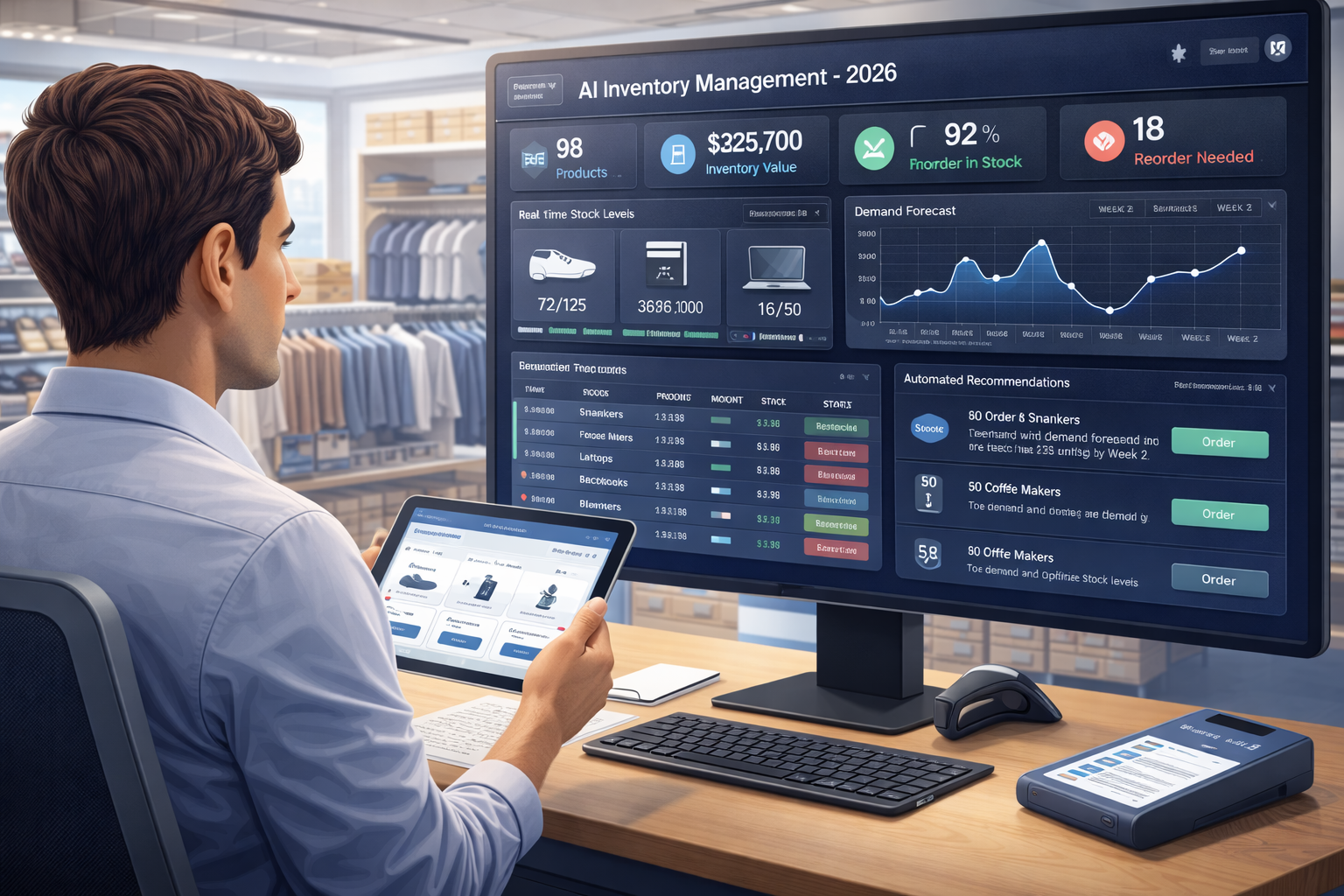
The fundamental tension in retail inventory has always been the same: hold too much stock and you’re tying up capital and risking markdowns when trends change; hold too little and you lose sales you could have made. Getting inventory exactly right — at scale, across thousands of SKUs, in multiple locations, accounting for seasonality, promotions, and external factors — is the kind of optimisation problem that AI was built for.
Target’s Inventory Ledger is the most technically impressive public example. The system uses advanced machine learning models and IoT devices to provide accurate inventory data in real time across 2,000 stores. It processes up to 360,000 inventory transactions per second and handles as many as 16,000 inventory position requests per second. No human-managed system could approach this.
The practical result: correct inventory levels across 2,000 stores in real time, reducing both overstocking and stockouts simultaneously. Overstocking ties up working capital and requires markdowns that erode margins. Stockouts mean lost sales and frustrated customers who go to a competitor and may not come back.
One apparel retailer automated inventory decisions entirely and saw a 300% year-over-year sales lift after removing stock visibility gaps and slow manual updates. That number is extraordinary enough to warrant skepticism — and yet it’s consistent with what happens when the core constraint (you don’t know what you have or where it is) is removed with AI-powered real-time tracking.
Levi Strauss deployed predictive analytics to fine-tune inventory across stores and e-commerce, reducing markdowns and excess inventory. Reduced markdowns matter enormously in fashion: every garment sold at full price is dramatically more profitable than one sold at 40% off in a clearance event.
One retailer reported saving $30,000 weekly — and four hours of manual work — by connecting AI-powered demand signals to automated replenishment decisions. The labour saving matters. Four hours per week of inventory management time, multiplied across thousands of retail operations, represents an enormous amount of human capacity redirected to higher-value activities.
Deloitte found that AI adoption in inventory and supply chain operations reduces waste by 15-30% and improves profitability. Predictive analytics decrease stockouts by 60-75% while reducing excess inventory holding costs by 25-40%. These aren’t aspirational figures — they’re outcome ranges from deployed implementations.
Dynamic Pricing: Real-Time Economics
Grocery stores with electronic shelf labels now run dozens of price changes daily based on AI-driven demand signals; some markets report up to 100 price updates per day on individual products.
Dynamic pricing AI works by analysing demand signals, inventory levels, competitor pricing, time-of-day patterns, weather, local events, and historical price sensitivity to adjust prices in real time. The goal is to find the price that maximises revenue given current conditions — higher when demand is high, lower when inventory needs to move.
eBay uses AI agents to dynamically adjust pricing and promotions based on competitor data, inventory levels, and customer demand. Retailers implementing AI pricing report up to 13% average order value lift during peak periods and 4.7% EBITDA improvement in pilot categories.
The caveat is real and deserves emphasis: after price sensitivity spikes in recent years, heavy-handed dynamic pricing will erode trust fast. Customers who discover they paid more than someone else for the identical item because of algorithmic timing feel exploited, not served. The retailers getting this right are the ones with guardrails — maximum price change percentages, transparency about when prices fluctuate, and customer communication strategies that treat price variation as a feature rather than a secret.
AI Customer Service: Handling the Volume Human Teams Can’t
The global AI customer service market hit $15.12 billion in 2026, projected to reach $47.82 billion by 2030. The adoption in retail is driven by a simple reality: retail generates enormous volumes of routine customer inquiries — order status, return policy, product availability, shipping estimates — that are identical in type but vary in specific detail.
AI chatbots resolve up to 86% of customer questions without human intervention in the best implementations; more typical e-commerce deployments land in the 50-70% range. The $3.50 return for every $1 invested in AI customer service reflects both cost savings on handled inquiries and the revenue improvement from faster, more available support.
MakerFlo, a customised products business, used AI to handle simultaneous customer support requests around the clock — removing the gap between customer question and answer that was previously limited by business hours and human availability.
The most important design decision in retail AI customer service is the escalation path. AI should handle the volume; humans should handle the edge cases. Getting this boundary wrong in either direction creates problems: AI trying to resolve complex complaints it can’t handle damages customer relationships; routing too many inquiries to humans defeats the efficiency purpose. The retailers deploying this well have mapped their customer inquiry types carefully and built escalation logic that matches inquiry complexity to resolution path.
Visual Search and Virtual Try-On: Reducing the Return Problem
E-commerce has a return problem. Online apparel return rates run 30-40% — compared to 8-10% in physical retail — because customers can’t assess fit, colour accuracy, or how a garment looks on their specific body before purchasing.
AI-powered virtual try-on directly addresses this. Customers upload a photo or use a live camera feed, and AI renders how a product will look on their specific body, in their specific environment. Sephora’s application for beauty products demonstrates the commercial case: customers who can see how a lipstick shade looks on their actual skin tone make more confident purchase decisions and return them less.
Nike’s 13-point measuring system uses AR and AI to fit shoes accurately, reducing the “I bought the wrong size” returns that are significant in footwear e-commerce.
The return cost reduction is substantial: returns cost retailers an estimated $300+ billion annually in the US through shipping, restocking, and lost-sale implications. Visual AI that reduces return rates by 18-25% generates ROI that can justify significant implementation investment quickly.
What Smaller Retailers Can Actually Deploy
The Amazon and Nike examples are useful benchmarks, but they describe retailers with hundreds of millions of dollars in technology investment. The practical question for a retailer with a Shopify store and a small team is: what’s actually accessible?
The honest answer in 2026 is: quite a lot.
AI-powered recommendation tools that plug into Shopify, WooCommerce, and Magento are available from providers including Klaviyo (email personalisation and product recommendations), LimeSpot (personalised product recommendations), and Rebuy (intelligent shopping cart recommendations). These don’t require data science teams — they require configuration, customer data, and a product catalogue.
AI customer service via platforms like Tidio ($29/month) or Freshdesk (free tier available) handles the routine inquiry volume that consumes small teams’ time. AI inventory forecasting tools that connect to existing point-of-sale systems surface demand predictions without requiring custom ML development.
The ceiling for AI investment in retail is whatever Amazon spends. But the floor — the minimum viable AI deployment that generates measurable ROI — is within reach of businesses generating $500K in annual revenue. Starting with one use case, measuring the result, and expanding based on evidence is how smaller retailers can access these capabilities without the risks of over-investment.