Stripe’s AI reduced fraud by 98% compared to rule-based systems. American Express improved fraud detection by 6%. The European Central Bank’s AI analyses 5 million documents. McKinsey estimates AI could add $340 billion to global banking annually. Here’s how it’s actually happening.
Finance has a particular relationship with AI that differs from most industries. The incentives are extremely clear and extremely large. Every false positive in fraud detection means a frustrated customer whose legitimate transaction was blocked. Every false negative means money the bank doesn’t get back. Every hour a loan application sits waiting for manual review is a customer who might go to a competitor.
When the cost of error is precisely calculable and the volume of transactions is in the billions per day, the business case for AI writes itself. Which is why, while healthcare is “below average” in AI adoption and education is still finding its footing, banking has been deploying AI at scale for years — and the results are measurable in ways that matter.
The Bank of England’s 2024 survey found that 75% of UK financial firms currently use AI, up from just 14% in 2019. China leads globally with 83% of banks using generative AI. Accenture’s analysis shows banks can achieve up to 4.9% revenue increase and 7.7% operational cost reduction within three years of AI adoption. Banks using AI report 29% improvement in pre-tax profits. These aren’t projections — they’re outcomes from institutions that have deployed and measured.
Here’s where those results are coming from.
Fraud Detection: The Clearest AI Success Story in Finance
Fraud is the most expensive problem in digital finance, and AI is the only technology that addresses it at scale in real time.
The scale of the problem first: companies worldwide lost an average 7.7% of annual revenue to fraud in 2025, an estimated $534 billion globally. Annual fraud losses are projected to increase to $40 billion in the US alone by 2027 according to Deloitte, fuelled partly by criminals using generative AI to create convincing deepfakes, synthetic voices, and forged documents at scale.
Banks are fighting AI with AI — and the results are decisive.
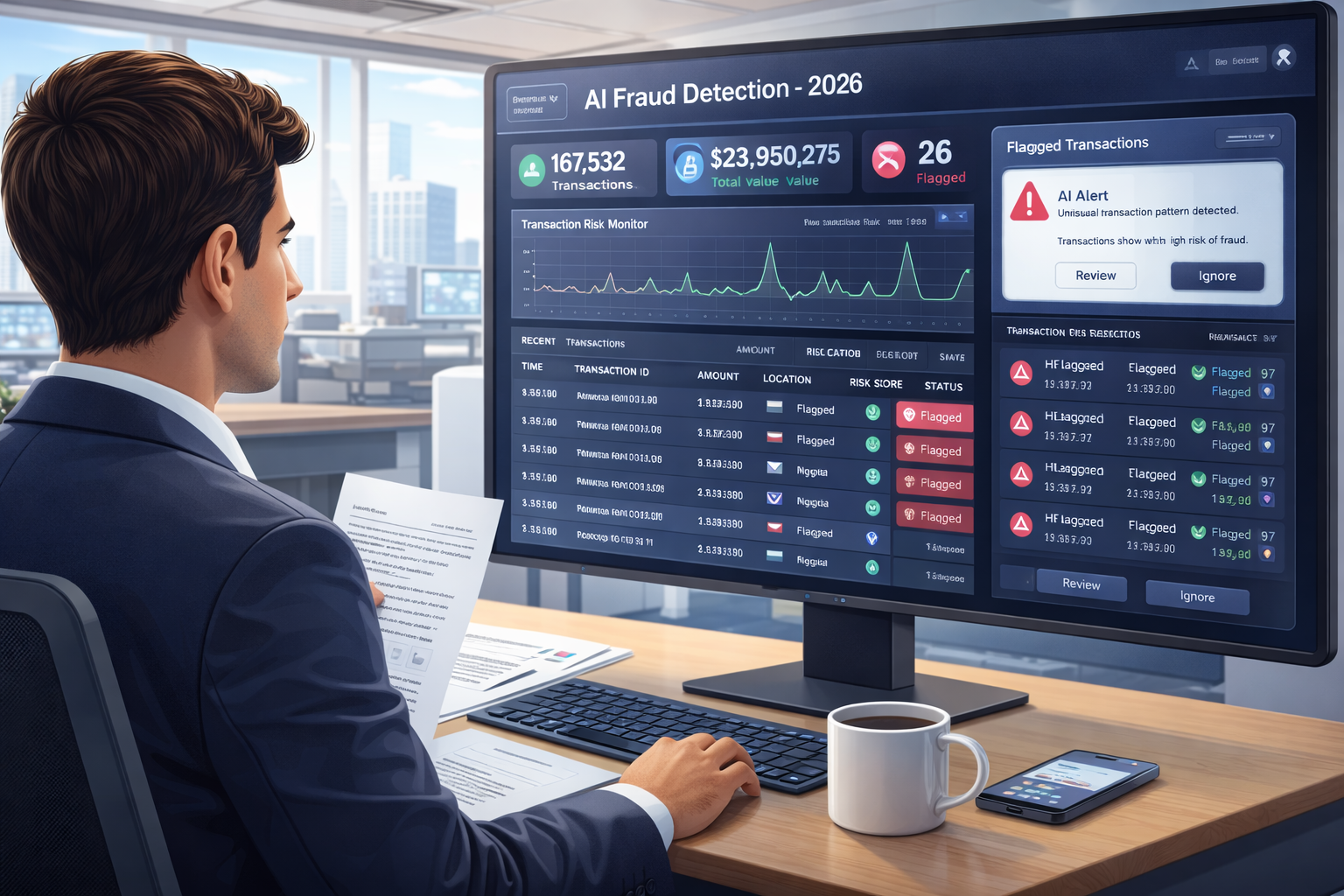
Stripe’s Radar is the clearest demonstration of what AI fraud detection can achieve. The machine learning system analyses hundreds of signals per transaction — device fingerprint, network patterns, transaction history, behavioural biometrics — and makes a fraud decision in under 100 milliseconds. The result: a 98% reduction in fraud compared to legacy rule-based systems. That is not a marginal improvement. A legacy fraud system with a 5% fraud rate reduced to 0.1% is a category-defining change in fraud economics.
American Express deployed Long Short-Term Memory (LSTM) AI models and achieved a 6% improvement in fraud detection. Against the volume of transactions American Express processes daily, a 6% improvement represents hundreds of millions of dollars in prevented losses annually.
PayPal improved real-time fraud detection by 10% through AI systems running around the clock worldwide. AI fraud systems reduce false positives by 70% while detecting 15% more genuine fraud compared to rules-based systems — the dual improvement matters because false positives are a customer experience problem (legitimate purchases being blocked) and genuine fraud detection is a direct loss prevention problem.
Mastercard’s 2025 payment fraud prevention report found that 85% of financial institutions using AI for fraud detection report seeing positive returns. 83% say AI has significantly sped up their fraud investigation and case resolution process. Organisations that have used AI for over five years report saving $4.3 million in lost revenue — almost double the average savings of $2.2 million for shorter-term adopters. The longer you train the model, the better it gets.
Credit Scoring: Lending to People Legacy Systems Couldn’t See
Traditional credit scoring has a specific problem: it only works well for people who have credit histories. First-time borrowers, immigrants, young adults, people who’ve been financially excluded — FICO scores classify them as unscoreable or high-risk based on absence of history rather than actual risk behaviour.
AI changes this by using alternative data sources. Analysing patterns in how someone manages a mobile phone contract, their utility payment history, their rental payment track record, their employment and income trajectory — all of this builds a risk picture that traditional scoring cannot access.
The practical effect: AI-powered credit scoring unlocks markets that FICO-gated products cannot address. Financial inclusion isn’t just a social good — it’s a commercial opportunity for lenders willing to build the capability.
For traditional borrowers, the speed improvement is the more immediately visible change. Conventional loan processing involves manual document review, human underwriting, back-and-forth for missing information, and approval cycles measured in days to weeks. AI-automated underwriting processes loan applications in minutes — verifying income documents automatically, cross-referencing credit history, checking employment, and generating an underwriting decision without human bottlenecks.
The implications compound: a mortgage applicant who gets an answer in 20 minutes rather than two weeks has a qualitatively different experience, and the bank that provides it gains a competitive advantage that extends beyond the specific transaction.
Wealth Management and Robo-Advisors: Democratising Investment
Robo-advisors now manage over $1.4 trillion in assets globally. The core proposition is straightforward: algorithmic portfolio management, based on client goals and risk tolerance, with automatic rebalancing and tax optimisation, at a fraction of the cost of human advisors.
For clients with investable assets below the minimums of traditional wealth managers — which can reach $500,000 to $1 million at private banks — robo-advisors represent access to portfolio management that was previously unavailable. AI is democratising a financial service that was historically reserved for the wealthy.
At the sophisticated end, generative AI is changing how financial planning conversations happen. Instead of a static financial plan produced annually, AI enables continuous planning — modelling different scenarios in real time, updating projections as circumstances change, and providing the kind of “what if I retire three years earlier?” analysis that previously required scheduling a meeting with an advisor.
The European Central Bank’s deployment of an AI system called “Athena,” used by over 1,000 supervisors to analyse more than 5 million documents, illustrates how AI is transforming financial oversight at the institutional level as well as the retail one. Supervisors who previously spent days manually reviewing filings can now use AI to surface anomalies, flag concerns, and direct attention to the documents that actually require human judgment.
Anti-Money Laundering: Finding Patterns in the Noise
Money laundering schemes are designed by definition to evade detection. They involve complex networks of transactions and entities, structured specifically to look like legitimate activity when viewed at the individual transaction level.
AI analyses these relationships at the network level rather than the transaction level — mapping connections between accounts, entities, and patterns over time to spot the suspicious structures that rule-based compliance systems miss entirely. Traditional AML systems generate enormous numbers of false positives — estimates suggest 95-99% of alerts generated by rules-based systems are false positives. This creates a compliance team that’s perpetually overwhelmed and a detection system that misses actual money laundering amid the noise.
Health systems spend close to $20 billion each year contesting claim denials from payers. The analogy in financial services is that compliance teams spend enormous resources chasing false positives that consume capacity needed for genuine enforcement.
McKinsey estimates AI could add $200-340 billion in annual value to the global banking industry across all applications. The AML and compliance component alone — reducing false positive rates and improving genuine detection — represents hundreds of millions in efficiency gains for large institutions.
AI Customer Service: Banking at Midnight
60-80% of customer service inquiries in banking are handled by AI without human agents in the best-implemented systems. This covers the questions that banking customers ask constantly: account balance, transaction status, branch hours, payment due dates, card replacement requests, basic fraud alerts.
For customers, the benefit is availability: AI customer service operates 24/7, responds immediately, and doesn’t require waiting on hold. For banks, the benefit is cost: AI customer service handles interactions at a fraction of the cost of human agents, while freeing human agents to handle the complex situations where empathy, judgment, and authority matter.
Bank of America’s Erica, the AI-powered virtual assistant, has handled hundreds of millions of customer interactions. Launched in 2018 and continuously improved, Erica demonstrates what a well-implemented banking AI assistant looks like at scale: capable of handling routine inquiries, escalating complex ones, and maintaining the security protocols required in financial contexts.
The customer service AI deployment also generates data about where customers struggle — patterns that inform product design, fee structures, communication clarity, and channel investment decisions. The AI isn’t just answering questions; it’s capturing intelligence about customer experience that previously required expensive surveys to approximate.
The Arms Race: When Fraudsters Use AI Too
Banking AI operates in a specific adversarial environment that most other industries don’t face. Fraudsters have access to the same AI tools as banks — and they’re using them.
Deepfake technology creates convincing fake videos and audio recordings to bypass biometric authentication systems. Automated phishing generates personalised, convincing messages at scale by scraping victim information from social media. Document forgery produces realistic fake identity documents, bank statements, and employment verification letters.
Synthetic identity fraud — combining stolen personal information with fabricated details to create a fake identity — is escalating as fraudsters use AI to sift through massive datasets and build more convincing profiles. 61% of payment leaders identify synthetic identity fraud as the fastest-growing threat, followed by impersonation scams (60%) and cross-border fraud (54%).
The implication: 90% of payment leaders expect higher financial losses in the next three years if they don’t increase AI use in fraud prevention. This isn’t theoretical — it’s the observed dynamic. As fraudsters improve their tools, banks must improve theirs. The static rule-based systems that characterised fraud prevention before AI cannot adapt fast enough. Machine learning systems that continuously retrain on new fraud patterns can.
Staying in the race requires sustained investment and continuous improvement. Organisations that have used AI for over five years outperform those who’ve used it for less — not because they made a one-time investment, but because they built and refined systems over time.