There’s a way to use AI for studying that genuinely makes you learn faster. And there’s a way that just makes you feel like you’re learning while you’re actually just consuming summaries. Here’s how to do the first one.
Let’s be honest about something uncomfortable.
The most natural, intuitive way to use AI for studying — paste your notes into ChatGPT, ask for a summary, read the summary — is also one of the least effective ways to actually learn. It feels productive. You cover the material quickly. You feel informed. And then, when it comes to actually applying the knowledge — in an exam, in a meeting, in a real situation — the information isn’t there.
Researchers call this the illusion of knowing. Passive review creates a feeling of familiarity with material without creating durable memory of it. A Cornell research study on AI in education found evidence that users who passively over-relied on AI had the lowest brain engagement and consistently underperformed at neural, linguistic, and behavioural levels. The passive approach is worse than useless — it creates false confidence.
This guide is about the other approach. Students using AI study techniques strategically report retention improvements of up to 42% compared to traditional methods, according to research on active recall and spaced repetition platforms. A Harvard University physics study found that students using AI tutors learned more than twice as much in less time compared to those in traditional active-learning classrooms.
The difference between those outcomes is not which AI tool you use. It’s how you use it.
The Principle That Makes Everything Else Work
Before the techniques, one principle to internalise: learning happens when your brain retrieves information, not when it receives information.
Reading, watching, and listening are not learning. They’re exposure. Learning is what happens when you’re forced to recall something — to pull it from memory, reconstruct it, explain it, apply it, or use it to solve a problem. That retrieval process is what builds the neural pathways that make knowledge durable.
This is why highlighting and re-reading are notoriously ineffective as study strategies — they’re passive. And it’s why practice testing, explaining concepts in your own words, and spaced repetition work so well — they’re active retrieval.
AI is extraordinary at generating retrieval practice at scale. It can produce practice questions instantly, adapt difficulty to your responses, explain gaps in your understanding, quiz you on exactly the material you’re weak on, and generate examples and analogies on demand. Used this way, AI is genuinely one of the most powerful learning tools available.
Used as a summary machine, it’s a sophisticated way to feel like you’re studying without actually doing it.
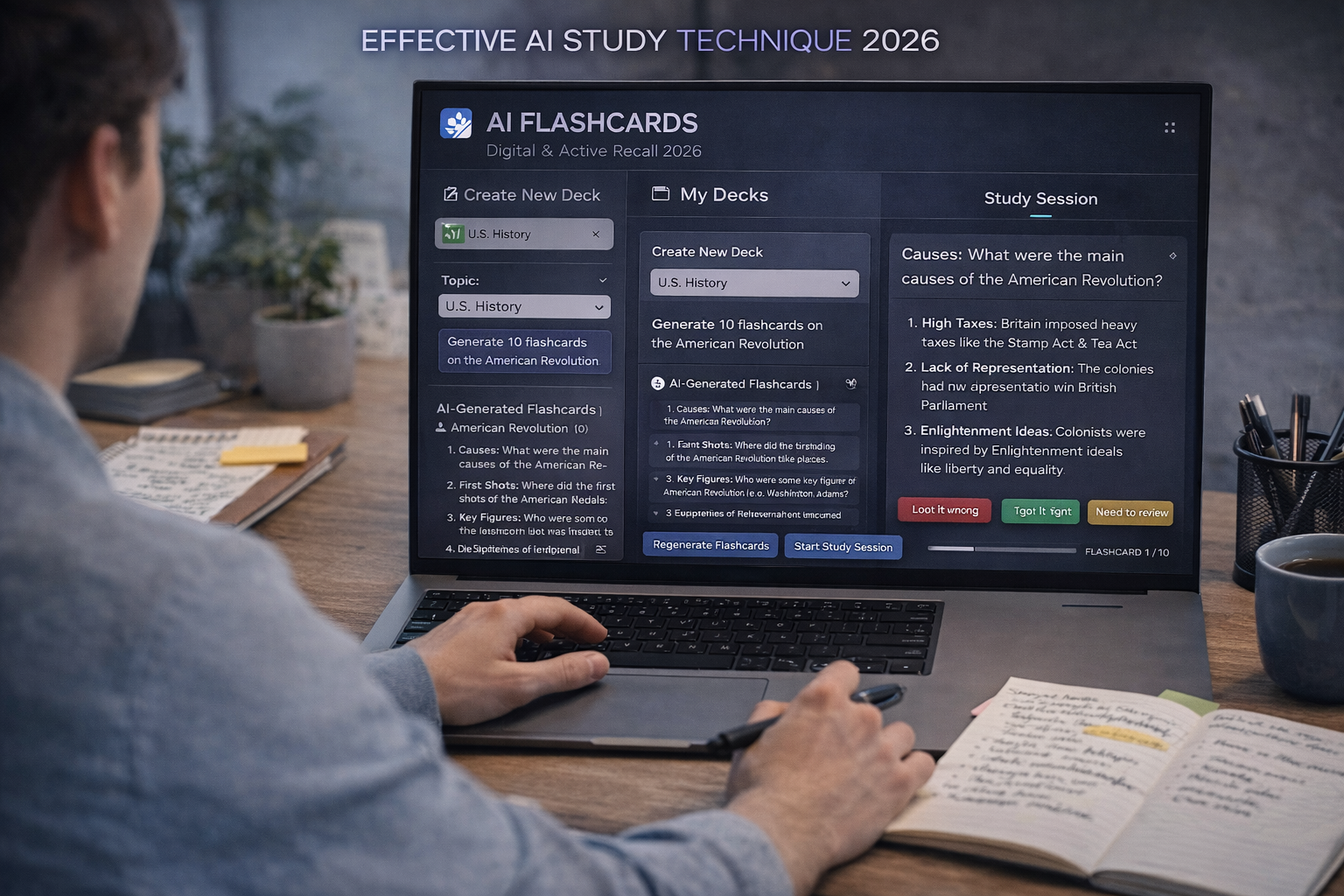
Technique 1: Generate Your Own Flashcards — But Make AI Create Them From YOUR Understanding
Classic flashcard creation used to take 30-45 minutes per chapter. AI reduces this to under 5 minutes. But there’s a better version than just asking AI to “make flashcards from my notes.”
The active version:
After reading a chapter or watching a lecture, close it. From memory, write down everything you think the key concepts are — even if it’s just a list of terms you think were important. Then give AI both your notes AND your rough list, and ask it to:
- Generate flashcards for concepts you included correctly
- Identify important concepts you missed entirely
- For concepts you included but got wrong, provide the correct version
The prompt: “Here are my lecture notes [paste]. Here are the concepts I thought were most important based on memory [paste your list]. Generate 20 flashcards (question front, answer back) for this material. Then tell me: which important concepts did I miss? Were there any I included that were incorrect or incomplete?”
This approach forces a retrieval attempt before AI fills the gaps. That retrieval attempt — even when you get things wrong — is the learning. The AI’s corrections are the most effective form of feedback because you’re receiving them precisely when your brain is primed to encode them.
Technique 2: Practice Testing — Generate Unlimited Exam-Level Questions
Practice testing is the single most effective study technique identified by cognitive science — more effective than re-reading, highlighting, or summarising. Yet most students only get practice tests when their professor provides them.
AI generates unlimited practice tests from any material, at any difficulty level.
The prompt that works:
“Create a 15-question practice test on [topic/chapter]. Requirements: (1) Include a mix of multiple-choice (with 4 options), short-answer (requiring 2-3 sentences), and one essay question. (2) Difficulty should be exam-level — not trivia, not graduate research. (3) After all questions, provide an answer key with brief explanations for why each correct answer is right. (4) Source material: [paste your notes or describe the topic in detail].”
Take the test without looking at your notes. Time yourself if your real exam will be timed. Then check your answers against the key.
The areas where you got things wrong or guessed correctly are your study targets. For each wrong answer, use the next technique.
For spaced repetition: Generate a new practice test on the same material 2 days later, then 5 days later, then 12 days later. Each session, start with the questions you got wrong in the previous session. This spacing pattern is what converts short-term recall into long-term retention.
Technique 3: The Socratic Dialogue — Use AI as a Tutor Who Asks, Not Tells
This is the technique most people don’t think to use, and it’s one of the most powerful for genuinely understanding difficult concepts rather than memorising them.
Instead of asking AI to explain something to you, ask AI to help you develop your understanding through questions.
The prompt:
“I’m trying to understand [concept]. Instead of explaining it to me directly, please: (1) Ask me to explain my current understanding of it in my own words. (2) Based on my answer, identify exactly what’s missing or incorrect in my understanding. (3) Ask me a question that helps me discover the missing piece through my own reasoning, rather than just telling me. Keep challenging me until I can explain [concept] accurately and completely. If I’m stuck after two attempts, then explain that specific gap.”
This is the Socratic method, and it’s more effective for deep understanding than reading explanations because it forces you to generate the knowledge rather than receive it. You’ll find yourself thinking harder than any lecture or textbook requires, and the understanding you arrive at through this process sticks because you built it yourself.
Use this technique for the concepts you find genuinely difficult — the ones where re-reading doesn’t help and you still don’t really get it.
Technique 4: The Feynman Technique — Explain It to AI Like It’s a Beginner
Richard Feynman, the physicist and legendary teacher, had a learning method: if you can’t explain something simply, you don’t understand it. The process of finding the simple explanation reveals exactly where your understanding has gaps.
AI is a perfect partner for this technique.
How to use it:
Set the AI’s role: “For this exercise, you are a curious 12-year-old who knows nothing about [subject area]. Ask questions when my explanations are unclear. Point out when I use jargon I haven’t explained. Tell me when you don’t understand something. Be genuinely curious but genuinely naive — not a student, not an adult — an engaged kid who will call out when things don’t make sense.”
Then explain your topic out loud (or by typing) as if you’re genuinely teaching this student. No notes. No looking things up.
The AI will ask: “Wait, what’s a molecule?” or “You said it ‘reacts’ but I don’t know what that means — what’s happening?” Those questions are your gaps. Every time you reach for jargon you can’t simplify, you’ve found something you don’t fully understand.
After the explanation, ask the AI (back in its normal mode): “Based on that explanation, what gaps in my understanding were most apparent? What would a genuine expert say differently?”
This technique is particularly effective for STEM subjects, legal concepts, economic theory — anything where understanding the mechanism matters more than memorising facts.
Technique 5: Contextualise Abstract Concepts with Custom Examples
Abstract concepts are hard to retain because they don’t connect to anything concrete in your memory. AI can generate infinite, personalised examples that anchor abstract ideas to things you already know.
The prompt:
“Explain [abstract concept] using an example from [your specific field/interest/daily life]. Make it concrete and specific — not a hypothetical, but a real scenario I would actually encounter as [describe yourself: a marketing professional, a nursing student, someone who manages a small restaurant, etc.]. After the example, show me how the concept plays out differently in two other contexts.”
For a nursing student learning about compensation mechanisms in the body: “Explain respiratory compensation for metabolic acidosis using a specific patient scenario I might encounter in an ICU. Walk through what I would observe, what would be happening physiologically, and how I would know compensation is occurring.”
For a business student learning about price elasticity: “Explain price elasticity of demand using an example from a restaurant owner’s perspective — specifically, what happens when they raise prices on their best-selling dish versus their least popular dish.”
The personalisation isn’t just for motivation. It creates memory hooks. When you encounter price elasticity again, you’ll think “the restaurant example” — and the abstract concept will come with it.
Technique 6: Document Your Learning — Use AI to Generate Study Notes, Not Receive Them
The worst way to use AI for notes is to paste lecture slides and say “summarise these.” The best way is to actively generate your own notes and use AI to improve them.
The workflow:
Immediately after a lecture, class, or reading session — within 24 hours, while the material is still in working memory — write everything you remember in your own words. Messy, incomplete, partially wrong — doesn’t matter. This is a brain dump from memory.
Then paste those notes to AI with this prompt: “These are my notes from memory on [topic]. Please: (1) Identify anything I got factually wrong and correct it. (2) Identify important concepts I missed entirely and add them. (3) Clarify anything I described vaguely or partially. (4) Don’t rewrite my notes into yours — annotate mine with corrections and additions, preserving my language wherever it’s correct.”
The key instruction — “don’t rewrite my notes into yours” — is what keeps the notes yours. AI-generated notes are processed by the AI, not your brain. Your notes, improved with AI, were processed by your brain first and then refined. That sequence matters for retention.
The result is a set of notes that combines what you actually learned (your brain dump) with what you missed (AI corrections) — which tells you exactly what to focus your next study session on.
What Not to Do — The Common Mistakes That Undermine Learning
Knowing the pitfalls is as important as knowing the techniques.
Don’t use AI-generated summaries as your primary study material. Summaries created by AI are information organised by AI’s understanding, not yours. Reading them creates the illusion of understanding without the reality of it.
Don’t skip the effortful retrieval. Every technique in this guide has a retrieval component — recalling before checking, explaining before being explained to, testing before reviewing. The effort of retrieval is not a bug in the method; it’s the point. Don’t shortcut it.
Don’t rely on AI for accuracy without verification. AI tutors can be confidently wrong. For subjects where accuracy matters — medicine, law, engineering, finance — verify anything you plan to rely on against a textbook, a reputable source, or your instructor. Use AI to understand and practice; use authoritative sources to confirm.
Don’t use AI to write the work you’re supposed to do yourself. There’s a clear line: using AI to help you learn material is studying. Using AI to produce the work you submit is academic dishonesty. The distinction matters beyond just getting caught — doing the work is how you actually learn, and learning is the actual point.
The Study Session Structure That Actually Works
Here’s what a 90-minute AI-assisted study session looks like when you apply these principles:
Minutes 0-15: Close all materials. Write everything you remember about the topic from memory — concepts, definitions, connections, examples. This is the retrieval attempt.
Minutes 15-30: Use AI Technique 1 (flashcard generation from your memory list) to identify gaps. Review the gaps, not everything — only what you missed.
Minutes 30-60: Use AI Technique 2 (practice testing) on the material. Focus on your weak areas from the gap identification.
Minutes 60-75: For the 2-3 concepts you got wrong on the practice test, use Technique 3 (Socratic dialogue) or Technique 5 (personalised examples) to build genuine understanding.
Minutes 75-90: Write a brief summary in your own words of what you learned in this session that you didn’t know before. Schedule your next review session in 2 days.
This structure is more effortful than reading a summary. That effort is the mechanism. The discomfort of not remembering, of being wrong, of working to explain something you only partially understand — that’s learning happening. Lean into it rather than shortcut past it.