AI in healthcare isn’t a future promise anymore. It’s already detecting cancers earlier, predicting hospital readmissions, cutting documentation time from two hours to fifteen minutes, and monitoring thousands of patients remotely. Here’s what’s actually happening — and what it means.
In 2019, a doctor in Yorkshire saw an AI flag a patient’s deteriorating vitals for immediate transfer to hospital. The AI had picked up patterns in pulse, blood oxygen levels, mobility, and chest pain that human assessment had classified as stable. The patient turned out to be critically ill.
That moment — AI catching what a trained clinician missed, not because the clinician was incompetent but because the AI was processing signals across dozens of variables simultaneously — captures why healthcare has become one of the most consequential deployment environments for artificial intelligence.
The scale of the problem gives the technology context. 4.5 billion people currently lack access to essential healthcare. A global health worker shortage of 11 million is expected by 2030. US healthcare administrative costs alone consume 25-30% of total spend. Clinicians spend over 13 hours a week on documentation. Healthcare is, as the World Economic Forum noted, “below average” in AI adoption compared to other industries — which means the opportunity ahead is substantial, and the early results already visible are just the beginning.
Here is what’s actually working, backed by data and specific examples.
AI Diagnostics: When the Machine Sees What Humans Miss
The most mature AI use case in healthcare is medical imaging — and the results are extraordinary enough that it’s worth dwelling on the specific numbers.
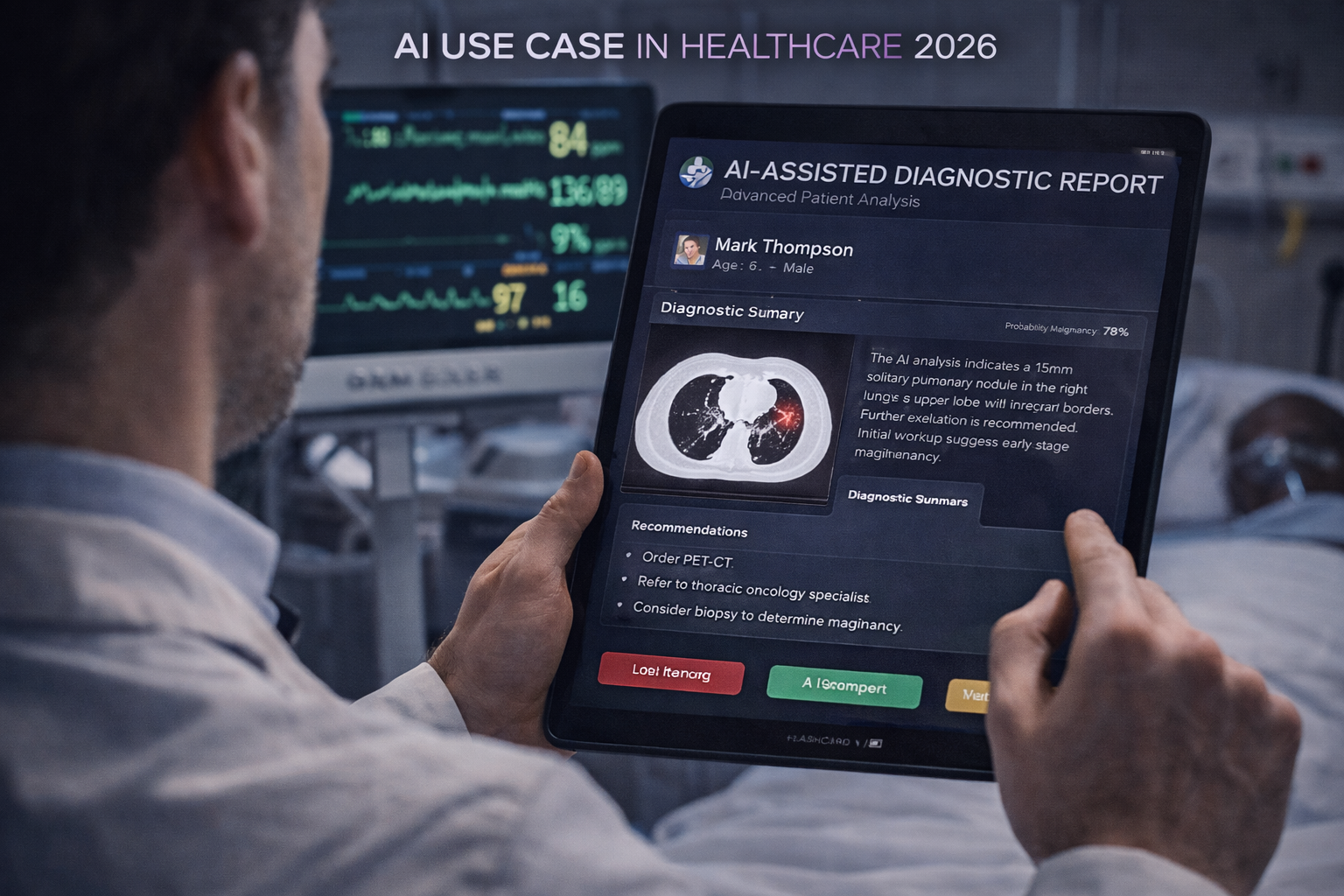
At Massachusetts General Hospital and MIT, AI algorithms detected lung nodules with 94% accuracy, compared to 65% accuracy for radiologists working alone. That’s not a marginal improvement — it’s a category shift. Early detection of lung cancer changes survival outcomes dramatically: stage I lung cancer has a 5-year survival rate above 60%; by stage IV, that drops below 10%.
Radiology AI has expanded beyond lungs. Urgent care doctors miss broken bones in up to 10% of X-ray cases — a combination of volume pressure, fatigue, and the inherent difficulty of spotting subtle fractures. UK’s National Institute for Health and Care Excellence evaluated bone fracture AI tools and confirmed they are “safe, reliable and could reduce the need for follow-up appointments.” When an AI can flag a subtle tibial hairline fracture that a human would miss after a long overnight shift, that’s a meaningful clinical outcome.
Cancer screening has seen perhaps the most important advances. A large randomised trial in Sweden involving over 105,000 women evaluated whether adding AI to mammography screening changed the rate of interval breast cancers — cancers detected between scheduled screenings, which tend to be more aggressive. The study found AI-supported screening achieved interval cancer rates no worse than standard double-reading by two radiologists. In other words, AI matched the accuracy of two experienced radiologists working together — while freeing one of them to review other patients.
For stroke, the timing window is ruthlessly specific. If a patient is within 4.5 hours of a stroke, both medical and surgical treatments are viable. After 6 hours, the calculus changes significantly. AI systems now help doctors establish onset times and assess whether interventions might be beneficial — critical information when every minute matters and the clinical picture is ambiguous.
By 2026, dozens of AI diagnostic tools have received FDA clearance or equivalent international approval. This isn’t experimental technology anymore. It’s cleared medical equipment.
Predictive Medicine: Moving from Reactive to Proactive
One of the most significant shifts AI enables in healthcare is temporal — from treating disease after it manifests to intervening before it does.
Consider sepsis. It’s one of the leading causes of in-hospital death, killing approximately 270,000 Americans annually. Sepsis is treatable when caught early and rapidly fatal when missed. The challenge: the early warning signs — subtle changes in vital patterns, lab values, clinical history — can be invisible in the noise of a busy ward.
AI-powered early warning systems monitor patient vital signs and lab results continuously, flagging patients at risk hours before clinical deterioration becomes obvious to human observers. This isn’t a theoretical improvement — sepsis detected two hours earlier is a patient who receives antibiotics and fluid resuscitation before their organs begin failing.
The same predictive logic applies to readmission risk. Hospitals are penalised in most developed healthcare systems for high readmission rates, and readmissions represent poor patient outcomes in addition to operational costs. AI models trained on patient history, diagnosis, social determinants, and discharge circumstances can identify patients most likely to return within 30 days — so that discharge planning, follow-up intensity, and community support can be tailored accordingly.
Perhaps the most striking demonstration of predictive AI’s potential comes from AstraZeneca’s research. Training a model on medical data from 500,000 people in a UK health data repository, researchers were able to predict disease diagnoses many years before clinical manifestation — including Alzheimer’s, chronic obstructive pulmonary disease, and kidney disease. As researcher Slavé Petrovski explained, by the time a disease manifests clinically, “that is far down the line from when the disease process began.” The AI was picking up molecular signatures of conditions that hadn’t yet become symptomatic.
That’s the promise: not just faster treatment, but earlier intervention, before the disease has taken hold.
Clinical Documentation: Giving Clinicians Their Time Back
Oracle’s work with AtlantiCare, a regional health system, produced a result that sounds almost too good to be true: documentation time reduced by 41%, saving providers 66 minutes per day. Across a hospital system, that’s thousands of hours monthly returned to patient care.
Ambient AI — where a microphone captures a patient-physician conversation and an AI drafts the clinical note in real time — is becoming one of the most rapidly adopted technologies in healthcare, precisely because its value proposition is immediate and measurable. Clinicians hate documentation. Not because they don’t understand its importance, but because generating accurate, compliant, detailed notes consumes time that should go to patients.
One implementation described in clinical literature reduced documentation time from 2 hours to 15 minutes daily. For context: before AI, many physicians reported spending more time on documentation than on direct patient care.
The technology is not without concerns. A report found that OpenAI’s Whisper — used by some hospitals for transcription — occasionally hallucinated details in transcriptions. This is why regulatory frameworks matter: AI documentation tools in clinical settings require validation, oversight, and clear protocols for human review before notes become part of the permanent record. The tools that are working well are the ones embedded in workflows with appropriate checks, not the ones deployed hastily.
That caveat aside, the direction is clear. A physician who spends 15 minutes on documentation instead of two hours has more time for the patient in front of them. That’s not just efficiency — it’s the quality of care.
Remote Monitoring: Hospital-Level Care at Home
The NHS virtual ward programme is worth examining in detail because it illustrates what AI-enabled remote care actually looks like in practice.
Thousands of seriously ill children in England are now being treated at home through “virtual wards.” Children with asthma, heart problems, infections, and long-term conditions receive hospital-level monitoring through wearable devices — heart rate monitors, pulse oximeters — with data transmitted to clinical teams around the clock. The platform Feebris uses AI to flag early warning signs, alerting nursing teams to anomalies before they become emergencies. Nurses visit when tests or medication are needed; otherwise, the child stays home.
The human benefit is harder to quantify than the clinical numbers but arguably more important: children recover better at home. Being separated from family creates its own health impacts, particularly in children. Virtual wards solve the clinical problem while also addressing the human one.
For chronic disease management, remote monitoring is transformative. Advanced continuous glucose monitors for diabetic patients now do more than track sugar levels — they learn each patient’s patterns and forecast dangerous highs or lows hours in advance. If the system predicts a hazardous swing, it alerts the patient and, if enabled, the care team immediately. Smart heart monitors analyse ECG signals and blood pressure trends continuously, detecting arrhythmias or early signs of heart failure that might be missed in a brief office visit.
A clinical study in Canada examined this effect directly. The AlayaCare programme for patients with chronic obstructive pulmonary disease and chronic heart failure used AI-powered monitoring to reduce emergency department visits by 68% and hospitalisations by 35% over three months. Average emergency visit cost fell from $243 to $67; hospitalisation cost fell from $3,842 to $1,399. Those numbers represent both significant cost savings and — more importantly — patients who didn’t have to suffer through emergency admissions.
AI in Emergency Response: When Seconds Are the Entire Margin
Emergency medicine is where AI’s ability to process information faster than humans has the most immediate life-or-death consequences.
An AI tool called Corti listens to emergency calls and can detect signs of cardiac arrest with 95% accuracy — prompting dispatchers to provide CPR instructions sooner than they might otherwise. In cardiac arrest, every minute without CPR reduces survival probability by 7-10%. Getting CPR instructions to a caller two minutes faster is, in the most literal sense, life-saving.
AI is also assisting paramedics in the field, predicting which patients are most critical and suggesting the best hospital for their specific needs — particularly relevant when a patient might be better served by a specialist facility than the nearest emergency room.
In the Yorkshire study mentioned at the opening of this article, AI predicted the patients needing hospital transfer with 80% accuracy — trained on factors including mobility, pulse, blood oxygen levels, and chest pain. NICE noted the tool “proved to respond without bias” — an important finding given that human triage has documented disparities in urgency assessment across gender, race, and socioeconomic factors.
Drug Discovery: Compressing the Timeline
The average new drug takes 10-15 years to move from laboratory concept to approved treatment, at a cost of approximately $2.6 billion. AI is compressing that timeline in specific, measurable ways.
AI analyses massive databases of molecular compounds to predict which are most likely to be effective against a target disease — replacing years of laboratory trial and error with computational screening that can evaluate billions of compound interactions. It also optimises clinical trials by identifying and recruiting eligible patients more efficiently, and can predict which trial participants are most likely to respond to a particular treatment.
The opioid crisis has generated a specific and urgent application: AI models that analyse patients’ health records — prescription history, clinical diagnoses, frequency of doctor visits — to identify patients at high risk of developing opioid use disorder before prescriptions are written. This isn’t surveillance; it’s preventive care. Identifying at-risk patients enables clinicians to consider alternative pain management approaches or provide additional monitoring and support.
The Honest Picture: What’s Not Working Yet
AI in healthcare is not uniformly successful, and the gaps matter as much as the advances.
Healthcare remains below average in AI adoption compared to other industries. Only 85% of respondents in an NVIDIA survey said AI budgets would increase — which means organisations are still investing, but many early deployments haven’t yet produced the expected outcomes.
The documentation hallucination problem is real. AI generating plausible-but-wrong information in a clinical context isn’t a UX problem — it’s a patient safety problem. The regulatory requirement for validation before deployment, and human review before permanent record, exists for good reason.
Trust remains an obstacle. A UK study found just 29% of people would trust AI to provide basic health advice — though over two-thirds were comfortable with AI being used to free up professionals’ time. The distinction matters: patients are more comfortable with AI-assisted clinicians than with AI-replacing clinicians. Healthcare AI implementations that work best maintain this distinction clearly.
And the equity gap persists. AI tools trained on datasets that underrepresent certain populations produce less accurate results for those populations. The potential for AI to address healthcare access gaps globally is significant. The risk that poorly designed tools exacerbate existing disparities is equally significant.
The headline results — 94% accuracy on lung nodule detection, 66 minutes saved per provider per day, 68% reduction in emergency visits — are real. So are the limitations. Both deserve honest attention.