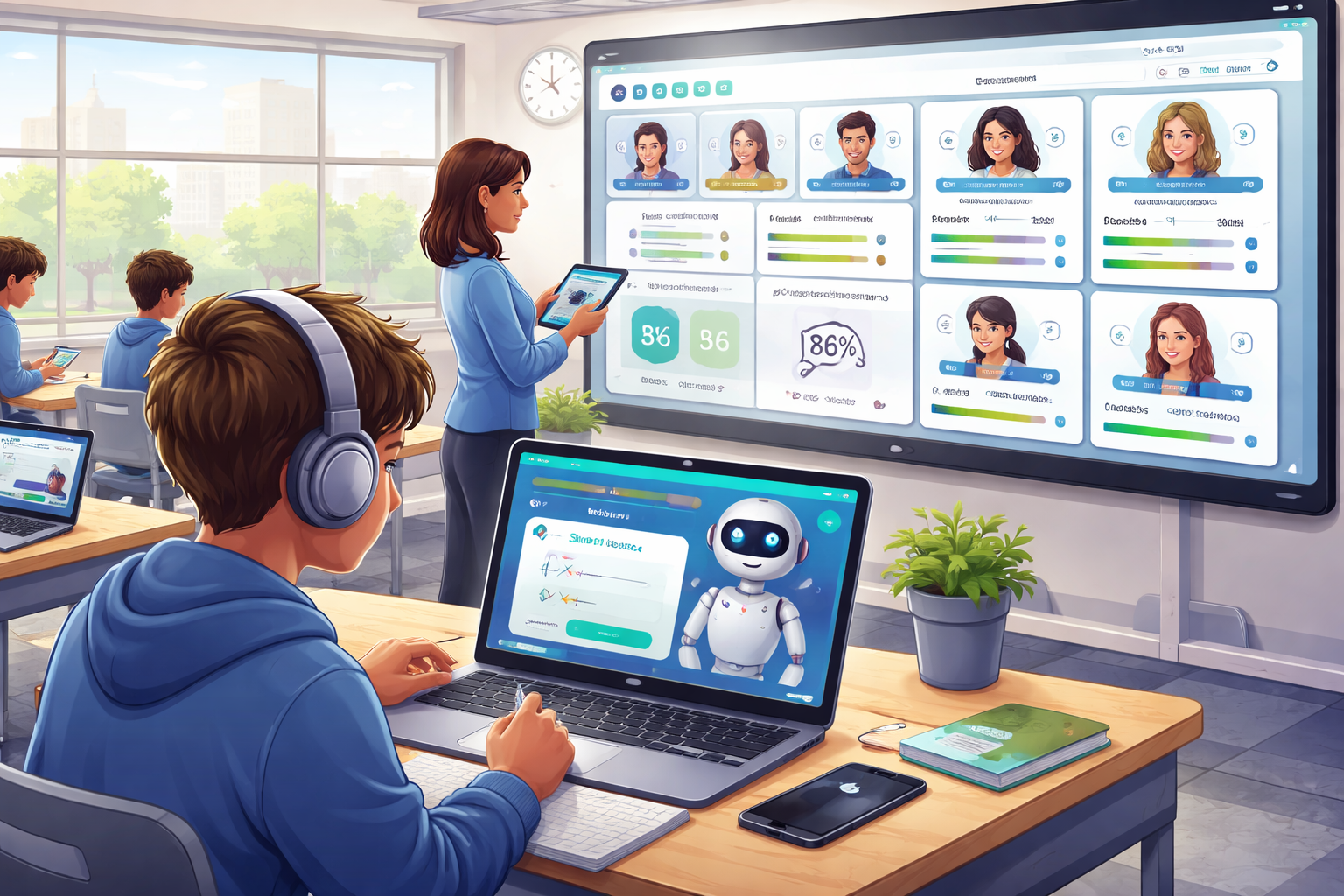
Student AI usage jumped from 66% to 92% in a single year. A Harvard physics study found AI tutors outperformed traditional classrooms by 2x. But 95% of college faculty fear students are losing the ability to think for themselves. The education story is more complicated than the headline numbers.
Let’s start with a number that should surprise everyone: global student AI usage jumped from 66% in 2024 to 92% in 2025. Not over five years. Not over a decade. In twelve months.
By the start of 2026, 86% of all students in higher education use AI as their primary research and brainstorming partner. 83% of K-12 teachers use generative AI, mainly for planning, feedback, and content support. 60% of teachers use AI tools daily.
In the same period, the American Association of Colleges and Universities surveyed college faculty and found that 95% fear student overreliance on AI and diminished critical thinking.
Both of these things are true at the same time. AI is genuinely improving educational outcomes in documented, peer-reviewed ways. And it’s creating risks that the same institutions haven’t yet figured out how to manage. Understanding what’s actually happening requires looking at both sides without letting either dominate the story.
The Results That Changed How Researchers Think About AI Learning
In June 2025, Harvard University published a physics study that’s now regularly cited as the most rigorous evidence yet of AI tutoring’s potential. Students in the AI tutoring condition learned more than twice as much in less time compared to those in traditional active-learning classrooms.
This is not a small effect. Traditional active-learning classrooms already outperform passive lectures — the fact that AI tutoring outperformed active learning by 2x represents a meaningful step change in what’s achievable.
Why does it work? The mechanism is straightforward when you understand it. AI tutoring can do what teachers in large classrooms cannot: respond immediately to every wrong answer, adapt difficulty in real time to each student’s level, generate unlimited practice problems on exactly the topics a student is struggling with, and be available at 2am before an exam when the student finally sits down to study.
Macquarie University in Australia provided corroborating evidence: students using an AI chatbot in coursework improved exam scores by up to 10%. DreamBox Learning’s AI-powered mathematics platform improved student proficiency by 20% in pilot schools, while simultaneously reducing teacher grading time by 25%.
These numbers aren’t from studies designed to prove AI works — they’re from rigorous evaluations measuring what actually happened when AI was deployed in real educational settings.
How Universities Are Using AI Right Now
The deployments that are already running reveal the breadth of AI’s educational applications beyond tutoring.
Arizona State University implemented an AI student support system that provided personalised nudges to at-risk students — not generic “you haven’t logged in recently” emails, but contextually relevant outreach based on academic trajectory, engagement patterns, and historical risk factors. The result: a 10% increase in retention rates and $10 million in annual savings from reduced dropout costs. Student dropout costs are not just administrative — every dropout represents a student who didn’t get their degree, with the lifetime earnings and opportunity implications that entails.
Georgia State University deployed an AI enrollment assistant called Pounce that handled the constant stream of administrative questions from incoming freshmen — financial aid status, course registration, housing applications, scholarship requirements. The results: the university reported a 4% increase in overall enrollment (translating to millions in additional tuition revenue), and 85% of users rated Pounce’s responses as helpful. Crucially, staff who had previously spent their days fielding these repetitive questions could refocus on the complex, high-stakes situations that genuinely require human judgment.
New Town High School in Australia partnered with Maths Pathway, an AI platform that personalises mathematics education by continuously assessing student progress and adjusting content accordingly. The outcomes after implementation: student engagement increased with 90% of students reporting greater confidence in maths, test scores improved by 15% across participating grades, the achievement gap between high- and low-performing students narrowed, and teachers reported a 30% reduction in time spent on lesson planning and grading.
Teachers saving 30% of planning and grading time don’t disappear — they redirect that time to the students who need them most. The one-on-one support that was impossible at scale becomes possible when AI handles the routine.
The Teacher Equation: 6 Weeks Reclaimed Per Year
The Gallup/Walton Family Foundation survey published in June 2025 found that teachers who use AI tools at least weekly save an average of 5.9 hours per week. Across a standard school year, that adds up to roughly 6 extra weeks of reclaimed time.
What do teachers actually use that time for? The most common applications are exactly the ones you’d hope:
Research and content gathering for lessons (used by 44% of teachers), creating lesson plans (38%), summarising information for preparation (38%), generating worksheets and classroom resources (37%), identifying student learning gaps using real-time performance data (24%), and simplifying complex topics for different ability levels (24%).
These are not tasks teachers do less of because AI exists. They’re tasks teachers do better, faster, and with more material variation because AI handles the mechanical parts of content creation, leaving human judgment for the pedagogical design.
Microsoft’s research supports this at scale: 80% of business leaders say AI and machine learning help employees work more efficiently and make better decisions — a finding that applies to teacher-employees as much as corporate ones.
AI personalisation has demonstrated effects on course completion that deserve particular attention. AI-personalised courses show 70% higher completion rates than traditional formats, according to available data. In online learning — where dropout rates historically exceed 90% for MOOCs — this is not a marginal improvement. It may be the difference between a certificate that changes someone’s career and a course they abandoned after week two.
Corporate Learning: The $400 Billion Transformation
Education doesn’t stop at graduation, and the AI transformation of corporate learning deserves its own attention.
Josh Bersin Company’s February 2026 research into corporate learning found AI transforming a $400 billion industry. The shift is structural: AI is compressing the time from identifying a skill gap to closing it, personalising training to individual employee roles and existing knowledge levels, and — most significantly — integrating learning into the workflow rather than treating it as a separate activity.
The traditional corporate learning model: identify a skill need, create a course, schedule employees to attend, hope it sticks. The AI-enabled model: continuous monitoring of employee performance identifies gaps, personalised micro-learning content surfaces in the tools employees are already using, AI coaches provide on-demand support when someone encounters a task they haven’t mastered.
General Electric deployed a tool called “Wingmate” (developed in collaboration with Microsoft) to help employees summarise manuals, resolve quality issues, and draft communications. Within three months, Wingmate had been queried over 500,000 times — indicating that employees found it genuinely useful rather than a training department mandate they ignored.
76% of office workers say AI helps their career, rising to 87% among Gen Z workers. This isn’t abstract enthusiasm — it reflects workers who are using AI tools daily and experiencing the difference in their ability to do their jobs well.
The Honest Complications: What Concerns Experts
The 95% faculty concern figure isn’t paranoia or technophobia. There are documented mechanisms by which AI overuse undermines learning.
Cornell researchers found that over-reliance on AI reduces brain engagement — users who passively receive AI outputs consistently underperform, at neural, linguistic, and behavioural levels, compared to those who engage actively with material. The neurological basis for learning through productive struggle — the benefit of wrestling with a difficult problem before receiving help — is well established. AI that eliminates struggle eliminates the learning mechanism.
There’s also an academic integrity crisis that institutions are navigating awkwardly. In 2024, 53% of UK university students used generative AI tools while completing assessments. By 2025, that figure was 88%. Only 10% of schools and universities have established formal AI guidelines. The majority of institutions are seeing behaviour that they don’t have clear rules about, creating inconsistent enforcement, student confusion about what’s permitted, and faculty who feel both threatened and ill-equipped.
33% of students face accusations related to excessive AI use and plagiarism. This is a systems failure as much as an individual one: students are using the most powerful productivity tool ever created in an environment with unclear rules and inadequate guidance.
The equity dimension also requires honest attention. Students with better devices, faster internet, and familiarity with AI tools gain advantages over those without. AI’s theoretical potential to equalise education access is real — real-time translation, adaptive difficulty, 24/7 availability. But so is the risk that AI adoption amplifies existing inequalities when deployment depends on infrastructure that is not equally distributed.
What the Evidence Actually Supports
The honest summary is that AI in education is producing real, documented improvements in specific, well-defined applications — while generating real, documented risks in others.
Where AI demonstrably works: personalised practice and feedback in quantitative subjects, administrative burden reduction for teachers, student support for at-risk populations, course completion in online learning, corporate learning delivery. The evidence here is solid.
Where AI requires caution: as a substitute for genuine intellectual effort, in assessment contexts without clear guidelines, in institutions without proper data privacy frameworks, and wherever deployment happens without teacher training and stakeholder consultation.
The institutions getting the most from AI are treating it as they would any powerful new tool: deploying it in specific, defined contexts, measuring outcomes, adjusting based on what they find, and maintaining clear human oversight over the decisions that determine student futures. The institutions struggling are the ones who deployed broadly and quickly without a clear theory of what they were trying to achieve.