A workplace divide is forming faster than most companies are managing it. AI super-users save nine hours a week and are getting promoted. Employees who haven’t adopted are watching and wondering if they’re next. 44% of Gen Z are sabotaging their company’s AI strategy. Leaders who don’t address this deliberately will have it addressed for them — badly.
Here’s a scenario playing out in companies right now that most leadership teams haven’t fully processed.
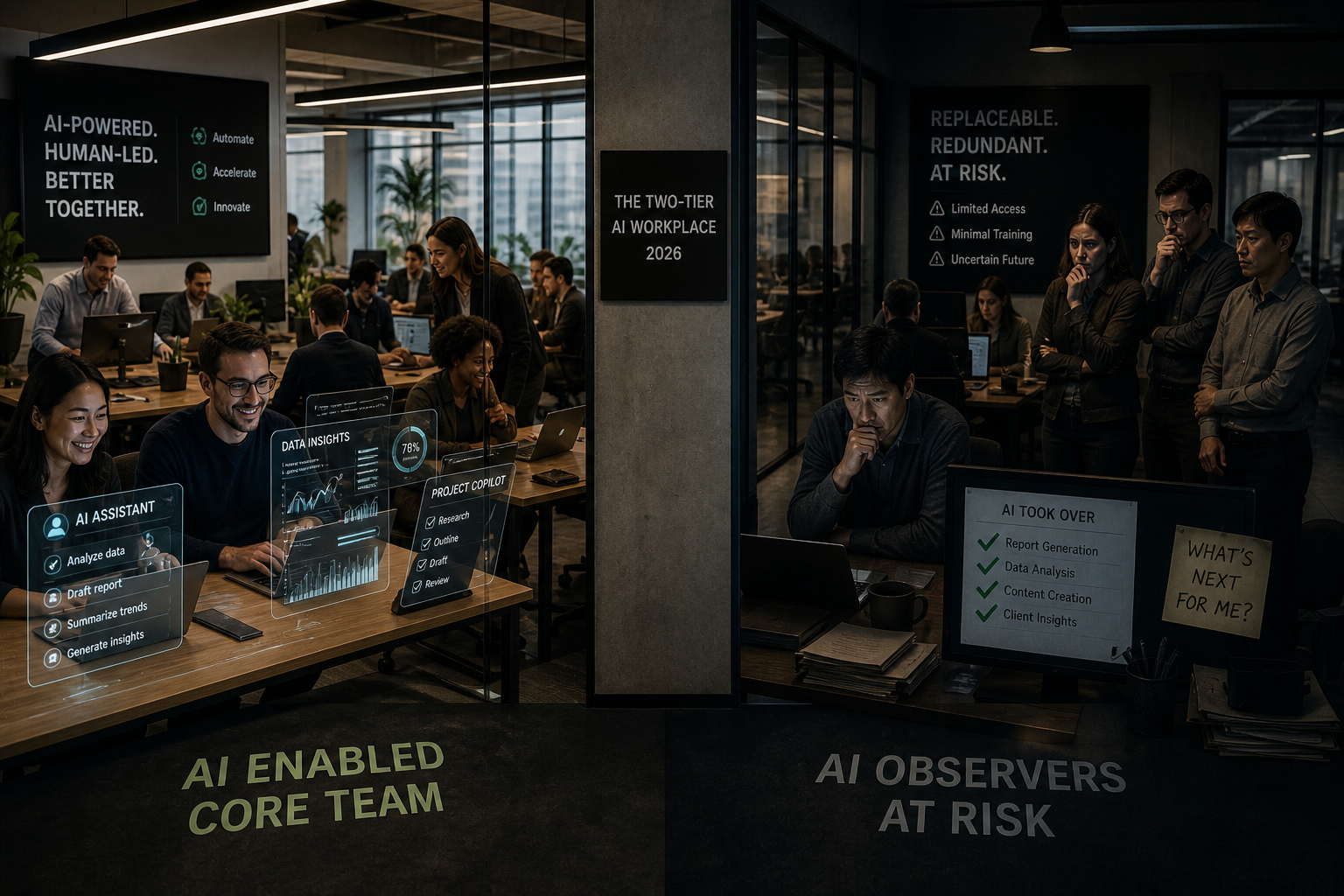
On one side of the office, there’s a group of employees — typically younger, typically in marketing, HR, sales, or customer support — who figured out AI tools early, integrated them into their workflow, and are now producing outputs that would have required a full team two years ago. They’re saving nine hours a week. They’re getting promoted at three times the rate of their colleagues. They’re becoming visibly, undeniably more productive than the people around them.
On the other side, there are employees who watched the AI wave come, didn’t know where to start, didn’t get adequate training, and are now watching their colleagues accelerate away from them in performance reviews while wondering when their own role will be eliminated. They are, according to Fortune’s recent reporting, “quietly rebelling.” A WalkMe survey found 80% of employees have at some point outright refused AI adoption mandates. Writer’s 2026 Enterprise AI Adoption Survey found 29% of employees admit to sabotaging their company’s AI strategy, rising to 44% among Gen Z — the cohort that is supposedly most AI-native.
That statistic should stop every leader in their tracks. The generation that grew up with smartphones, that adopted every consumer technology ahead of every other demographic, is the generation most likely to sabotage enterprise AI adoption. Why? Because they’re also the generation bearing the economic cost of AI most directly — watching entry-level job markets tighten, watching their early career years compete with tools that can produce professional-quality output at near-zero cost, watching their own employers publicly announce that those who won’t adopt will be laid off.
They’re not Luddites. They’re scared. And scared employees who feel their economic future is threatened do not become enthusiastic AI adopters when you tell them to.
The Data on the Divide
Writer’s survey of 1,200 C-suite executives and 1,200 employees captures the bifurcation in specific numbers that deserve attention.
AI super-users — defined as employees who have genuinely integrated AI into their core workflow, not just experimented with it — save nine hours per week on average. That’s 4.5 times more than employees who have been slower to adopt. They are 3x more likely to have received both a promotion and a raise in the past year. They are 5x more productive overall by comparable task output metrics.
This is an enormous performance gap. The kind that, once visible to management, creates irresistible incentive to double down on the top performers and manage out the rest. 92% of C-suite executives admit they are actively cultivating an “AI elite” class of employees. 60% are planning layoffs specifically targeting non-adopters. 77% say employees who refuse to become AI-proficient won’t be considered for promotions.
The consequence of those signals, communicated into organisations where only a third of employees have received adequate AI training, is predictable: heightened anxiety, reduced psychological safety, a workforce managing the appearance of AI use rather than genuinely developing AI capability, and resistance that goes underground.
Gallup’s February 2026 survey of 23,717 US employees adds contextual texture: 27% of employees in AI-adopting organisations say their workplace has changed in disruptive ways “to a large or very large extent” in the past year. That’s more than one in four people experiencing significant disruption. Only 46% of employees trust AI systems at work, despite over two-thirds using them regularly. The trust gap between frontline employees (53% trust their leaders to implement AI responsibly) and senior leaders (71%) is 18 percentage points — a gap that reflects a real difference in information, agency, and perceived stakes.
Why the Standard Corporate Response Makes This Worse
Most companies have responded to the adoption challenge with some version of the same playbook: mandatory AI training modules, AI tool licenses for all employees, targets for AI usage metrics (login rates, prompts submitted, workflows touched), and communications messaging about AI enhancing rather than replacing roles.
This playbook is producing the sabotage numbers in the Writer survey for a set of reasons that are straightforward once you understand them.
Mandatory training without workflow context is theatre. Employees sitting through two-hour video modules on how to use ChatGPT, without specific application to their actual job, build no genuine capability. They learn the tool exists. They don’t learn what it does to their work. The result is employees who can describe AI conceptually and cannot use it to produce better work. This is checked-box compliance with zero productivity impact.
Usage metrics incentivise performance over substance. When employees are evaluated on how much they use AI, they use it to produce outputs they then discard, or use it for low-stakes tasks while doing their substantive work manually. The metric shows adoption. The business outcome doesn’t move. Meanwhile, the employees who are genuinely developing AI proficiency often use it less frequently but produce dramatically better work — and the usage metric counts them as laggards.
“AI enhances, not replaces” messaging isn’t credible when layoff announcements keep happening. Amazon, Microsoft, Salesforce, and others have explicitly cited AI efficiency as a reason for workforce reductions. Employees who hear “AI will free you for higher-value work” while watching colleagues get laid off after AI deployments don’t believe the messaging. They believe the layoffs. The credibility gap between what companies say and what employees observe is one of the primary drivers of active resistance.
What Business Leaders Should Actually Do
The companies navigating this well are not the ones suppressing the divide. They’re the ones making it explicit, addressing it honestly, and building systems that pull employees toward proficiency rather than pushing them through mandatory compliance.
Make the super-user path visible and accessible, not elite. The performance gap between AI super-users and non-adopters is real and growing. Trying to hide it creates resentment when employees discover it anyway. Instead, identify your AI super-users, document specifically what they’re doing differently, and build structured pathways for other employees to develop those same capabilities. This is not standard training. It’s workflow-specific capability development: this is how a marketing coordinator in your company specifically uses AI, here are the specific workflows where it’s changing the output, here is how you build those skills in your role.
Redesign jobs before announcing AI adoption mandates. The single most important predictor of successful AI adoption is whether employees understand how AI fits into their specific workflow — not “AI in general” but “this tool, for this task, in this workflow, producing this outcome.” That understanding requires job design work before training. What tasks should AI handle? What tasks should humans handle? Where does human judgment remain essential? Companies that answer these questions clearly before rolling out tools see dramatically higher genuine adoption rates.
Address the economic anxiety directly. The WalkMe report notes that “a third of the enterprise workforce has never used AI tools at all — and they report the lowest levels of support, the least training, and the highest anxiety about disruption.” These employees are not refusing AI because they’re technophobic. They haven’t been reached. They haven’t been supported. They’ve received the communication that AI is coming and experienced nothing to suggest they’ll be helped to adapt. The companies that treat reskilling as seriously as they treat tool deployment — real investment, real time, real support — see this anxiety convert to engagement. The companies that treat reskilling as messaging see it convert to resistance.
Measure what matters. Stop measuring AI adoption by login rates and prompts submitted. Start measuring: business outcome changes in workflows where AI was deployed, employee-reported time savings on specific tasks, quality improvement in specific outputs. These are harder metrics to collect and far more useful for understanding whether your AI investment is producing business value. They also show employees that you care about the impact of their work, not the compliance with a mandate — which changes the dynamic from surveillance to support.
Be honest about what AI changes. The credibility problem with “AI enhances rather than replaces” messaging isn’t that it’s false — it’s largely accurate for experienced workers with complex judgment-intensive roles. The problem is that it’s incomplete. Entry-level work is being reduced. Some roles are being eliminated. Employees who can see this happening and hear only reassurance from leadership stop trusting leadership on AI. An honest conversation — “AI is changing what work looks like, here is specifically how it affects your role, here is what the company is doing to support your development” — is harder than reassurance. It’s also what the employees who are watching most carefully need to hear.
The Structural Implication
Here’s what the data is pointing toward if companies don’t address the divide deliberately: a workforce where a small, highly compensated AI elite produces the bulk of knowledge work output, while a larger group of employees is retained for compliance, oversight, or client-facing roles at lower wages with less advancement opportunity — not because that’s the intention, but because the divide was allowed to compound without intervention.
That outcome is bad for companies (high attrition among the employees most able to leave, poor morale among the rest, reduced organisational adaptability) and bad for people.
The companies that are building something more durable are treating the AI transition as what it is: not a technology rollout, but an organisational redesign. They’re investing in the human infrastructure — the workflow redesign, the genuine capability development, the honest communication, the job security commitments for employees who develop AI proficiency — that determines whether the technology delivers its full value or gets undermined by the resistance of a workforce that wasn’t brought along.
The data says 29% of employees are sabotaging their company’s AI strategy. The correct response to that number is not to intensify the mandate. It’s to ask why, and to address the answer.