Gemini and ChatGPT now score identically on overall intelligence benchmarks. The choice between them in 2026 is almost entirely about ecosystem. Here’s the honest breakdown of when Gemini wins, when it loses, and for whom the $19.99/month is an obvious yes.
In March 2026, something happened that would have seemed impossible eighteen months ago: Google’s Gemini 3.1 Pro and OpenAI’s GPT-5.4 scored identically — 57 points — on the Artificial Analysis Intelligence Index, the most respected overall capability benchmark for large language models. For the first time in the modern AI era, the leading model from Google and the leading model from OpenAI are genuinely tied on overall capability.
That convergence reshapes the question from “which AI is smarter?” to “which AI fits my workflow?”
For a meaningful segment of users — professionals and businesses whose daily work runs on Google Workspace — the answer is Gemini, and it’s not close. For everyone else, the decision requires more nuance. This review provides it.
Gemini has grown significantly: 1.8 billion monthly visits in early 2026, representing 200% year-over-year growth. It’s no longer a secondary option people try when ChatGPT is full — it’s a primary tool for tens of millions of professionals. Understanding why requires understanding what Gemini is actually built to do.
What Gemini Actually Is in 2026
Google built Gemini differently from its competitors. Where ChatGPT and Claude are primarily text-in, text-out systems that have added multimodal capabilities over time, Gemini was designed from the ground up to process text, images, video, and audio simultaneously as native inputs. That architectural difference shows up in specific capabilities that matter for specific users.
The current flagship model, Gemini 3.1 Pro, is Google DeepMind’s latest release (February 19, 2026). It processes up to 1 hour of video and 8 hours of audio natively — not through transcription, but through direct multimodal understanding. It has a context window of 1 million to 2 million tokens, significantly larger than ChatGPT’s 256-400K. And its web search integration draws directly from Google’s search index — the world’s most comprehensive — with results that are fresher and more reliably sourced than what Bing-powered ChatGPT browsing returns.
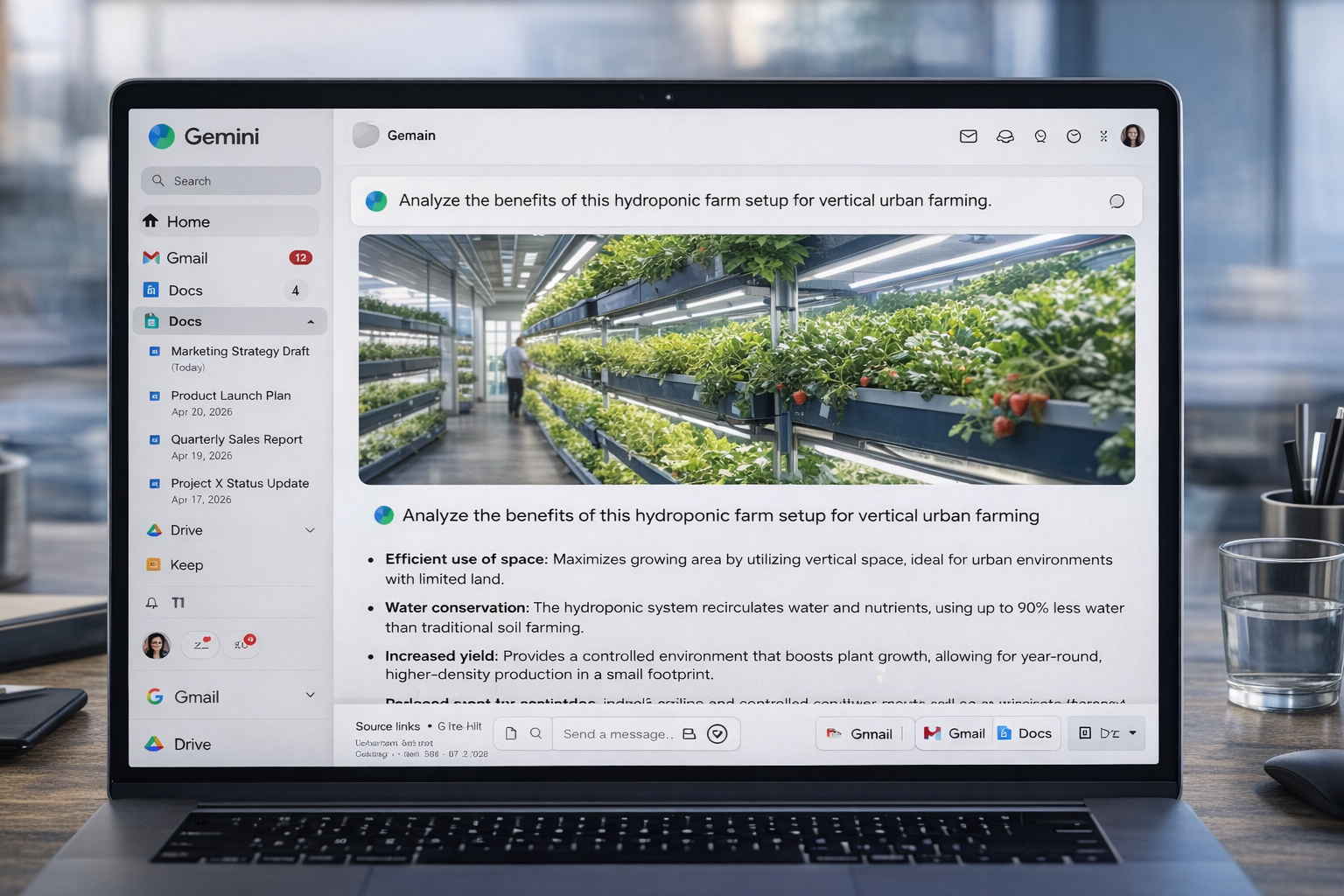
The integration with Google Workspace is the most immediately practical differentiator for professional users: Gmail, Docs, Sheets, Drive, Calendar, and Meet all connect natively. Gemini can read your email threads, pull files from Drive, summarise calendar events, and draft responses that sync back automatically. This is not a feature you access through a plugin menu — it’s built into the tools you already use.
Pricing: What Each Tier Actually Gets You
Free tier: Access to Gemini 2.5 Flash, limited access to 2.5 Pro. Suitable for casual use and light experimentation. Users report hitting limits around 50 requests per day for the Pro model, though Google officially doubled the Pro plan limit to 100 requests per day in response to user feedback.
Google AI Pro ($19.99/month): Expanded access to Gemini 3.1 Pro, higher usage limits comparable to ChatGPT Plus, Deep Research capabilities, 2TB of cloud storage, full Workspace AI integration across Gmail, Docs, Sheets, Drive, and Calendar. This is the primary paid tier and the one this review focuses on.
Google AI Ultra ($249.99/month): Google’s most powerful tier. Video generation with Veo 3, the highest capability models, maximum usage limits, YouTube Premium subscription. Priced for filmmakers, power developers, and creative professionals who need the absolute ceiling. A 50% first-time subscriber discount applies in early 2026.
Enterprise: Google Workspace customers can add Gemini capabilities through tiered add-ons. Custom pricing. For organisations already on Google Workspace Business or Enterprise, the incremental AI capability is often negotiated into existing contracts.
The price comparison: At $19.99/month, Google AI Pro is essentially identical in price to ChatGPT Plus ($20/month) and Claude Pro ($20/month). The premium tier is where Google differentiates sharply: AI Ultra at $249.99/month versus ChatGPT Pro at $200/month versus Claude Max at $100-200/month. For most users, the standard tier is the relevant comparison.
Where Gemini Wins: The Honest Assessment
Multimodal capabilities — clear winner over ChatGPT.
This is Gemini’s most decisive competitive advantage. Gemini 3.1 Pro processes video and audio that ChatGPT simply cannot handle. You can upload a video file or paste a YouTube link and the model will analyse content frame by frame with full audio transcription. You can hand it an hour of meeting footage and ask for a structured summary with action items and key decisions.
ChatGPT has computer use (75% on OSWorld, slightly above human baseline), which Gemini matches but approaches differently. But ChatGPT cannot process video files. For anyone whose work involves video — content creators, L&D professionals, market researchers, journalists — this is decisive.
Google Workspace integration — transformative if you live there.
If your professional life runs on Gmail, Docs, Sheets, and Drive, Gemini’s workspace integration is a genuine productivity multiplier. In March 2026, Google rolled out substantial improvements to cross-Workspace AI. The practical effect: Gemini can read your email threads, identify the most important follow-ups, draft responses, pull relevant documents from Drive, and summarise what happened in last week’s meeting — all without you leaving the tools you’re already in.
For a non-Google environment — Notion, Slack, Microsoft 365, mixed-tool teams — this advantage evaporates. ChatGPT’s broader connector ecosystem becomes more relevant there.
Context window — significant advantage for long documents.
Gemini 3.1 Pro’s 1-2 million token context window dwarfs ChatGPT’s 256-400K. For processing entire book manuscripts, lengthy codebases, or extensive research corpora in a single conversation, Gemini’s ceiling is meaningfully higher. Testing a 200-page research report — asking Gemini to identify methodological inconsistencies — produced reliable results where ChatGPT struggled to maintain coherence at the document’s later sections.
Real-time information — native Google Search advantage.
Gemini’s web search integration draws from Google’s index directly. For tasks requiring current information, Gemini’s results tend to be fresher and better-sourced than ChatGPT’s Bing-powered browsing. On specific research queries with rapidly changing facts — regulatory changes, recent funding rounds, current pricing — Gemini’s search quality is noticeably better.
Speed — faster for most everyday tasks.
In practical testing, Gemini 3.1 Pro returns responses faster than GPT-5.4 for most routine queries. ChatGPT’s extended thinking modes (o1, o3) are deliberately slower for complex reasoning. For quick-turnaround daily tasks, Gemini’s speed is a real quality-of-life advantage.
Where Gemini Loses: The Honest Assessment
Coding — ChatGPT and Claude lead.
On SWE-bench Verified, GPT-5.4 scores approximately 71.7% and Gemini 3.1 Pro trails at approximately 63.8%. That’s nearly an eight-percentage-point gap on real-world software engineering tasks. For developers choosing between Gemini and ChatGPT as a coding assistant, the benchmark data strongly favours ChatGPT — and Claude leads both for complex, multi-file coding work.
Creative writing — ChatGPT produces more engaging outputs.
In head-to-head testing on creative writing tasks — marketing copy, narrative content, engaging prose — ChatGPT consistently produces more compelling results. Gemini tends toward structured and professional; ChatGPT tends toward natural and engaging. For content creators and marketers, this distinction matters.
Conversational quality — slightly less natural.
The interface, while functional, is generally rated as less intuitive and less polished than ChatGPT. ChatGPT’s training optimises explicitly for human-like dialogue; Gemini’s optimises for factual accuracy and task completion. For casual conversation and brainstorming, ChatGPT feels more engaging.
Usage limits on the free tier — more restrictive than marketed.
Users consistently report hitting the free-tier limits faster than expected. The jump from free to Pro at $19.99/month is the most significant friction point for casual users who don’t need the full feature set.
Hallucinations — still present, more on factual claims than ChatGPT.
Gemini hallucinates less on time-sensitive queries thanks to its Google Search integration. It hallucinates more on timeless conceptual questions where it’s drawing on training rather than live search. For high-stakes information work, verification remains essential regardless of which tool you’re using.
The Benchmark Reality: What Parity Actually Means
The headline finding — Gemini 3.1 Pro and GPT-5.4 scoring 57 on the Intelligence Index — is real and significant. It represents the first time the two platforms have been genuinely tied on overall capability.
But that overall score hides important variance. GPT-5.4 leads on coding (71.7% vs 63.8% on SWE-bench Verified). Gemini 3.1 Pro leads on some reasoning benchmarks (ARC-AGI-2: 77.1% vs 73.3% for GPT). On MATH-500, both score in the 97% range — essentially saturated. On MMLU-Pro (broad knowledge), the gap is minimal.
The practical interpretation: both models are genuinely excellent across most tasks. The category-level differences — Gemini on multimodal and search, ChatGPT on coding and creative writing — are where the decision lives.
The Verdict: A Clear Recommendation
Google AI Pro at $19.99/month is an obvious yes if: Your daily work runs substantially in Gmail, Google Docs, Google Sheets, or Google Drive. You regularly need to analyse video or audio content. You frequently need real-time, current information with reliable sourcing. You’re a researcher or analyst who processes large documents. You find ChatGPT’s interface works for you but want deeper integration with your existing tools.
Google AI Pro at $19.99/month is not the right choice if: You don’t use Google Workspace as your primary productivity stack. Your primary use case is coding. You need the strongest creative writing output. You’re a developer who values the ecosystem of tools built around OpenAI’s API.
The most common professional pattern in 2026: Using Gemini for research, multimodal analysis, and Google Workspace tasks — and ChatGPT (or Claude) for coding, content creation, and automation. The two tools are priced identically and serve genuinely different workflows. Many professionals are running both.
The question isn’t which AI is better. It’s which ecosystem you already live in — and which gaps in your current workflow you most need to close.