
Enterprise AI budgets are growing 65% in 2026. Nearly half of executives call their AI adoption “a massive disappointment.” The money is increasing. The results are not. Here’s the honest framework for building an AI strategy that delivers — based on what the 29% who are seeing real ROI are actually doing.
Two numbers sit next to each other in the 2026 enterprise AI data and demand explanation.
The first: average enterprise AI spend is projected to jump 65% this year, from approximately $7 million to $11.6 million. That’s a meaningful budget increase — real money, real decisions, real executive commitment.
The second: only 29% of executives see significant ROI from their generative AI investments. 48% describe AI adoption as “a massive disappointment” — up from 34% last year. Three-quarters of executives admit their company’s AI strategy is “more for show” than actual internal guidance.
Those two numbers are not in tension. They explain each other. The budgets are growing precisely because boards and CEOs understand AI’s strategic importance. The disappointment is growing at the same pace because the strategy for allocating those budgets — the governance, the use case selection, the measurement framework, the change management — hasn’t kept up with the investment.
Deloitte’s 2026 State of AI in the Enterprise report frames this clearly: organisations are “at the untapped edge of AI’s true potential.” The technology is ready. The deployment approach is not.
This piece is a framework for closing that gap — specifically for business leaders who have real AI budgets to allocate and real accountability for what those budgets produce.
The Strategic Architecture That AI Front-Runners Have Built
The companies seeing genuine ROI from AI investments share a structural characteristic that most businesses haven’t replicated: they have moved from what PwC calls “ground-up” to “top-down” AI strategy.
Ground-up AI: individual teams launch isolated AI projects based on their specific enthusiasms and priorities. There is no coordination across initiatives. Resources are duplicated. Learnings don’t transfer. Governance is inconsistent. The result, as PwC notes, is “projects that may not match enterprise priorities, are rarely executed with precision, and almost never lead to transformation.”
This is the dominant mode of AI adoption in most large organisations right now. McKinsey found that less than 30% of companies have their CEO directly sponsoring the AI agenda — which means 70% are running AI primarily as departmental initiatives without coordination from the top.
Top-down AI: senior leadership makes deliberate decisions about which specific workflows and business processes to prioritise for AI investment. They commit the full “enterprise muscle” — not just budget, but talent, technical resources, change management, and executive time. They run all AI initiatives through a centralised function (often called an “AI studio” or “Centre of Excellence”) that builds reusable components, consistent governance, and shared learnings.
The difference in outcomes is substantial. Deloitte’s data shows that “enterprises where senior leadership actively shapes AI governance achieve significantly greater business value than those delegating the work to technical teams alone.”
The practical implication for your 2026 AI budget: before allocating it across departments and use cases, answer the question at the executive level: “Which two or three workflows or business processes, if transformed by AI, would produce the largest impact on our strategic priorities?” Those answers should drive the concentration of budget. Not “how much does HR get” and “how much does marketing get” but “what are the highest-value workflows in the company and what do they require?”
The Use Case Selection Framework: Where to Point the Money
Not all AI use cases are created equal. The companies wasting their AI budgets are those treating every department’s wish list as equivalent. The companies generating ROI are using a selection framework that prioritises based on impact, feasibility, and strategic alignment.
The Deloitte categorisation of agentic AI value is useful here:
High-volume transactional workflows (customer service, data entry, claims processing): these produce the fastest, most measurable ROI because the baseline is clear, the task is well-defined, and the volume is high enough to produce significant cost savings quickly. These are where to start.
Knowledge work (research, analysis, content creation): ROI takes the form of productivity and quality improvement rather than direct cost saving. Harder to measure, but often larger in aggregate because it affects your highest-cost employees. These are where to expand once transactional workflows are running.
Complex decision support (fraud detection, risk assessment, supply chain optimisation): highest potential return, highest complexity, longest timeline to ROI. These are where to invest once organisational AI maturity is established.
For most organisations in 2026, the right answer is: concentrate budget on Category 1 to prove ROI, develop capability in Category 2, begin research on Category 3. Organisations that jump directly to Category 3 before establishing Category 1 capability are the ones producing the expensive failures documented in failure rate statistics.
The selection criteria within each category:
Volume and repetition. How many instances of this workflow happen per day/week/month? The economic case for AI is most compelling at high volume.
Current cost. What does this workflow cost in human time? Calculate at loaded cost per hour. The higher the current cost, the larger the potential ROI.
Data readiness. Does your organisation have clean, accessible, sufficient data to support this use case? (If not, data readiness investment is a prerequisite, not an obstacle.)
Integration complexity. How many systems does this workflow touch, and how accessible are they via API? The more systems, the more complex the integration — but also the higher the value from coordination, because manual hand-offs between systems are where time and errors accumulate.
Strategic alignment. Does improving this workflow directly affect the metrics that senior leadership is accountable for? If not, the ROI will be real but invisible to the people who control budget.
Building the Governance Framework Before Scaling
The single biggest differentiator between the 29% seeing significant ROI and the 48% calling their AI adoption a disappointment is governance — specifically, whether governance was built before scaling or tried to be retrofitted after problems emerged.
PwC’s research on responsible AI is revealing here: 60% of executives say that responsible AI boosts ROI and efficiency, and 55% report improved customer experience and innovation as results. But nearly half also said turning responsible AI principles into operational processes has been a challenge. “Agentic workflows are spreading faster than governance models can address their unique needs.”
The governance framework that works isn’t complicated. It has four components.
Use case review. Before any AI project is approved, it passes through a structured review that covers: What is the specific business outcome? What data does it require and is that data AI-ready? What are the risk factors (bias, accuracy, error consequences, compliance obligations)? Who is accountable for the outcome? What are the success metrics and measurement methodology?
Monitoring architecture. Every AI deployment in production requires continuous monitoring of: output accuracy (are the AI’s outputs correct?), model drift (is accuracy changing over time?), usage patterns (are outputs being used as intended, or are there unexpected use patterns?), and business outcome metrics (are the business metrics the AI was supposed to affect actually moving?).
Incident response. Before any AI system goes live, define what happens when it makes consequential errors. Who is notified? What is the escalation path? What is the rollback procedure? AI systems make novel error patterns that differ from the errors humans make. Without a defined incident response, organisations discover this at the worst possible moment.
Human oversight policy. For every AI deployment, explicitly define: where humans remain in the decision-making loop (human-in-the-loop), where humans set parameters and review exceptions (human-on-the-loop), and where AI acts fully autonomously with periodic human audit. The policy should match the stakes of the decision — irreversible, high-consequence decisions require more human oversight, not less.
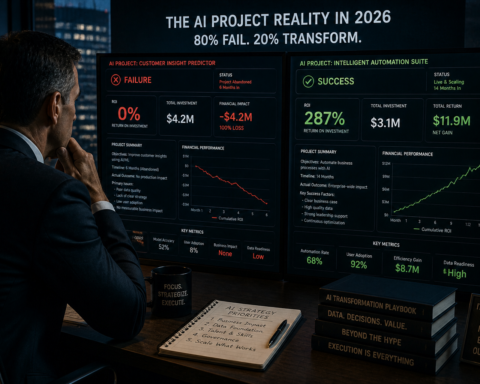
The organisations that build this governance infrastructure before scaling AI deployments are the ones that avoid the specific failure modes that produce the 80% failure statistics. It takes time. It requires process investment that doesn’t show up in productivity metrics. It is, consistently, what separates the organisations generating 383% ROI from those generating 0%.
The Talent and Capability Investment Most Budgets Underfund
The AI skills gap is seen as the biggest barrier to enterprise AI integration, according to Deloitte. PwC’s research shows the 20/80 rule: technology delivers about 20% of an initiative’s value; the other 80% comes from redesigning work. Yet most AI budgets allocate 90%+ to technology and 10% or less to the capability development required to capture that 80%.
The capability investment required to capture full AI value is not primarily technical skills — it’s what PwC calls “change fitness.” The capacity of the organisation to:
Identify which workflows should be redesigned around AI capabilities (requires business acumen and process knowledge, not machine learning expertise).
Design human-AI collaboration models that capture both AI’s consistency and human judgment (requires organisational design skill).
Train employees in genuine AI proficiency specific to their workflows (requires pedagogical skill and workflow knowledge, not generic AI training content).
Measure AI initiative outcomes and adapt based on results (requires analytical skill and accountability infrastructure).
None of these capabilities are built by purchasing more AI licenses or running more mandatory training modules. They’re built by treating AI transformation as what Harvard Business School faculty describe it as: “a platform that sits at the center of workflows, decisions, and customer journeys” that “quietly sets the defaults” for how work happens.
The practical budget implication: allocate a minimum of 25% of your AI investment to the human capability and change management work. This is not a “nice to have” line item. It is the investment that determines whether the other 75% produces the 80% of value that technology alone cannot deliver.
The Measurement System That Makes ROI Visible
The final piece of the strategy is the measurement framework that creates accountability for AI investment outcomes. Without this, AI investment is faith-based — you believe it’s working because the demos were impressive and the usage metrics look good.
The measurement system that produces real accountability has three layers.
Activity metrics (necessary but insufficient): What is the AI doing? Tasks completed, time taken, error rate on specific task types. These measure whether the AI is working technically. They do not measure whether the business is improving.
Outcome metrics (where accountability lives): What happened to the business metrics the AI was supposed to affect? Customer service resolution time, cost per resolved ticket, qualified lead conversion rate, time from invoice receipt to payment approval. These are the metrics that justify budget. They require baselines established before deployment.
Strategic impact metrics (the long-term story): What happened to the strategic KPIs the organisation was prioritising — revenue growth, customer retention, operational margin, employee productivity? These take longer to appear and require attribution methodology to connect to specific AI initiatives. They are worth the effort because they are the metrics boards and investors care about.
The organisations that set up all three layers before AI deployment can produce the clear, board-ready ROI narrative that justifies continued investment. The organisations that measure only activity metrics find themselves unable to answer the question that every AI budget approval ultimately requires: “What did we get for our money?”
The 29% generating significant ROI from AI in 2026 are not primarily the organisations with the biggest budgets, the most advanced models, or the most technically sophisticated teams. They are the organisations that defined what success looks like before deployment, built governance before scaling, invested in capability alongside technology, and measured outcomes against the business metrics that matter.
That approach is available to every organisation with a meaningful AI budget and the discipline to use it well.