The legal profession has gone from 31% AI adoption to 69% in a single year. A firm automated contract review at 92% accuracy and moved to fixed-fee billing. Courts have also sanctioned a lawyer $109,700 for AI-generated errors. Both stories are true and both matter. Here’s what’s actually happening in legal AI in 2026.
There are two ways to write about AI in law in 2026, and most coverage picks one and ignores the other.
The first way: quote the extraordinary numbers. More than 90% of surveyed lawyers now use at least one AI tool in their daily work. Individual AI adoption among lawyers more than doubled from 2025 to 2026, going from 31% to 69% according to the 8am Legal Industry Report of 1,300 professionals. A midsize firm slashed contract review times by 60%. Wilson Sonsini built a proprietary AI system achieving 92% accuracy in contract review, moved away from the billable hour for commercial contracting, and is using AI as a client-facing revenue driver. Law firms are reporting weekly time savings of 6-20%, averaging nearly 10% of the workweek, freed for strategic work.
The second way: quote the consequences. A federal court in Oregon ordered a lawyer to pay $109,700 in sanctions for filing AI-generated errors. The rate of AI hallucination cases in legal filings has accelerated to four or five new documented cases per day. By December 2025, courts had documented 660 cases of lawyers submitting AI-hallucinated citations — up from 120 total cases in the prior two years. The Nebraska Supreme Court suspended an attorney. The Georgia Supreme Court heard an awkward explanation. OpenAI was sued for allegedly providing bad legal advice to someone who then filed frivolous suits.
Both of those paragraphs are accurate. Both represent something real about what AI means for the legal profession in 2026. Reporting only one of them — which most coverage does — produces a picture that’s wrong in the direction it’s incomplete.
This article covers both.
What Lawyers Are Actually Using AI For Right Now
The 2026 Wolters Kluwer Future Ready Lawyer Survey, covering 810 legal professionals across the US, China, and eight European countries, documents the specific tasks where AI is most deployed. The list is not dominated by headline-grabbing autonomous legal work. It’s dominated by tasks that are high-volume, repetitive, and time-consuming:
Legal research. Platforms like CoCounsel by Casetext and Lexis+ AI search case law, statutes, and regulations in seconds with natural language queries. An attorney preparing for a case can identify precedent-setting rulings in minutes that previously took days of manual database searching. The research platforms are careful about source attribution — citations come with links to verified sources, which is what distinguishes them from general-purpose AI tools that can hallucinate cases that don’t exist.
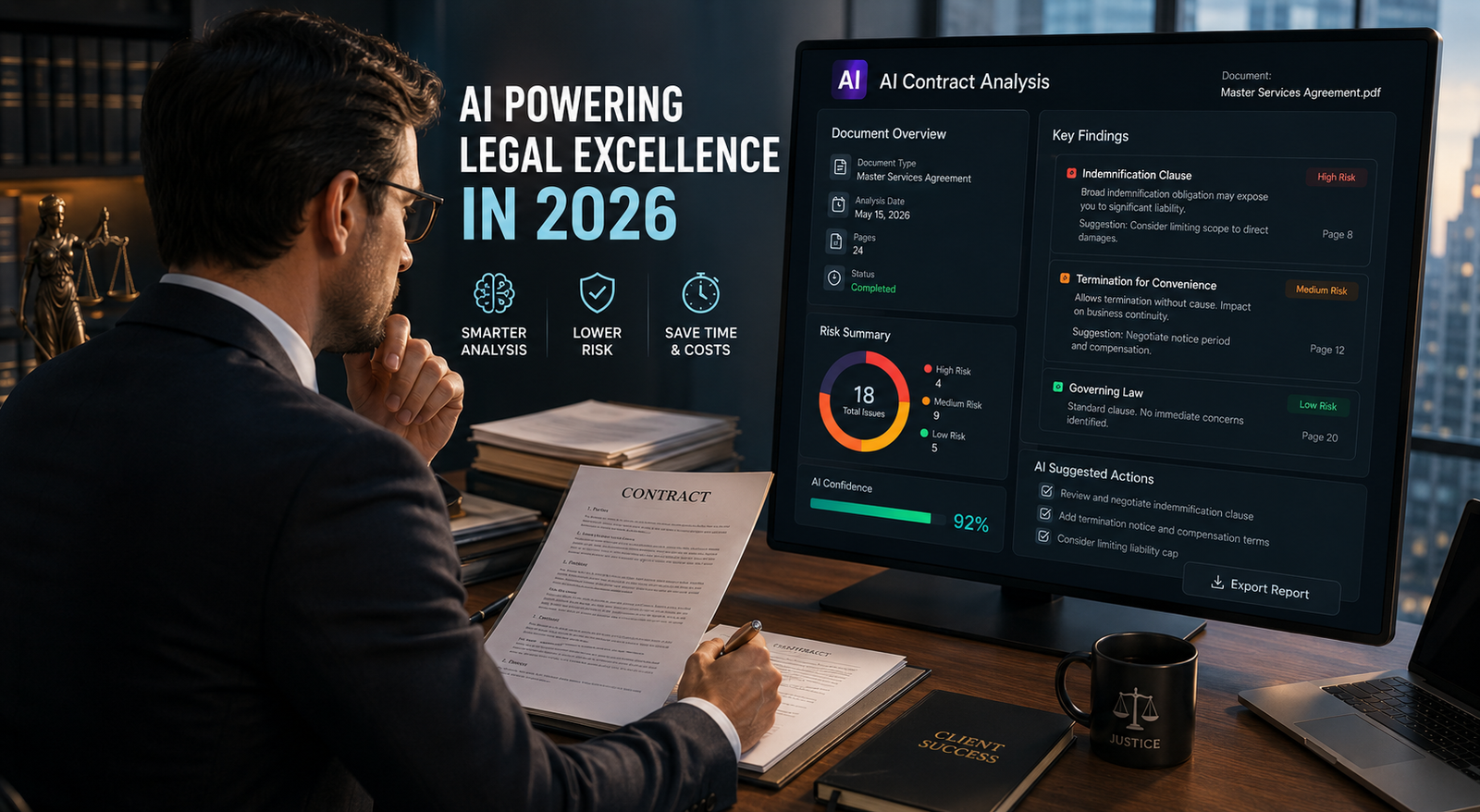
Contract review and analysis. AI tools can review and analyse contracts in minutes rather than hours, flagging missing clauses, identifying inconsistencies, and surfacing risk factors. Spellbook, which integrates directly with Microsoft Word, lets lawyers do this without switching tools. Kira Systems analyses large volumes of contracts simultaneously. A law firm can use AI to flag missing force majeure clauses across hundreds of vendor agreements in the time it would previously take to review five.
Document drafting and revision. AI generates first drafts, redlines documents, and reformats contract language for different jurisdictions. The key distinction here is “first draft” — experienced lawyers treat AI output as a starting point, not a finished product. The quality of AI drafting has improved dramatically, but the judgment about whether a clause is appropriate for a specific client’s risk profile remains human.
Internal knowledge management. Firms are using AI to build searchable systems across their precedent libraries, past deal documents, and internal research. Questions that previously required tracking down the right partner who remembered a specific deal can now be answered in seconds by an AI that’s indexed the entire document library.
Administrative and operational tasks. Microsoft Copilot integrated into Word, Outlook, Teams, and SharePoint is helping legal professionals automate document summarisation, draft communications, and handle routine compliance checks within the firm’s existing infrastructure.
The Case Studies Worth Understanding
Wilson Sonsini’s Neuron platform is the most interesting model in the industry right now. The firm partnered with Dioptra to launch a proprietary technology platform that embedded 60+ years of Wilson Sonsini’s legal expertise into custom agentic workflows. The result: 92% accuracy in contract review. More importantly, the firm used this capability to move away from the billable hour for commercial contracting, offering fixed-fee services instead.
This is AI as a genuine business model transformation, not just an efficiency tool. The billable hour model — where law firms are economically incentivised to spend more time on tasks — is structurally incompatible with AI that dramatically reduces time-per-task. Wilson Sonsini’s response is to capture the value of AI efficiency rather than fight it: lower prices, faster turnaround, fixed fees, and higher volume through what the firm describes as “legal product as a service.”
Not every firm can or should replicate this exactly. But it demonstrates that the most sophisticated legal AI deployments are rethinking revenue models, not just workflow efficiency.
Latham & Watkins’ Academy model represents how to build AI capability systematically across a large organisation. Rather than leaving AI adoption to individual attorney discretion, Latham invested in a structured training programme where a litigator learns AI tools specifically for deposition prep, a corporate lawyer learns AI specifically for cap table analysis, and so on — preventing the generic “one-size-fits-all IT seminar” that produces checkbox compliance rather than genuine proficiency.
Alturas Capital Partners illustrates the in-house team story. Their legal team uses AI to draft and revise transaction documents, customise lease and investment clauses, and finalise redlines during active negotiations — keeping complex drafting in-house that previously went to outside counsel. Commercial lease negotiations shortened from weeks to days. Outside counsel spend reduced by hundreds of thousands of dollars.
Solo practitioners benefit differently. The case of a lawyer at Cunningham Legal is representative: AI enables handling more clients by accelerating contract drafting, with AI-powered risk identification catching potential issues during initial review that might otherwise surface later as costly disputes or malpractice risks. For a solo practitioner, the ability to take on more time-sensitive contract matters without hiring additional staff or extending turnaround times is a genuine business transformation.
The Hallucination Problem: What the Numbers Actually Mean
The 660 documented court cases of AI hallucinated citations by December 2025, accelerating to four or five new cases per day in 2026, are not primarily a story about AI’s limitations. They’re a story about lawyers who submitted AI outputs without verification.
The cases consistently follow the same pattern: a lawyer uses a general-purpose AI tool — often ChatGPT, sometimes Claude — to assist with legal research. The tool generates citations. The lawyer doesn’t verify them against actual legal databases. The citations don’t exist, or exist in a different form than stated. A judge notices. Sanctions follow.
The $109,700 Oregon sanction is the most extreme outcome. The Nebraska Supreme Court suspension, the Georgia Supreme Court hearing, and dozens of smaller financial penalties represent a pattern that has not slowed despite widespread coverage.
Why does it keep happening? A university law librarian’s comment from NPR’s coverage captures it: “I am surprised that people are still doing this when it’s been in the news.” The honest answer is probably a combination of time pressure, inadequate training, and a failure to appreciate the difference between a tool that sounds authoritative and one that is reliable.
The solution is not complicated. Legal-specific AI tools with source-verified citations — CoCounsel, Lexis+ AI, Harvey — are designed specifically to prevent this problem by grounding every output in actual verified sources. The lawyers generating hallucination scandals are typically using general-purpose chatbots for legal research rather than purpose-built legal research platforms.
This is a workflow and training problem, not an AI capability problem. The capability exists to do legal research accurately. Using the wrong tool and skipping verification steps is the failure mode.
The Bigger Picture: What AI Means for Legal Careers
One data point that usually gets left out of the AI-and-law discussion: MIT research found a 6.4% increase in legal employment over the relevant period, despite AI adoption accelerating. This is not the pattern most people expect.
The explanation, offered by multiple industry observers, is that AI is expanding what law firms can do, not replacing the people doing it. A firm that can review 10x more contracts with the same team can take on more work. An attorney who can research a case in hours instead of days can handle more clients. AI efficiency is turning into revenue growth, not headcount reduction — at least for now.
What is changing: the skills mix. Law firms are placing a premium on technical fluency. Paralegals and junior associates who can effectively use AI tools are becoming more valuable than those who can’t. Partners at senior levels are adopting AI for strategic synthesis and argument testing rather than document generation. The profession is differentiating within itself — as one legal educator put it, “lawyers who understand how to effectively and ethically use generative AI replace lawyers who don’t.”
The “80/20 reversal” that legal futurists describe: lawyers spending 80% of their time on strategic advisory work rather than document review, rather than the reverse — is beginning to happen in the firms that have invested seriously in AI. The firms that haven’t started yet are accumulating a competitive disadvantage that compounds.