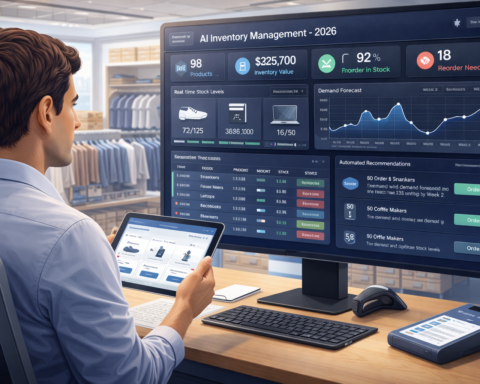
A US auto distributor had $47 million sitting in excess inventory. They switched from quarterly Excel forecasting to a weekly ML model. The inventory came down. That’s the supply chain AI story in a specific example — not a trend piece, not a prediction, but a before-and-after with a number attached. Here’s the full picture across manufacturing, logistics, and procurement.
The global AI-in-supply-chain market grew from $6.5 billion in 2022 to nearly $20 billion in 2026. But that number, like most market size statistics, tells you more about investment appetite than about outcomes. The question that CFOs and operations leaders are now asking — the question that supply chain AI vendors are being required to answer — is not how large the market is. It’s whether the investment is showing up in the P&L.
The answer is increasingly yes, in specific documented ways, for organisations that deployed correctly. And increasingly uncomfortable for organisations that invested broadly without defining what success looked like before they started.
This article is about the former group — the specific, named, documented cases where AI produced measurable supply chain outcomes in 2026. And the honest context around what went right and what still goes wrong.
Demand Forecasting: Where the ROI Is Clearest and Largest
If you want to make a supply chain AI investment that your CFO will sign off on, demand forecasting is where the evidence is most robust and the numbers are most defensible.
The mechanism is straightforward. Traditional forecasting relies on historical sales data, adjusted for known seasonality and promotional plans. It runs on batch cycles — weekly or monthly — and uses relatively simple statistical models. It’s structurally unable to incorporate the kind of real-time signals that actually drive demand: social media trends, competitive price changes, weather events, economic shifts, regional events, and supply disruptions.
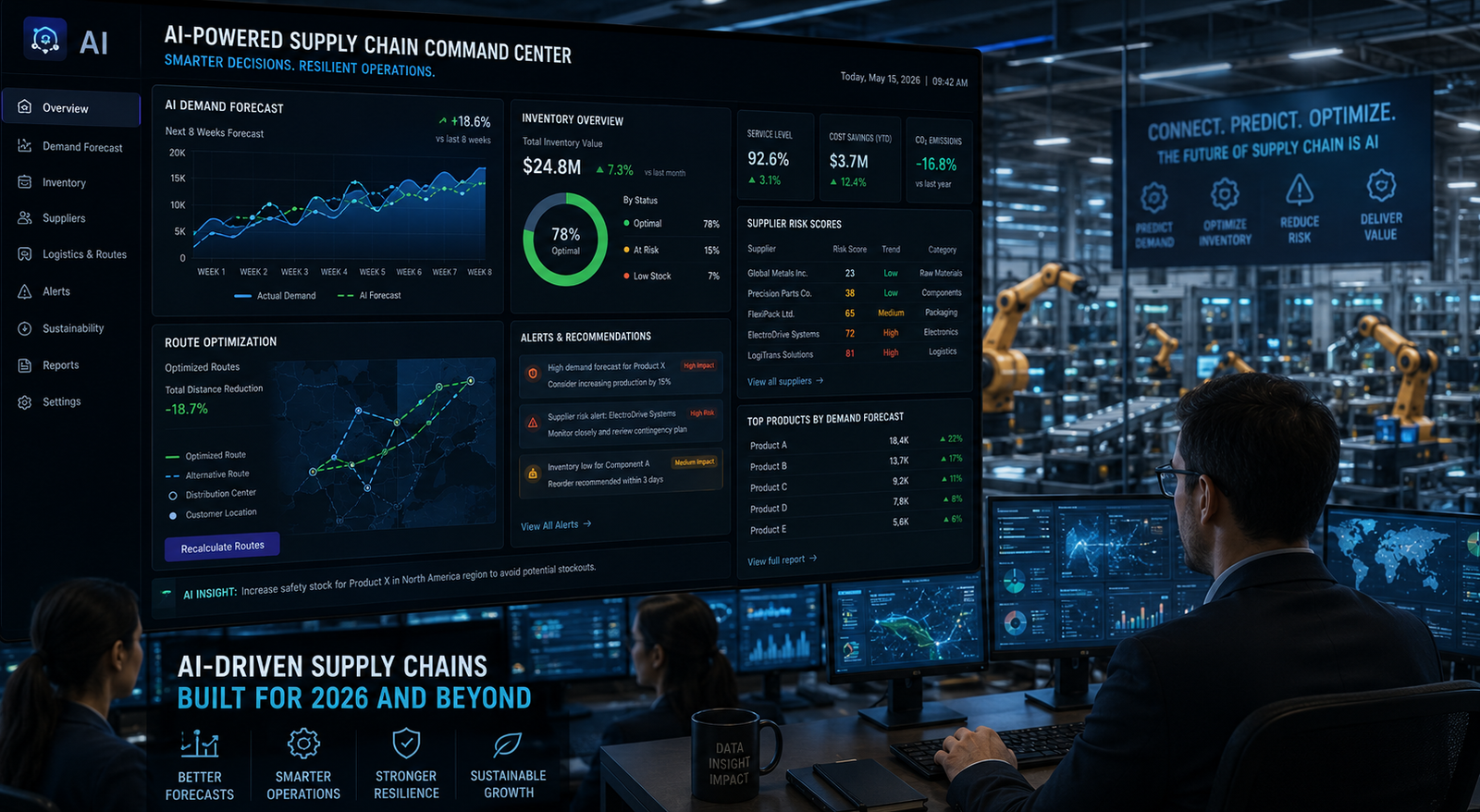
AI demand forecasting models incorporate all of these. They run continuously, recalibrate predictions as new data arrives, and model demand at a granular level — by SKU, by region, by channel — rather than as aggregate averages.
McKinsey’s documented outcome across multiple supply chain AI implementations: 20-50% improvement in demand forecast accuracy. The practical implication of that improvement is enormous, because forecast error is directly linked to the two most expensive supply chain problems: stockouts (you don’t have what customers want) and excess inventory (you have too much of what they don’t).
The auto distributor example is worth examining in detail. The company was running quarterly Excel-based forecasting — a reasonable approach that most mid-market manufacturers still use. The problem: quarterly forecasting with manual inputs has structural error rates that produce predictable excess inventory. Switching to a weekly ML model with real-time data inputs allowed the system to catch demand shifts in near real-time rather than a quarter too late. The excess inventory reduction of $47 million represents working capital that was sitting in warehouses unnecessarily.
AI demand forecasting models built on AWS SageMaker have documented 230-380% ROI with payback in 10-14 months across the implementations analysed. The mechanism: fewer stockouts, less excess inventory, better procurement timing.
Predictive Maintenance: Turning “When It Breaks” Into “Before It Breaks”
The economics of predictive maintenance AI are compelling enough that even conservative manufacturers are deploying it.
The traditional model: maintain equipment on fixed schedules regardless of actual condition, or respond to breakdowns when they occur. The cost of the latter is not just the repair — it’s the production downtime, the expedited delivery costs for urgent orders, and the customer relationship damage when delivery commitments can’t be met.
Predictive maintenance AI works by ingesting sensor data from equipment — vibration patterns, temperature readings, pressure levels, operational hours — and learning what the data looks like before a failure. Machine learning models identify failure signatures weeks before they manifest as breakdowns. The maintenance intervention is triggered not by a calendar, but by the sensor data pattern.
A US auto parts manufacturer avoided 300+ hours of downtime in a year by implementing predictive maintenance using Dynamics 365 and Azure IoT integration. For a manufacturing facility, 300 hours of avoided downtime at typical production rates represents millions in preserved revenue.
Siemens has documented significant reductions in unexpected failures and maintenance costs at industrial scale. Shell’s oil and gas operations report improved operational efficiency. General Electric’s jet engine monitoring system predicts maintenance needs before issues arise — with direct safety and reliability implications in aviation.
For a 500,000 square foot US facility spending $180,000 per month on energy, a 15% AI-driven energy consumption reduction saves $27,000 every month — $324,000 annually from a single model. The energy efficiency gains from AI-powered building and equipment management are a secondary benefit of the same sensor infrastructure that enables predictive maintenance.
One manufacturing plant’s production schedule optimisation result: approximately $275,000 in annual savings from automating maintenance planning as part of a broader scheduling overhaul, with ML models preventing roughly 42% of production line faults when integrated into scheduling.
Generative AI in Product Design: Airbus and the 45% Weight Reduction
This is the use case that tends to surprise people who haven’t followed manufacturing AI closely, because it goes well beyond process optimisation into the product itself.
Airbus used generative AI to design aircraft components. The AI was given the performance specifications — load requirements, safety margins, material constraints — and generated hundreds of alternative structural designs based on predefined criteria. It found designs that met all the strength and safety requirements while using substantially less material.
The results: 45% lighter components while meeting all strength requirements. Design cycles dropped from 18 months to 4 months. Material costs fell by up to 25%.
For context on why this matters: in aviation, weight directly affects fuel consumption and range. A 45% weight reduction in structural components is not an incremental improvement — it represents the kind of capability leap that was previously only achievable through years of expert engineering iteration. The time compression from 18 months to 4 months changes competitive dynamics in product development.
The ROI on design AI more broadly: 40-60% reduction in design cycle time with 15-25% faster time-to-market. For manufacturers dealing with rising material costs in 2026, the 15-25% material cost reduction from AI-optimised designs represents margin recovery that can be significant at scale.
Generative AI for materials discovery — processing vast amounts of data on material properties and iterating combinations to propose new materials with desired properties — is an emerging adjacent use case. For manufacturers depending on specific material supply chains, the ability to design around alternative materials with equivalent performance is both a supply chain resilience strategy and a potential cost lever.
Logistics and Route Optimisation: Where Speed and Cost Meet
DHL has deployed AI-powered logistics agents that monitor global shipments in real-time, identify disruptions, and autonomously suggest alternative routes to maintain delivery continuity. The scale of this deployment — across DHL’s global network of millions of shipments — is the kind of operational scope where even marginal improvements in route efficiency translate to enormous cost reductions.
Route optimisation AI processes traffic patterns, package information, delivery locations, weather conditions, and service commitments simultaneously, recalculating routes in real time as conditions shift. The result isn’t just shorter routes — it’s optimised load planning, smarter consolidation decisions, and delivery sequences that minimise cost while meeting time commitments.
A national retail chain using AI logistics cut delivery times by 18% and saved over $200,000 annually in fuel and labour costs. One of the largest US logistics companies is using a proprietary AI platform to optimise picking routes within its warehouses, boosting workforce productivity by about 30% while slashing operational costs.
Amazon’s Packaging Decision Engine evaluates millions of items daily to suggest the most suitable packaging, eliminating over 2 million tons of packaging materials globally since 2015 — an outcome with both cost and sustainability dimensions.
The disruption response speed is equally significant. Global supply chains are operating under elevated disruption risk: Everstream Analytics rates geopolitical fragmentation at a 97% threat level for 2026, extreme weather risk at 93%. A supply chain that can detect a disruption — a port closure, a supplier failure, a carrier delay — and automatically identify alternative routing within minutes rather than hours has a structural resilience advantage.
A Fortune 500 manufacturer that deployed AI supplier monitoring reported: 100% visibility into supplier commitments, 3 weeks’ advance warning of supplier disruptions, and a 30% reduction in supply-driven stockouts. That advance warning changes the response from crisis management to planned mitigation.
The Companies Doing This at Scale in 2026
BMW developed SORDI.ai with Monkeyway to optimise industrial planning and supply chains with generative AI — scanning assets, creating 3D digital twins using Vertex AI, and running thousands of simulations to optimise distribution efficiency.
Toyota Motor North America is implementing Amazon SageMaker to unify and govern data across connected car, sales, manufacturing, and supply chain units. Their stated goal: pre-empt quality issues and enable generative AI applications across the enterprise.
Nestlé’s NesGPT is a proprietary LLM deployed across sales, marketing, legal, and product innovation teams, specifically including supply chain optimisation — identifying potential stockouts and optimising pricing strategies.
Uniper automated material and service needs using Celonis and Microsoft, with Copilot in Teams and Power Automate orchestrating approvals, SAP actions, and replacing manual component planning with proactive agentic workflows.
Microsoft’s own supply chain is targeting 100 AI agents in production by end of 2026, with the company reporting that AI in logistics is already saving their teams hundreds of hours each month.
The Honest Assessment: What Still Fails
The supply chain AI failure pattern is consistent and documented. McKinsey’s analysis is direct: “Pilot programs are where value goes to die. AI pilots often show promise but fail to scale enterprise-wide because they are layered onto legacy infrastructure without redefining workflows or decision-making processes.”
The specific failure modes: fragmented data across systems that prevent AI from accessing the inputs it needs, organisational silos where AI insights reach the wrong people or reach decision-makers too late to act, and measurement frameworks that track technology activity rather than business outcomes.
The organisations seeing the documented results described above share three characteristics. They embed AI into existing workflows rather than creating parallel systems. They define success metrics before deployment. And they treat AI as infrastructure — subject to the same governance rigour as financial systems — rather than as an innovation experiment.
The supply chain AI market at $20 billion is real. The ROI for organisations that deploy correctly is documented and significant. The gap between investment and impact for organisations that don’t is equally real — and the performance accountability moment that 2026 represents for supply chain leaders is the clearest signal yet that the experimentation era is over.