Everyone talks about what AI gives you when you use it for writing: speed, structure, the end of the blank page. Nobody talks honestly about what it costs. After six months of daily use, I have opinions about both.
Let me tell you the moment I realised something had gone wrong.
I was drafting an email to a client — not even an article, just a professional email — and I opened Claude before I’d written a single word myself. I hadn’t tried to think about what I wanted to say. I’d gone straight to the tool.
That’s when it hit me: I’d been outsourcing the first draft of my thinking to a machine, and I hadn’t noticed it happening. The productivity gains were real, the articles were getting done faster, the feedback was good. But something subtle had shifted in my process, and I didn’t know what it meant.
That shift — and what I’ve figured out about it after a year of paying closer attention — is what this piece is about. Not whether AI writing tools are good or bad. That’s the wrong question. The right question is: what do they do to the person using them, and is that trade-off worth it for you specifically?
What I Used, How I Used It
For context on what I’m describing: six months of daily use across ChatGPT, Claude, and Gemini for a writing practice that includes long-form articles, opinion pieces, and technical content. The workflow that developed was roughly the pattern described in MEFAI’s writing tutorial — brief, structure, section-by-section drafting, editorial passes.
The productivity numbers were real and significant. Articles that previously took four to six hours to draft took two. Research synthesis that used to consume a morning happened in twenty minutes. I published more. I met more deadlines without stress. The mechanical parts of the work — getting words on the page, handling transitions, formatting — got dramatically easier.
That’s the part of the story the AI productivity community tells. It’s accurate. It’s also incomplete.
What Nobody Tells You About AI Writing Assistance
The blank page stops being scary. But the blank page was doing something important.
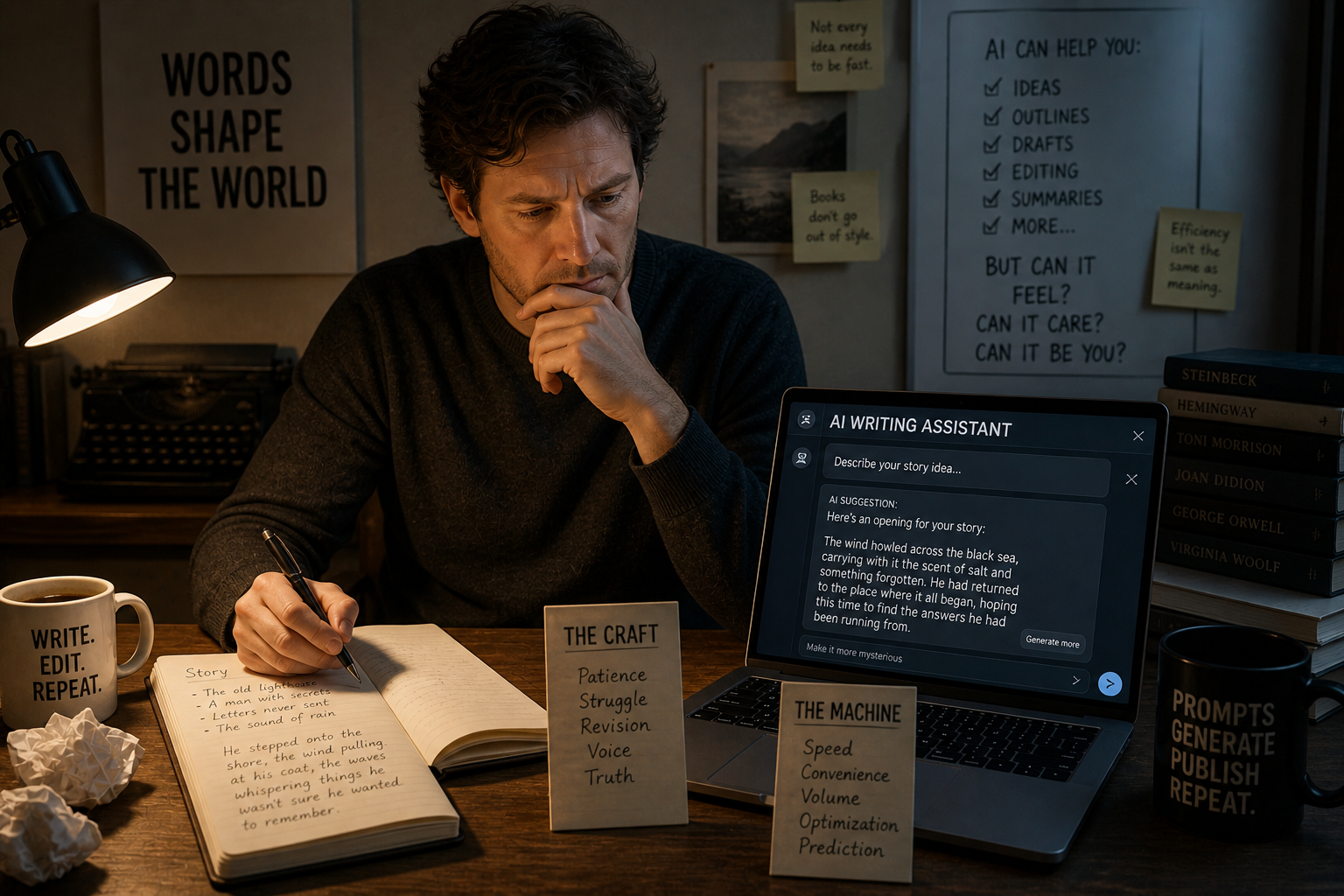
The blank page, for writers, is not just an obstacle. It’s where the actual thinking happens. The struggle to articulate something you haven’t quite grasped yet — to find the right framing for a complex idea, to discover what you actually believe about something by the process of trying to say it — that struggle is the writing. It’s not preliminary to the writing. It is the writing.
When you outsource the first draft to an AI, you’re outsourcing that struggle. The result is faster content. It’s not necessarily deeper thinking. And the difference matters most when the subject matters — when you’re writing about something you care about, when the goal is to produce an idea that’s genuinely yours rather than a competent synthesis of what’s already been said.
I noticed this most clearly in opinion pieces. An AI can generate a competent opinion piece argument about almost any topic in minutes. The structure is clear, the points are defensible, the writing is clean. It also sounds like every other AI-generated opinion piece — which is to say it sounds like the median of serious online commentary, with all the genuine friction of a real perspective smoothed away.
The opinions that land — the ones that make a reader feel the writer actually thought something through, that cost the writer something to say — those still come from somewhere that AI can’t reach. From the specific combination of experience, frustration, observation, and stubbornness that produces a genuine take. That process doesn’t get faster with AI assistance. It gets shorter-circuited.
You start to sound like everyone else.
This one crept up on me. After a few months of heavy AI use, a friend who reads my work regularly asked if I was okay. The writing was fine, she said. Maybe better than fine in some technical sense. But it didn’t sound like me anymore.
She was right. The distinctive awkwardnesses of my natural voice — the long sentences that reverse themselves, the tendency to acknowledge a counterargument and then immediately argue with it, the occasional weird digression that either lands or doesn’t — those had been smoothed away by the editorial logic of AI tools, which optimise for clarity and flow. The result was cleaner. It was also more generic.
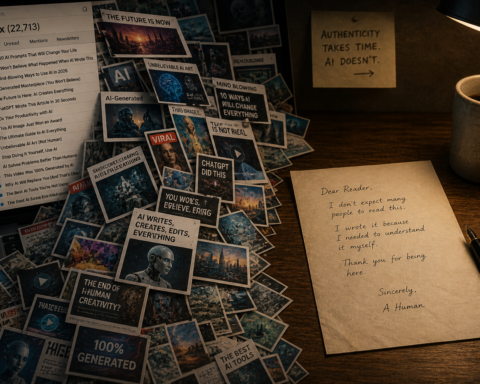
getty Image’s research is relevant here: 78% of consumers believe that because of its origin, an image generated using AI cannot be considered authentic. The same instinct applies to writing. Audiences are becoming more attuned to the texture of AI-generated and AI-assisted content than most writers want to believe. Not because it’s technically detectable in most cases, but because it has a particular quality of competent impersonality that triggers something in readers who are paying attention.
The research process changes in ways that matter.
When I started a piece with AI-assisted research synthesis, I got fast, comprehensive overviews. I also stopped discovering the unexpected things that come from actually reading your sources.
Anyone who reads deeply about a topic knows the experience: you’re looking for one thing and you find something adjacent that changes how you understand the main topic. The serendipity of genuine exploration. AI synthesis removes that serendipity. It gives you what the evidence shows, efficiently. It doesn’t give you the wrong turn that turned out to be right.
I started noticing this in the quality of my arguments. The AI-assisted pieces were well-supported. They were also somewhat predictable — they made the case that the evidence most obviously supported, rather than the more interesting argument that required reading past what the summaries said into what the studies actually implied.
The Case for AI Writing Tools (Honestly Made)
All of that said, I’m still using these tools. Here’s why, honestly.
The time savings are real and significant. Two hours instead of five on a first draft means more work gets done. For content that serves a clear functional purpose — explanations, guides, structured analyses where the goal is clarity rather than voice — AI assistance makes me more productive without meaningful quality trade-offs.
The block problem is solved. The blank page, which was sometimes genuinely paralyzing, is gone. For writers who struggle with initiation — who can revise indefinitely but struggle to start — that matters enormously.
The editing mode is valuable. Using AI not to write but to edit — to catch logical gaps, to tighten loose sections, to suggest where the argument is missing something — is genuinely useful and doesn’t cost you the same things that first-draft generation does. The AI as copy editor is a different tool than the AI as writer.
And there’s something honest about acknowledging what the new capability is. If you’re producing a high volume of content where consistency and coverage matter more than distinctive voice — content marketing, educational material, structured guides — AI assistance is a legitimate professional tool. Just as word processors replaced typewriters without making writing worse, AI assistance can be part of a professional writing workflow without replacing the distinctly human thing that good writing does.
The mistake is pretending it’s neutral — that you get the speed and lose nothing. You do lose things. The question is whether those losses matter for the specific work you’re doing.
The Honest Framework
After six months, my working framework is this:
AI for first drafts: mostly no. The blank page is hard. That hardness is doing something. I’ve gone back to writing rough first drafts myself, often badly, before using AI for any part of the process.
AI for research and structure: yes, with verification. Fast synthesis is valuable. The serendipity problem is real, so I read at least some primary sources for anything important.
AI for editing passes: yes. “Find the weakest argument in this piece and tell me why.” “Identify sections where the logic doesn’t follow.” That mode is useful without the same costs.
AI for functional content: yes, fully. Product descriptions, structured guides, technical explanations, standard business communications. These don’t require voice in the same way, and the efficiency gains are real.
The line I draw is this: when the content I’m producing is trying to say something I actually think, that comes from somewhere AI cannot access. The specific combination of experience, frustration, observation, and stubbornness that produces a genuine perspective — that still has to start with me.
AI can help me say it better once I’ve found it. It can’t find it for me.