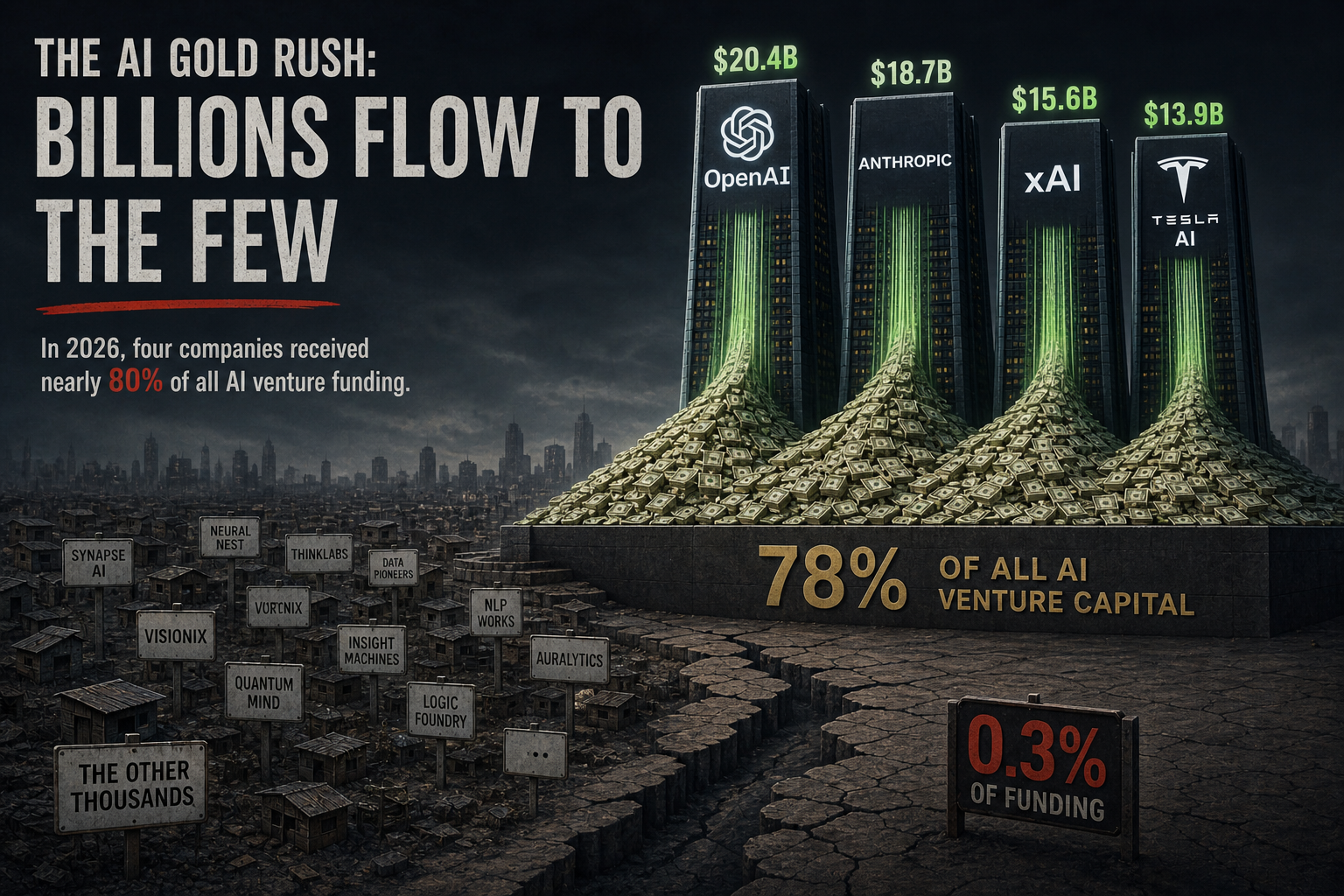
Q1 2026 produced the biggest venture capital quarter in history. 80% went to AI. Four companies took 65% of that. The AI industry loves to talk about democratising intelligence. The funding data tells a different story. Here’s the opinion nobody in the industry is saying clearly.
The AI industry has a favourite phrase. You hear it in keynotes, investor memos, founder interviews, and TED talks with almost metronomic regularity: we are democratising intelligence.
The implicit promise is meaningful and worth taking seriously. If the cognitive tools that previously required elite education, expensive consultants, or large corporate research budgets can be made available to everyone with a smartphone — that genuinely could be one of the most egalitarian technological shifts in history. The ability to draft a legal letter, understand a medical diagnosis, or get expert-level feedback on a business plan regardless of your economic position — that matters.
Then you look at the Q1 2026 funding data and something becomes clear.
$300 billion in venture capital. 80% to AI companies. Four companies — OpenAI ($122 billion), Anthropic ($30 billion), xAI ($20 billion), and Waymo ($16 billion) — captured 65% of global venture investment in a single quarter. The Crunchbase Unicorn Board added $900 billion in value during those three months.
The same technology being described as democratising intelligence is producing the most concentrated accumulation of private capital in the history of venture capital.
Those two things are not in contradiction. But they deserve to be held up next to each other more often than they are.
The Infrastructure Problem Nobody Wants to Name
Here’s the foundational tension in the AI economy: the technology that runs AI — the compute infrastructure, the training clusters, the data centres — requires capital at a scale that structurally concentrates power in a small number of entities.
The combined capital expenditure of Amazon, Google, Meta, and Microsoft on AI infrastructure in 2026 approaches $650 billion. That’s more than the GDP of all but the top twenty national economies. OpenAI is projecting cumulative losses of $115 billion through 2029. Training a frontier model — the kind that powers the “democratised” tools — costs hundreds of millions of dollars and requires access to semiconductor supply chains, enormous data centre capacity, and energy infrastructure that only a handful of organisations in the world can command.
This isn’t anyone’s fault in the sense of a deliberate choice to exclude people. It’s a structural reality of what frontier AI costs. But structural realities have structural consequences, and the consequence here is that control over the most capable AI systems is concentrated in the same cluster of organisations that controlled the previous era of technology dominance — the tech hyperscalers, a small number of well-funded frontier labs, and the sovereign wealth funds and institutional investors who have access to the funding rounds that precede public markets.
The people who will most benefit economically from the AI transition are substantially the same people who were already most economically advantaged before it.
The Foundation Model Transparency Index Should Make Everyone Angry
One specific number from the Stanford 2026 AI Index deserves more outrage than it has received.
The Foundation Model Transparency Index — a measure of how much major AI companies disclose about their models’ training data, computational requirements, capabilities, and limitations — dropped from an average score of 58 to 40 in a single year.
Read that again. As AI models become more powerful, more widely used, and more consequential to the decisions they influence — the organisations building them are becoming less transparent about how they work.
The Stanford report’s phrasing is careful but pointed: “The most capable models often disclose the least.”
This is not a coincidence. It is the natural behaviour of organisations whose competitive advantage depends on proprietary model development keeping their methods opaque while their valuations depend on being perceived as responsible stewards of transformative technology. These incentives are fundamentally in tension, and in 2026, the competitive incentive is winning.
What this means in practice: the AI systems making increasingly consequential decisions about what information people see, what opportunities they’re offered, what credit they can access, and what medical diagnoses they receive are, simultaneously, becoming more capable and less explainable. The organisations that could provide accountability are retreating from it at precisely the moment when accountability matters most.
The FTC has escalated its antitrust investigation into Microsoft, examining whether its bundling of AI capabilities across Office, Azure, and Windows is creating anticompetitive market structures. The European Commission has raised concerns about the same dynamics. These regulatory efforts are attempts to address the structural power concentration problem. Whether they succeed depends on whether regulatory capacity can keep pace with the speed of deployment — a race the regulators are currently losing.
The Democratisation That Is Happening
I want to be careful here not to make a purely negative argument, because the democratisation story isn’t entirely fiction. There are real, documented cases where AI is redistributing access to capabilities that were previously reserved for those with more resources.
A solo freelancer in Mumbai can now access writing, coding, analysis, and research tools that would have required a small corporate team five years ago. A small business owner in Lagos can use AI for customer service, marketing, and operations at a cost that was genuinely impossible before. A student in rural Indonesia can access tutoring and explanation at a quality that historically required expensive human expertise.
The consumer value is real. The Stanford AI Index estimates the value of generative AI tools to US consumers at $172 billion annually by early 2026, with the median value per user tripling between 2025 and 2026. Four out of five US high school and college students use AI for schoolwork. These are genuine redistribution of cognitive access.
But there’s a distinction that the democratisation narrative tends to blur: access to AI tools is being distributed broadly, while control over AI infrastructure, economic benefit from AI development, and influence over AI’s direction are being concentrated narrowly.
You can use ChatGPT for free. You cannot meaningfully influence what OpenAI does with the data your conversations generate. You cannot affect how they train future models. You cannot participate in the $852 billion valuation being created from the collective intelligence of hundreds of millions of users. The free-at-point-of-use model is not the same thing as democratisation.
What Would Actual Democratisation Look Like?
This is the question I wish more people in the industry were asking seriously.
Some possibilities that actual democratisation advocates are discussing: open-source frontier models that don’t require dependence on proprietary providers. Publicly funded compute infrastructure that doesn’t route all AI capability through a small number of private entities. Transparency requirements that give researchers, regulators, and the public meaningful insight into how consequential AI systems work. Revenue-sharing mechanisms that give early adopters and data contributors some stake in the value their contributions enable.
None of these are technologically impossible. They’re politically and economically difficult — which means they require pressure, regulation, and coordination that isn’t happening at the pace the technology is moving.
The Meta argument for open-sourcing Llama deserves credit, even if the motivations are competitive rather than purely altruistic. Anthropic’s safety research, which involves publishing methodologies and findings, contributes to the ecosystem even while the company maintains commercial confidentiality on other dimensions. These are genuine partial democratisations.
But the funding data is honest in a way the keynote speeches aren’t. The money is concentrating. The power is concentrating. The transparency is declining. And the workers experiencing the immediate costs of this transition are not the ones benefiting from the $900 billion in unicorn board value created in Q1 2026.
That tension is the most important story in AI right now. It’s not being told loudly enough by the people who have the platforms to tell it.