
The “augmentation not replacement” framing is real as far as it goes. Experienced workers in AI-exposed fields are seeing wages rise. The problem is what the same data shows for entry-level workers. And the industry’s refusal to be honest about that is making everything worse.
There’s a sentence in every corporate AI announcement about workforce impact. You can almost predict it before you read it. It appears in earnings call transcripts, in executive interviews, in the HR communications that go out to employees when a company deploys AI. It goes something like this:
“AI will augment our workforce, not replace it. Our people will be freed from repetitive tasks to focus on higher-value work.”
I’ve been reading this sentence for two years. And I want to be clear: it isn’t a lie. Parts of it are demonstrably true. But it is systematically, consistently, deliberately incomplete — in a way that is making the public trust problem worse and helping exactly nobody who most needs help right now.
Let me tell you what the data actually shows.
What’s True About the Augmentation Argument
The Dallas Federal Reserve published research in February 2026 that is worth reading carefully, because it confirms the augmentation argument — and then adds something the augmentation argument never mentions.
In AI-exposed occupations, wages are growing faster than national averages. Since fall 2022, nominal average weekly wages nationwide have increased 7.5%. In the computer systems design sector — highly AI-exposed — they’ve risen 16.7%. Experienced workers with tacit knowledge (understanding gained through doing, not just knowing) are seeing those skills valued more, not less, as AI handles the codified knowledge tasks. The workers who have learned how to work with AI rather than be replaced by it are genuinely benefiting.
That’s the augmentation story, and it’s real.
Goldman Sachs’ research confirms a similar pattern: in their base case, 6-7% of workers will be displaced over a 10-year transition period, and broader GDP growth will create new jobs. A measured, slow transition would produce only about a 0.6 percentage point increase in unemployment. Technology transitions historically do create new categories of work. The long-run trend is not apocalyptic.
All of this is true. The augmentation argument rests on real evidence.
What the Augmentation Argument Never Mentions
Here’s the sentence that the Dallas Fed paper follows its positive wage data with:
“Employment totals for older workers have not declined. In a recent article, Federal Reserve Bank of Dallas economist Tyler Atkinson argues that this fall in employment for those under 25 is not due to layoffs but to a low job finding rate for young workers entering the labor force. Basically, the job market is getting very tough for new graduates in AI-exposed fields.”
Entry-level employment in AI-exposed fields is declining. Not through layoffs of existing workers — through failure to replace them when they leave, and through reduced hiring of new graduates. The people bearing the cost of this transition right now are the people who haven’t gotten their first job yet.
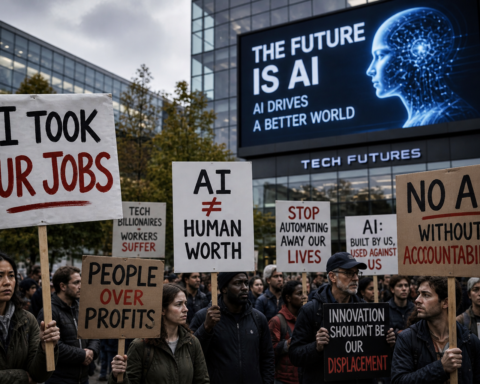
And these aren’t random people. This is the generation — Gen Z — that grew up watching AI develop, that learned to use AI tools in school, that did everything they were told to do to prepare for a knowledge economy. Gallup’s research documents their anger with uncomfortable precision: Gen Z excitement about AI fell from 36% to 22% in a single year. Their anger rose from 22% to 31%. The researchers attribute this specifically to AI “dimming prospects for entry-level workers.”
The augmentation argument is true for people who already have jobs with accumulated experience, tacit knowledge, and institutional relationships. It is incomplete — to the point of being misleading — when applied to people trying to get their first job in those fields.
There is a specific human cost to this that the aggregate “AI helps workers” framing obscures: the entry-level job is not just a paycheck. It’s where you learn the tacit knowledge that makes you an experienced worker worth augmenting. It’s the pipeline. If the pipeline is disrupted, the experienced workers who can partner with AI won’t be replaced — they’ll retire, and there will be nobody behind them.
Why “It’ll Create New Jobs” Isn’t Reassuring Right Now
The standard augmentation counter is that technology transitions always create new categories of work. The internet eliminated travel agents and created social media managers. Mechanisation eliminated farm labour and created industrial labour. This time will be different only if we refuse to adapt.
I believe this is probably true over a long enough horizon. But “probably true over twenty years” is not a useful response to a 24-year-old who can’t get their first job in content writing in 2026 because the content marketing team at every company just reduced headcount by 40% after deploying AI.
The Goldman Sachs base case — 6-7% displacement over 10 years — explicitly notes that outcomes depend heavily on whether the transition is “more frontloaded.” If you move quickly, the aggregate unemployment impact is “much larger.” We are, by most indicators, in a more frontloaded scenario than the base case assumes. AI capability improvements are accelerating. Deployment rates are accelerating. The pace at which human labour in knowledge work is being substituted is not following a gentle historical curve.
New jobs will probably emerge. They probably won’t emerge fast enough, or in the same places, or requiring the same skills, as the jobs being displaced. The people bearing the costs of that gap — younger workers in affected fields — deserve to be told this honestly, not reassured with aggregate statistics that don’t describe their situation.
The Specific Harm of Pretending Otherwise
Here’s why the dishonesty matters practically, not just ethically.
When the industry consistently communicates “augmentation, not replacement,” it shapes how training, retraining, and social support programs get designed — or don’t. If we believe the transition is smooth and the workers are fine, there’s less urgency around building the support structures for workers who aren’t fine.
It also shapes public trust in AI, in exactly the wrong direction. When people experiencing real job market disruption hear “AI will augment, not replace” from the same companies deploying the AI that’s affecting their job search — they hear it as denial. As gaslighting. As the people who benefit from AI pretending the costs don’t exist. This is part of why 56% of AI experts believe AI will have a positive impact on jobs while only 23% of the general public agrees. The credibility gap was created by saying things that sounded reassuring and weren’t accurate to people’s experience.
The public that is most sceptical of AI in 2026 is not primarily afraid of Skynet. They’re afraid — correctly, based on real data — that the transition will be poorly supported, that the costs will be borne by the least powerful, and that the people saying “you’ll be fine” are the ones who will definitely be fine.
What Honest Communication Would Look Like
The honest version of the augmentation argument is something like this:
“AI is changing the labour market in ways that are creating real benefits for experienced workers with specific skills, while simultaneously making it significantly harder for entry-level workers in affected fields to get their first jobs. The long-run economic case for AI-driven growth is strong, but the transition period will produce genuine disruption concentrated in specific demographics. We are actively working on retraining programs, transition support, and hiring pipelines for entry-level talent. Here’s specifically what we’re doing.”
That’s harder to say than “augmentation, not replacement.” It’s also honest. And honesty — combined with concrete action — is the only thing that will eventually close the trust gap between the AI industry and the public experiencing its effects.
The industry has the data. The question is whether it has the courage to use it.