AI-generated and AI-assisted content hasn’t killed creativity. It’s done something subtler and in some ways more damaging: it’s devalued competence. When technically proficient content is effectively free to produce, the market for technically proficient content collapses. Here’s what that means for everyone who makes things.
There’s a specific type of creative work that has been quietly devastated in the past eighteen months, and I don’t think enough people are naming it clearly.
Not the work that requires deep expertise, years of craft, a distinctive point of view, or lived experience that can’t be simulated. Not the work that emerges from genuine struggle with a specific problem or material. That work is still valuable. It may be more valuable than it’s ever been, precisely because the alternative is now so abundant.
The work that has been devastated is the work that was competent but generic. The 800-word blog post that covered the basics clearly. The stock illustration that communicated the concept effectively. The business writing that was professional and inoffensive. The marketing copy that described the product accurately. The resume summary that hit the right notes.
This category of work — technically adequate, functionally sufficient, professionally produced — has been effectively devalued to zero. AI does it better than most human practitioners managed, faster, at a cost that rounds to nothing.
This is not a disaster. In many ways it’s a liberation. Nobody mourns the hours previously spent writing corporate boilerplate. The question is what it demands from the humans who made their living doing it — and whether the industry is being honest about the answer.
The Flood Is Real and It’s Already Here
The numbers tell the story. The Stanford 2026 AI Index shows that generative AI reached 53% population adoption in under three years — faster than the personal computer or the internet. The estimated value to consumers reached $172 billion annually by early 2026. The median value per user tripled between 2025 and 2026.
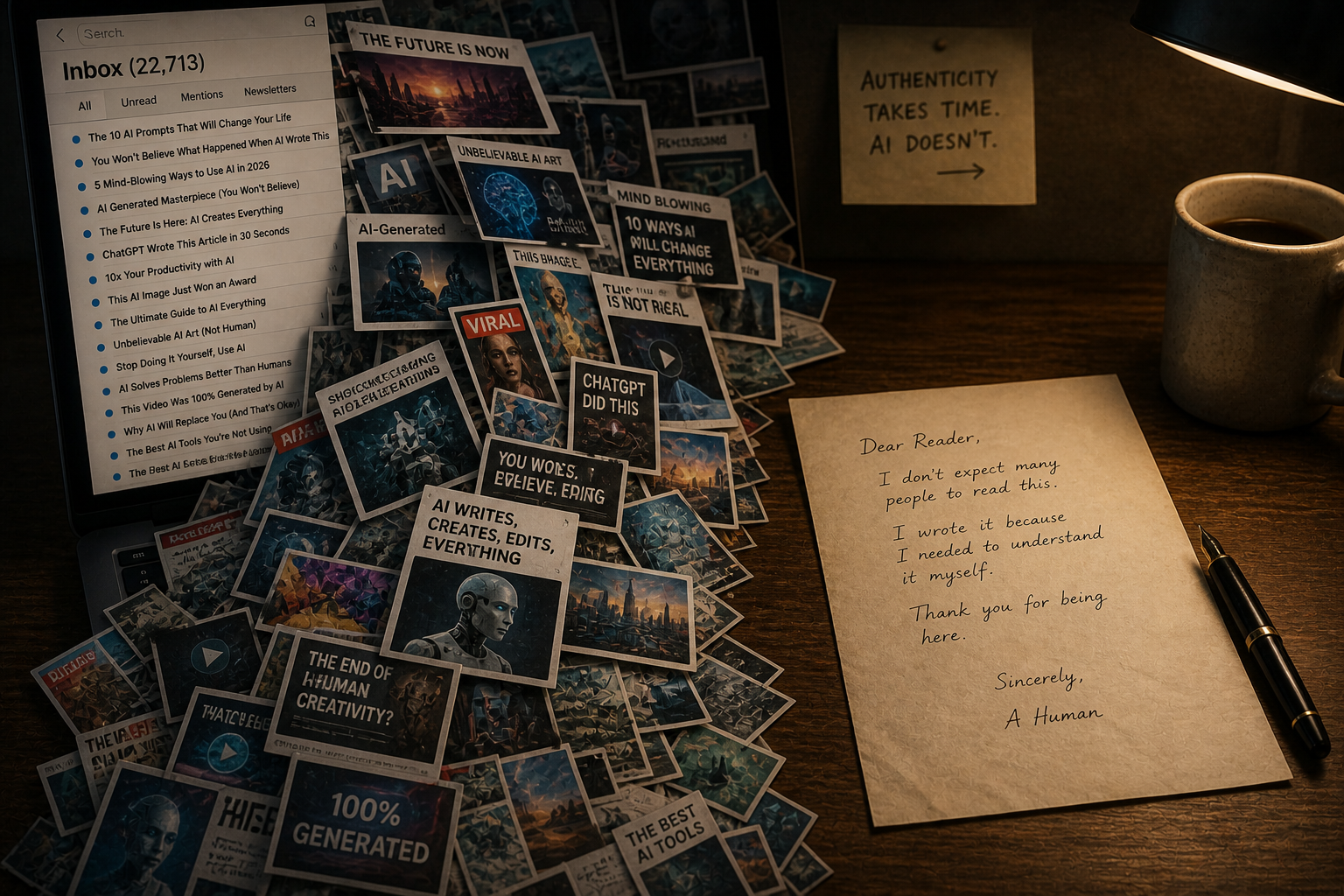
That value is being created by the production of content at previously impossible scale. Getty Images documented the market reality bluntly: AI-generated visuals are flooding social media and commercial marketplaces. Music generation has reached a level of competence where most commercial uses — backgrounds, videos, ads — can be served by AI composition without meaningful quality loss. Text content for marketing, SEO, product descriptions, and basic communication is being produced at scale by teams that have dramatically reduced their human writing capacity.
The internet is experiencing what some have started calling “content inflation” — a massive increase in the volume of technically adequate content without a corresponding increase in the amount of genuinely distinctive content. Search engines are struggling to surface good writing precisely because they’re now indexing a much larger proportion of writing that is correct but characterless. Readers who consume a lot of content online have started to describe the texture of AI-adjacent content even when they can’t technically identify it — a particular quality of competent impersonality that registers as absence.
The British programmer Simon Willison’s term for low-quality AI-produced content — “AI slop” — has entered common usage. It describes a real phenomenon. But I think the “slop” framing slightly misses the deeper problem. The issue isn’t low quality. The issue is high volume of medium quality — content that is too good to dismiss but not good enough to remember.
What Authenticity Actually Means Now
Getty Images’ research is striking on this: 78% of global consumers believe that because of its origin, an image generated by AI cannot be considered authentic. 66% of consumers believe human-created content should be priced higher. When brands disclose AI use in creative work, perception of quality drops even when quality is unchanged.
This consumer instinct — which the AI industry tends to dismiss as naive or temporary — is actually tracking something real.
Authenticity in creative work isn’t purely about the production method. It’s about whether the work contains a perspective that emerged from genuine encounter with the world. A photograph of a specific street corner at a specific moment, made by a specific person who chose to be there and to look at that thing — it contains information about experience that a generated image, no matter how technically accomplished, doesn’t contain.
A piece of writing that emerged from someone genuinely wrestling with a question, following their curiosity to unexpected places, willing to say something uncomfortable or specific or potentially wrong — it has a texture that AI writing, optimising for plausible-sounding text, doesn’t replicate. Not because AI writing is bad. Because AI writing optimises for plausibility rather than truth-seeking, and those produce different textures even when they produce similar surface outputs.
The most interesting creative work emerging in 2026 is, perhaps predictably, work that foregrounds the human element precisely because AI foregrounding is now the default. Writing that is specific to a person’s experience in ways that can’t be generalised. Art that shows the hand, the process, the mistake that was kept. Performance that is embodied and unrepeatable. The market for authenticity is growing as the supply of technically proficient generic content increases.
The Uncomfortable Creative Question
Here’s the question that the AI content revolution is forcing on anyone who makes things for a living:
What, specifically, can you do that AI cannot?
Not “humans are creative, AI isn’t.” That’s true at the level of abstraction and nearly useless at the level of practical career advice. Specifically: in your particular creative domain, with your particular skills and experience and perspective, what can you produce that a well-prompted AI cannot replicate?
For many people who’ve spent years getting good at a specific category of competent, reliable work — the answer to that question is increasingly uncomfortable. The 800-word explainer article, the standard marketing email, the generic illustration, the service-industry prose — these are being substituted at scale.
The uncomfortable truth is that “competent professional” was always partly a moat built on information asymmetry and access barriers that didn’t actually measure creative value. The client who couldn’t design hired a designer because they couldn’t design, not because every designer’s work was irreplaceable. The company that needed copywriting hired copywriters because writing clearly was harder than it appeared. Those barriers are now lower. Much lower.
What survives — and what I think will command increasing value — is the work that couldn’t have been produced by anyone else. The perspective that comes from specific experience. The design sensibility that reflects a genuine aesthetic vision rather than a synthesis of existing design. The writing that risks saying something the writer actually believes rather than the thing most readers will accept. The creative work that carries the marks of genuine encounter with difficult material.
This is harder to produce than competent generic work. It’s also harder to evaluate, harder to commission, and harder to price. The transition from a market that valued reliable competence to one that values genuine distinctiveness is not comfortable for the people who built skills and careers around the former.
What This Actually Demands
The demand is genuine, not motivational-poster vague.
It demands knowing the difference between what you can do that is genuinely yours and what you can do that has been made generic. Most creative practitioners have both in their work. The question is which to lean into.
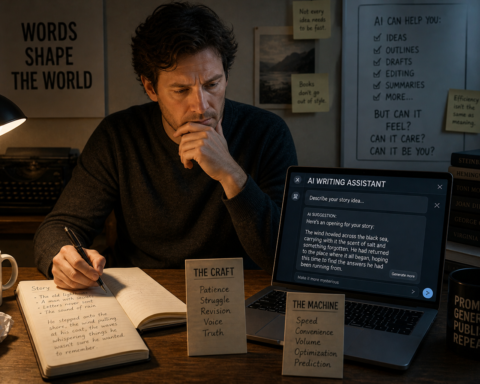
It demands resisting the pull of AI assistance at the moments when the struggle is the work. The blank page is where genuine perspective emerges. Outsourcing the blank page produces technically proficient work that doesn’t contain the struggle — and the struggle is often what makes the work worth reading.
It demands accepting that the market for “adequate” is not coming back. The clients who needed someone adequate when adequate was hard to produce don’t need that anymore. The opportunity is in the market for “unmistakably yours” — which is a smaller market and a harder sell, but the only one that AI isn’t racing to the bottom of.
And it demands — this is the hardest one — actually having something to say. The AI content flood has exposed a latent truth that the creative industries spent decades papering over: a lot of what was produced was filler. It wasn’t bad. It served a function. But it didn’t represent anyone’s genuine engagement with the world. That work isn’t missed.
What’s missed — what commands attention in a world where adequate is free — is the work that couldn’t have existed without the specific person who made it. That’s always been the point. It’s just more visible now.