60% of HR teams are still bogged down by manual tasks that AI could automate. But the companies actually doing it are seeing dramatic results: 65% cost reductions per interview, 33% faster time-to-hire, documentation that used to take a day now taking minutes. Here’s what’s working — and what remains stubbornly human.
Here’s the honest state of AI in HR in 2026: about 52% of companies are still in the experimentation stage. Only 1% report wide implementation. And 60% of HR teams say they’re bogged down by manual tasks that AI could automate.
The gap between what AI can demonstrably do for HR and what most HR departments are actually doing with AI is enormous — which means both the opportunity and the complexity are real. The companies that have moved from experimenting to deploying are seeing results significant enough to make their competitors pay attention. The companies still experimenting are, in many cases, unsure where to start.
This article is for both groups. It covers what’s working, with specific examples and specific numbers. It also covers what remains genuinely human work — because the clearest signal of AI maturity in any field is knowing where the technology belongs and where it doesn’t.
AI Recruitment: Where the Evidence Is Clearest
Recruiting is where AI in HR has the longest track record and the most documented outcomes. It’s also where the risks of getting it wrong are most consequential — bad hiring decisions are expensive, and algorithmic bias in screening is both a legal and ethical exposure.
With that dual context, here’s what the data shows.
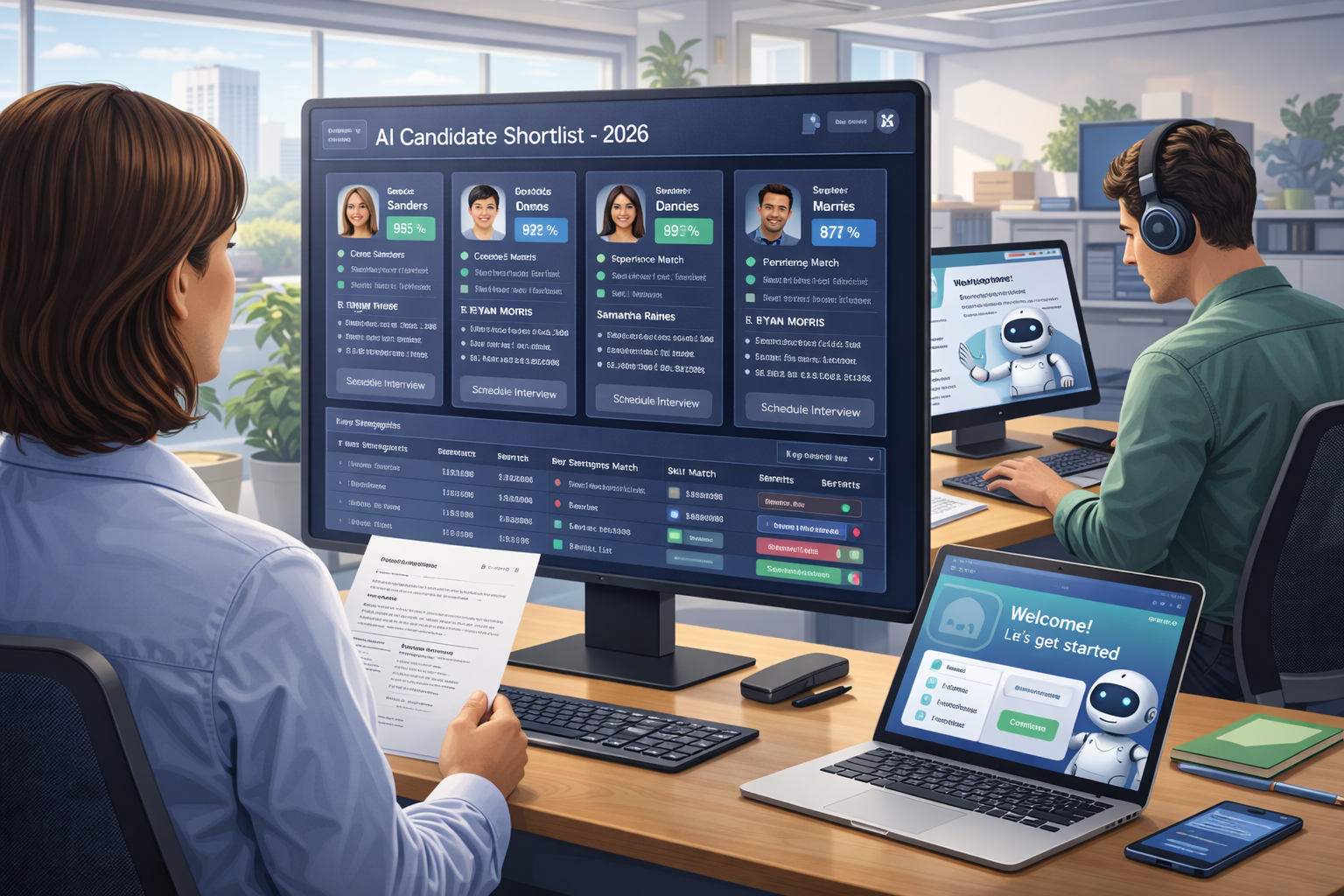
A life insurance company with high-volume hiring challenges implemented Maya, a conversational AI system, to manage the top-of-funnel recruitment pipeline. The results within two months: cost per interview dropped from $37 to $13 — a 65% reduction. Time-to-interview fell from 5-7 days to one day. Maya fully managed the screening of both qualified and unqualified candidates, freeing recruiters to focus exclusively on high-quality applicants. Remarkably, 92% of candidates believed they were interacting with a real human during the AI-managed screening.
Integrity Staffing — operating in industrial and warehouse placement where candidates apply to multiple jobs simultaneously and the engagement window is measured in hours, not days — used AI to scale personalised candidate engagement. The constraint they faced was real: by the time a human recruiter could follow up on an application, the candidate had often already taken another offer. AI enabled immediate, personalised engagement that preserved the response window.
What’s consistent across these implementations: AI handles volume and speed; humans handle judgment and relationship. The screening of 500 candidates to identify the 50 worth interviewing is volume work that AI does faster, more consistently, and cheaper than humans. The actual interview, the cultural assessment, the offer negotiation, the candidate experience at the critical moment — those remain human.
AI use across HR tasks climbed to 43% in 2026, up from 26% in 2024 — crossing from experiment to standard practice. LinkedIn data shows companies using AI-assisted recruiter messaging are 9% more likely to make a quality hire — presumably because the messages are more targeted and response rates are higher.
AI Onboarding: The First 90 Days, Personalised at Scale
New employee onboarding is structurally suited for AI because it has the same basic content (company policies, benefits, systems access, job responsibilities) with individual variation (role-specific training, manager-specific context, location-specific information) delivered to people who are simultaneously excited, anxious, and information-overloaded.
Human HR teams onboarding 200 new employees in a quarter cannot provide genuinely personalised experiences for each one. AI can.
Specific AI applications in onboarding that are working: automated delivery of documentation (contracts, tax forms, benefits enrolment), AI chatbots available 24/7 to answer the questions new hires have at 10pm on their first day, personalised learning paths that adapt based on the role and the new hire’s existing knowledge, automatic provisioning of system access and permissions based on role.
The administrative relief for HR teams is significant. Agentic AI now handles multi-step workflows across systems with minimal human input — for example, automatically syncing a name change across payroll, benefits, and tax records simultaneously rather than requiring manual updates across each system.
For new hires, the experience improvement is equally significant. Being able to ask “how do I expense a client dinner?” or “when does my health insurance start?” at any hour and get an accurate, immediate answer beats the experience of waiting for an HR manager to have a spare moment.
Salesforce research from 2025 found that agentic AI adoption in HR currently sits at 15% — but is expected to spike to 64% within two years. The directional acceleration suggests companies understand the value proposition even if they haven’t deployed yet.
AI in Learning and Development: Closing Skill Gaps at Scale
General Electric’s “Wingmate” deployment illustrates what happens when AI learning tools are embedded in the actual workflow rather than siloed in a separate learning management system.
Developed in collaboration with Microsoft, Wingmate helps GE employees summarise technical manuals, resolve quality issues, and draft communications — directly within the tools they’re already using. Within three months of launch, Wingmate was queried over 500,000 times. That adoption rate reflects employees finding it genuinely useful, not employees completing mandatory training modules they resented.
The shift this represents is structural. Traditional corporate learning: identify skill gap → create course → schedule training → hope transfer occurs. AI-enabled learning: identify skill gap → surface relevant content in the tool the employee is using → provide just-in-time support at the moment of need.
Mitr Learning and Media’s analysis makes the key distinction: most organisations apply AI to tasks; very few apply it to workforce decisions. The companies seeing the most impact are the ones connecting learning systems to workforce intelligence — AI that identifies a skill gap also triggers the learning pathway to close it, tracks whether the gap is closing, and surfaces the outcome data that informs future decisions.
This matters because the ROI of L&D has historically been difficult to measure. AI creates the feedback loops that connect training investment to performance outcomes, which makes the business case for L&D investment more defensible and the decisions about where to invest more informed.
AI Predictive Analytics: Knowing Before Problems Happen
One of the most significant AI applications in HR is also one of the most underused: predictive analytics for retention and workforce planning.
The problem it solves is straightforward: employee attrition is expensive. Replacing an employee costs between 50-200% of their annual salary depending on seniority and role. If you knew 90 days in advance that a high-performer was likely to leave, you’d have time to have a retention conversation, address the underlying issue, or at minimum begin succession planning.
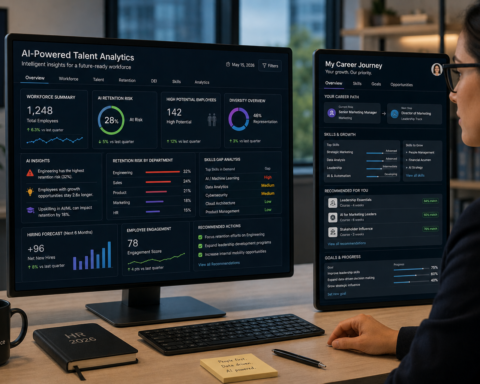
AI models trained on historical data — performance ratings, promotion velocity, compensation relative to market, manager changes, project outcomes, engagement survey responses, even patterns in email behaviour (with appropriate privacy controls) — can identify employees who share characteristics with those who have previously left. These are not certainties; they’re signals worth acting on.
Organisations that invest in AI-driven retention analytics report the ability to deploy targeted interventions: development conversations, compensation adjustments, role changes, increased manager attention — specifically for the employees the model identifies as flight risks. The results, when measured, show meaningful improvements in retention rates for the employees who receive intervention.
Workforce planning — knowing what skills you’ll need in 18 months based on business direction, understanding which roles are at risk of being automated away and which will grow — benefits similarly from AI’s ability to process large datasets and surface patterns that human analysts would take weeks to identify.
80% of business leaders say AI and machine learning help employees work more efficiently and make better decisions. For HR specifically, that efficiency compounds: better hiring decisions reduce downstream training costs and attrition; better retention reduces recruiting costs; better learning and development reduces the need for external hiring.
The Employee Experience Layer: Continuous Listening at Scale
Traditional employee engagement measurement: annual survey, results six weeks later, action planning that may or may not connect to what employees actually said. The response rate is typically low because employees don’t believe their feedback produces change.
AI-enabled continuous listening is different in kind, not just degree. Natural language processing analyses employee communications (with explicit consent and appropriate anonymisation), exit interview transcripts, help desk tickets, and survey verbatims to surface themes, sentiment shifts, and emerging issues in real time.
HR leaders who previously learned about engagement problems from annual surveys can now see leading indicators weeks or months earlier — before disengagement becomes resignation. The practical question is what you do with the intelligence: the best implementations connect continuous listening outputs to manager coaching, policy adjustments, and resource allocation decisions.
AI-powered virtual assistants and chatbots provide instant responses to employee questions around the clock, in multiple languages, creating a more inclusive communication experience. This is particularly significant in multinational organisations where time zones, languages, and geographic distances create information access inequities. An employee in a regional office who can’t get a benefits question answered because HQ is asleep now gets the same immediate access as a headquarters employee.
The Lines That AI Can’t Cross — And Shouldn’t
The companies getting AI in HR right are the ones who are clear about what remains human work.
Employee relations, conflict resolution, investigations, wellbeing conversations — these depend on context, discretion, and psychological safety. A chatbot can take a harassment report; it cannot conduct a fair investigation. An AI can flag that an employee’s engagement signals have shifted; it cannot have the conversation that might retain them.
Culture and leadership development stay human because coaching managers, navigating organisational change, and building trust rely on relationships and credibility that algorithms cannot replicate.
The bias risk is not hypothetical. 44% of recruiters worry AI may be more biased than traditional selection methods, and the evidence from University of Washington research — showing AI screening systems favouring white-associated names 85.1% of the time — validates the concern. Regular bias audits of AI decision systems are not optional in HR; they’re an ethical requirement and increasingly a legal one. The EU AI Act obligations for AI in hiring began in August 2026.
And yet — and this is the honest conclusion — AI in HR done thoughtfully produces better outcomes than AI in HR avoided out of caution. The same human biases that AI can encode are present in human-only screening. Documented, auditable, continuously monitored AI processes are, in principle, more correctable than the invisible biases of individual human judgments. The goal is AI that surfaces bias and enables correction, not AI that automates bias at scale.
The companies that navigate this well — deploying AI where speed and consistency help, preserving human judgment where context and empathy matter, auditing continuously for bias and fairness — are the ones who will use AI to build the HR function that both employees and businesses need.