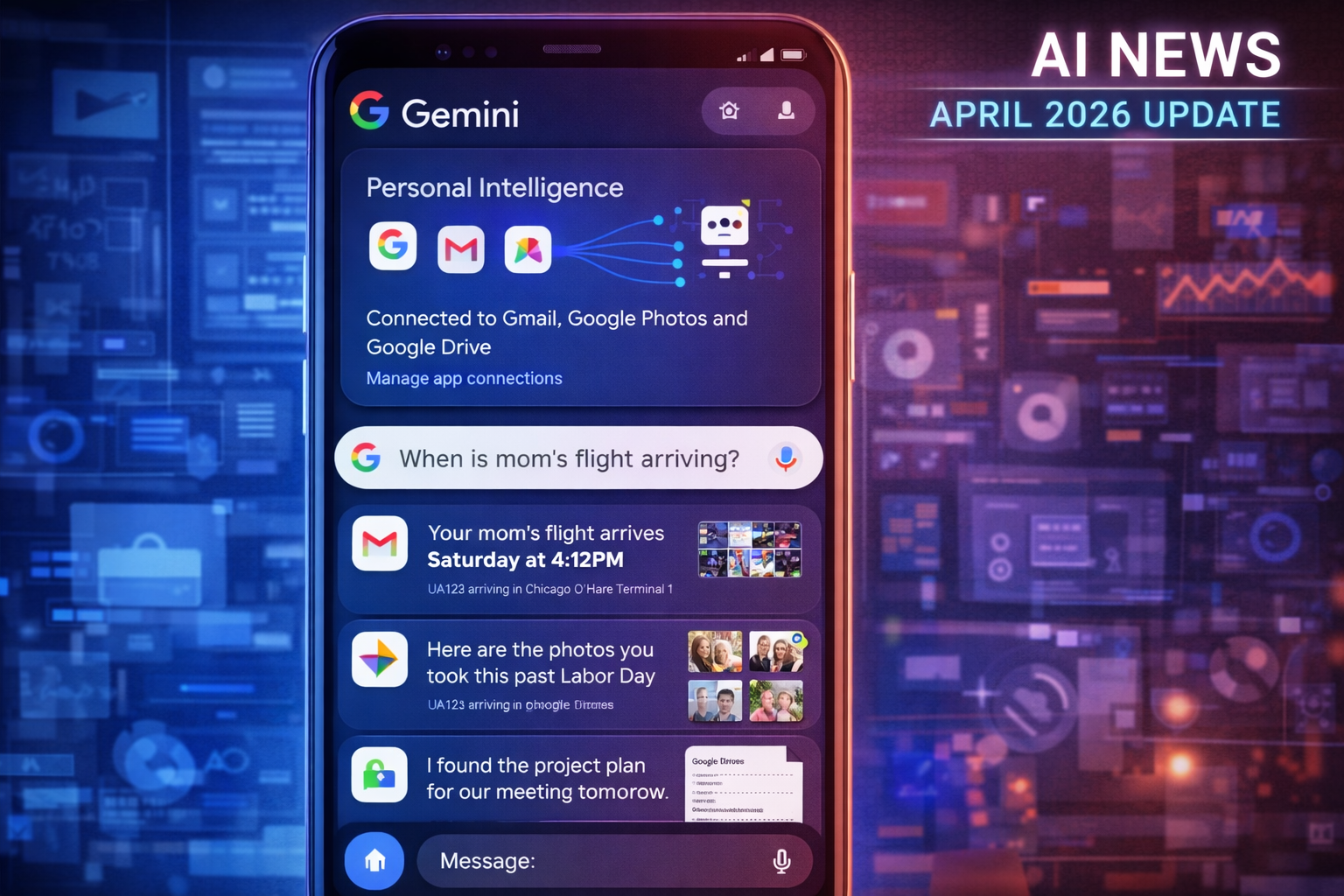
On March 17, Google expanded Gemini’s Personal Intelligence feature to all free-tier US users. It’s the most significant shift in AI assistant design since ChatGPT launched — and it’s barely been discussed outside tech circles.
There’s a version of Gemini that knows your name. And then there’s the version that knows your sister’s wedding is next month because it read the thread in your Gmail, that you’ve been researching flights to Copenhagen because it saw your Google Search history, and that you still haven’t finished that work presentation because the Google Drive file shows “last edited 3 days ago.”
That second version became free to all US users on March 17, 2026. Google called the expansion of Personal Intelligence to its free tier a quiet milestone. I’d call it a design philosophy made real — and one that raises questions that deserve more public conversation than they’re currently getting.
What Gemini 3.1 Pro Actually Is Now
Released February 19, 2026, Gemini 3.1 Pro is Google’s current flagship model, and it ties with GPT-5.4 on the Artificial Analysis Intelligence Index — the broadest capability benchmark, covering 339 models. Two models at the top. Same score. For the first time in the modern AI era, the headline capability competition is genuinely a tie.
The differentiation has moved elsewhere. And for Google, the differentiator is Personal Intelligence.
When you connect Gemini to your Google account and opt in, it gains access to Gmail, Google Photos, YouTube, Google Drive, Google Search history, and Google Maps. The stated goal is to give Gemini enough context about your actual life to provide answers that are relevant to your actual situation rather than to a hypothetical person who asked the same question.
The demo examples from Google’s release: “What should I get my dad for his birthday?” and Gemini looks through your email for context about your father, your previous gift discussions, your shopping history. “Help me prepare for my team meeting” and Gemini pulls the relevant documents from Drive, the emails between team members, the calendar event details.
These are not hypothetical capabilities. They’re shipping features.
Gemini in Chrome Is Now Your Browsing Companion
Alongside the Personal Intelligence expansion, Google launched major updates to Gemini in Chrome in April. The updates are available on Windows and macOS to Google AI Pro and Ultra subscribers in the US.
The new side panel experience in Chrome lets you multitask — Gemini sits alongside any webpage you’re browsing, available to explain, summarise, or answer questions about what you’re reading without leaving the tab. It integrates with deeper Google apps, including image editing via Nano Banana. And there’s a preview feature called auto browse, which helps automate tasks while keeping you in control.
The practical implication: Gemini is no longer primarily a destination you navigate to. It’s becoming a layer on top of the web — always accessible, contextually aware of what you’re looking at, able to help you do things with the content rather than just describe it.
This is the direction Google has been moving toward for several years. The web browser is the place where most people spend most of their computing time. An AI that lives inside the browser rather than alongside it has a fundamentally different relationship with the user.
Gemini 3 Deep Think: When AI Does Actual Science
The update that made me stop and pay attention wasn’t the Personal Intelligence expansion. It was what Google announced on April 15 for Gemini 3 Deep Think — a major upgrade to its specialised reasoning mode, built specifically for science, research, and engineering.
Google updated Deep Think in close partnership with scientists and researchers, with a focus on problems that “often lack clear guardrails or a single correct solution and data is often messy or incomplete.” That’s the description of real scientific work, not the clean benchmarks that labs typically train for.
The results are striking. Lisa Carbone, a mathematician at Rutgers University working on mathematical structures in high-energy physics, used Deep Think to review a highly technical paper. Deep Think identified a subtle logical flaw that had previously passed through human peer review unnoticed.
At Duke University, the Wang Lab used Deep Think to optimise fabrication methods for complex crystal growth for semiconductor material discovery.
The model also demonstrates gold medal-level results on the written sections of the 2025 International Physics Olympiad and Chemistry Olympiad, and achieves 50.5% on CMT-Benchmark for advanced theoretical physics.
These aren’t productivity use cases. These are contributions to science. The fact that an AI model is now catching errors in peer-reviewed physics papers is a signal worth taking seriously, regardless of where you stand on AI’s broader trajectory.
Deep Think is available to Google AI Ultra subscribers in the Gemini app, and is now accessible via the Gemini API to select researchers, engineers, and enterprises.
The Gemini 3.1 Flash TTS Launch: AI That Sounds Like a Director
On April 15, Google also launched Gemini 3.1 Flash TTS, its newest text-to-speech model. It scores 1,211 on the Artificial Analysis TTS leaderboard — strong enough to challenge ElevenLabs as the serious developer option for audio applications.
What makes it genuinely different is audio tags. You can embed natural language commands directly into text to direct vocal style, pacing, and delivery: [excited], [pause], [conversational], [formal]. Over 200 tags are available, spanning emotions, pacing, accent styles, and format templates. You can configure distinct speaker personalities, apply scene direction, and control character-by-character delivery.
This is Google repositioning text-to-speech from “voice synthesis” to “AI vocal performance.” It’s available now in Google AI Studio, the Gemini API, and Vertex AI — free for prototyping, production pricing via Vertex AI.
For podcast producers, audiobook creators, corporate training developers, and anyone building voice applications, this changes the cost-quality trade-off significantly.
The Honest Question Nobody Is Asking Loudly Enough
The Personal Intelligence feature is impressive. It is also the most significant data access expansion Google has given its AI products — connecting them, with user permission, to essentially everything you’ve done, said, searched for, or stored in Google’s ecosystem.
The opt-in framing matters and is genuine. You choose to enable this. Google has been thoughtful about the UI design around consent.
But opt-in features that are prominently featured in AI assistants — especially free ones — tend to see high adoption from users who don’t fully process what they’re agreeing to. Most people will tap “Connect” because it makes Gemini more useful, which it does. Fewer will carefully consider what it means to have an AI system with access to their complete email history, photo library, and search behaviour.
This isn’t an argument against the feature. It’s an argument for clearer public conversation about it. The trade-off — a significantly more capable and personalised AI in exchange for much broader data access — deserves explicit discussion, not just a settings toggle.
Google has been public about its approach to data privacy in the context of Personal Intelligence. The feature is opt-in, data isn’t used to train models without additional consent, and users can disconnect at any time. These are real protections.
They’re also the minimum baseline for a feature this consequential. Worth watching whether public literacy about what’s being shared keeps pace with adoption.
The Number That Matters Most
Gemini AI Overviews now reach 2 billion users monthly. The Gemini app has 650 million monthly active users. More than 70% of Google Cloud customers use Google’s AI. 13 million developers have built on Google’s generative models.
These aren’t metrics from a challenger. They’re the metrics of a platform that has made AI ubiquitous across the products billions of people use daily, whether those people think of themselves as AI users or not.
The interesting question for the rest of 2026 is whether Gemini’s integration advantage — embedded in Search, Gmail, Drive, Chrome, Android, Workspace — compounds into something that meaningfully changes the competitive landscape, or whether the capability gap with OpenAI and Anthropic becomes a ceiling that integration alone can’t overcome.
Based on what Google shipped in April, they’re betting heavily on the integration advantage. The Gemini 3 Deep Think results suggest the capability gap may be narrower than commonly assumed. Both things appear to be true.