The Stanford 2026 AI Index buried the most important data in the middle of a 423-page report: the US lead over China in AI capability has collapsed from comfortable to essentially nothing. While the industry was celebrating record funding quarters, China was getting faster. This is not a drill.
Here’s what I think the AI industry’s amnesia about history keeps getting wrong:
The assumption that technological leadership, once established, is self-perpetuating. That the US lead in AI, built over decades of research investment, immigration of global talent, and Silicon Valley network effects, is a structural advantage that quarterly funding records will sustain indefinitely.
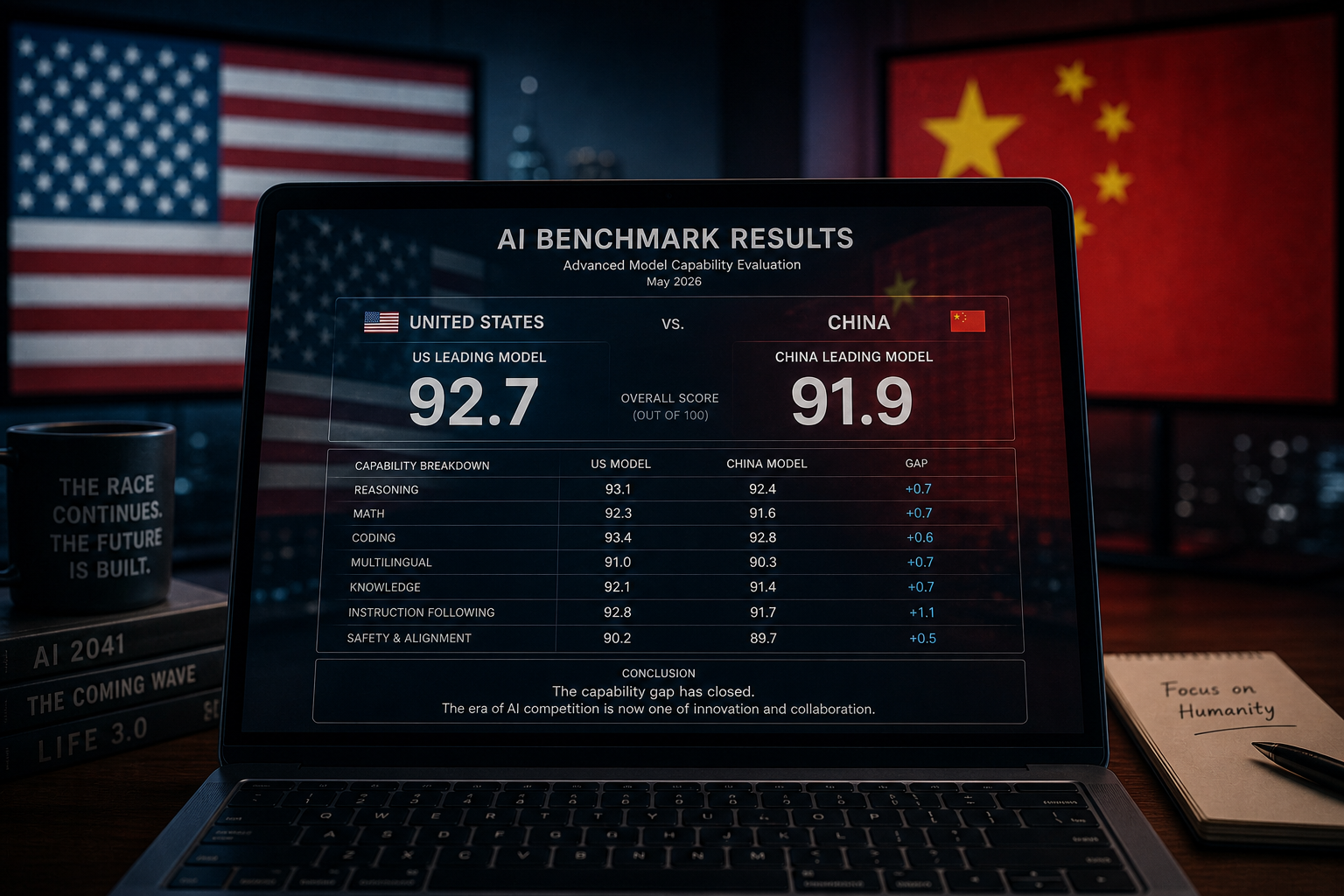
The Stanford 2026 AI Index data says something different. As of March 2026, Anthropic’s leading model holds a 2.7 percentage point edge over the best Chinese model on the Artificial Analysis Intelligence Index. Since early 2025, US and Chinese models have been trading the top spot on benchmarks back and forth. China leads in publication volume, citations, and industrial robot installations. The US still produces more top-tier models and higher-impact patents. But the “comfortable US lead” that AI boosters have been citing as evidence that everything is fine has essentially closed.
Meanwhile, the flow of AI researchers into the United States has dropped 89% since 2017. In the last year alone, that flow dropped 80%.
I want to sit with that number for a moment. The US research advantage in AI is not primarily a function of domestic talent production. It’s a function of attracting the best AI researchers from around the world. That pipeline — which built Google Brain, OpenAI, Anthropic, and every major US AI lab — has been falling dramatically for close to a decade and collapsed in the most recent year.
These two data points together — the closing capability gap and the collapsing talent pipeline — represent the most important structural development in AI in 2026. They’re getting significantly less coverage than the IPO race and the quarterly funding records.
What China Actually Built
The narrative about China’s AI industry in US tech coverage tends to be one of two flavours: either “Chinese AI is heavily censored state tech that can’t compete with Western openness,” or “China is the existential threat that will surpass us imminently.” Both framings miss what’s actually happening.
China has built a genuine AI ecosystem. Alibaba’s Qwen series, Baidu’s ERNIE family, DeepSeek, Moonshot AI, and others are producing models that are competitive with Western frontier models in increasingly broad capability areas. When DeepSeek-R1 briefly matched the top US model in February 2025, it wasn’t an anomaly — it was an indicator of the trajectory.
China invests approximately $62 billion annually in AI development through government programmes. Its approach is different from the US — more centrally coordinated, more focused on specific industrial applications, more oriented toward physical AI (robotics, manufacturing automation, logistics) — but it is not less serious. Amazon’s warehouse robot fleet crossed 1 million units while China has been installing industrial robots at a rate that leads the world.
Chinese AI companies have pursued a deliberate open-weights strategy for many models — mirroring Meta’s Llama playbook — precisely to build global developer ecosystems that are not dependent on access to Western frontier models. Alibaba’s Qwen 3.5 was designed to run on high-end consumer hardware, reducing the barrier to adoption in markets where cloud access is expensive. This strategy has worked. Chinese models are deployed broadly across Southeast Asia, the Middle East, and African markets.
The capability gap has closed not because the US slowed down — it didn’t — but because China sped up faster than most predictions assumed.
The Talent Pipeline Collapse Is the Actual Crisis
The 89% decline in AI researcher immigration to the US since 2017 is not primarily a story about immigration policy, though policy is part of it. It’s a story about the changing calculus for where ambitious AI researchers want to be.
Ten years ago, the US had almost all of the frontier AI research, most of the funding, and essentially all of the major AI companies. The career opportunity was concentrated here in a way that made the US the obvious destination for anyone serious about AI research. That concentration is no longer as stark.
Researchers from China who would previously have sought PhDs or postdocs in the US and then joined US companies now have domestically competitive alternatives. Baidu, Alibaba, and Tencent run serious AI research labs. DeepSeek’s research operation attracted talent that would have previously gone to US companies. Google DeepMind London, the UK frontier AI ecosystem, and European AI research institutions offer alternative trajectories that didn’t exist at the same quality five years ago.
The US also created its own headwinds. Export controls on semiconductor technology — designed to slow China’s AI development by restricting access to advanced chips — have created uncertainty for researchers from China who might want to work at US labs. Visa processing times and denial rates for high-skill technology workers increased through the same period the immigration flows were declining. The implicit message — that the US was actively trying to prevent the flow of technology and people across the Pacific — made Chinese researchers less eager to build careers in an environment where their connections to home institutions could create professional complications.
Whether the export control strategy is correct geopolitically is a genuinely hard question. The talent pipeline cost of that strategy is real and measurable and needs to be part of the calculation.
The Environmental Cost That’s Not In the Funding Headlines
There’s one more piece of the US-China AI picture that deserves more coverage alongside the capability benchmarks: the environmental accounting.
The Stanford 2026 AI Index documented this plainly. Grok 4’s training run alone produced an estimated 72,816 tons of CO2 equivalent — roughly the equivalent of driving 17,000 cars for a full year. AI data centre power capacity has reached 29.6 gigawatts — comparable to what it takes to power the entire state of New York at peak demand. Annual inference operations for GPT-4o alone may use water equivalent to the drinking water needs of 12 million people.
China’s AI development has its own environmental footprint, and China’s electrical grid is substantially more carbon-intensive than the US grid for most applications. But the narrative that US AI leadership is unambiguously good for global sustainability — sometimes implicit in the “we need to maintain AI dominance” framing — doesn’t survive contact with these numbers.
The environmental cost of AI capability leadership is significant, concentrated geographically, and largely borne by the communities in the physical proximity of data centres rather than by the companies or users generating the demand. This is a political and ethical dimension of the US-China AI race that is almost entirely absent from the competitive framing that dominates coverage.
What I Actually Think Should Happen
I’ll be direct about my view because I think the editorial genre demands it.
The US lead in AI, which was a structural feature of the technology landscape for a decade, should not be taken for granted. The combination of closing capability gap and collapsing talent pipeline represents a genuine structural vulnerability that neither the funding headlines nor the capability benchmark claims from individual companies adequately address.
Maintaining AI leadership in a world where the geopolitical stakes are high requires sustained investment in the talent pipeline — which means immigration policy, research funding, and creating the conditions that make the US the obvious destination for ambitious researchers again.
It also requires honesty about what “leadership” means. A lead measured in quarterly benchmark points that trade back and forth is not the same as the structural dominance that characterised the previous era. Communicating to investors, policymakers, and the public as if the lead is comfortable when the data shows it’s essentially closed is not honesty. It’s narrative management.
And it requires grappling seriously with the question of whether the goal is US dominance of AI or good AI outcomes for the world — because those are not identical, and the policy choices that maximise the former don’t always maximise the latter.
This is the geopolitical AI story of 2026. It’s more important, and harder, than the IPO race. I wish more of the people covering AI were spending time on it.