The San Antonio Spurs create their entire season travel logistics in 20 minutes with AI — a task that used to take three weeks. A professional rugby team using AI load management reported 30% fewer injuries over two seasons. Machine learning predicts injury risk with 85-90% accuracy. AI in sports is no longer about fan engagement gimmicks — it’s inside the technical decisions that determine whether teams win.
There’s a specific conversation happening in professional sports performance departments right now that doesn’t usually make it into sports columns. It goes something like this: one of your best players has just logged 38 minutes of high-intensity running. Their heart rate variability is down 12% from baseline. Their jump landing force patterns this week are starting to mirror those of three other players who suffered hamstring injuries at this point in previous seasons.
Do you rest them for the next game?
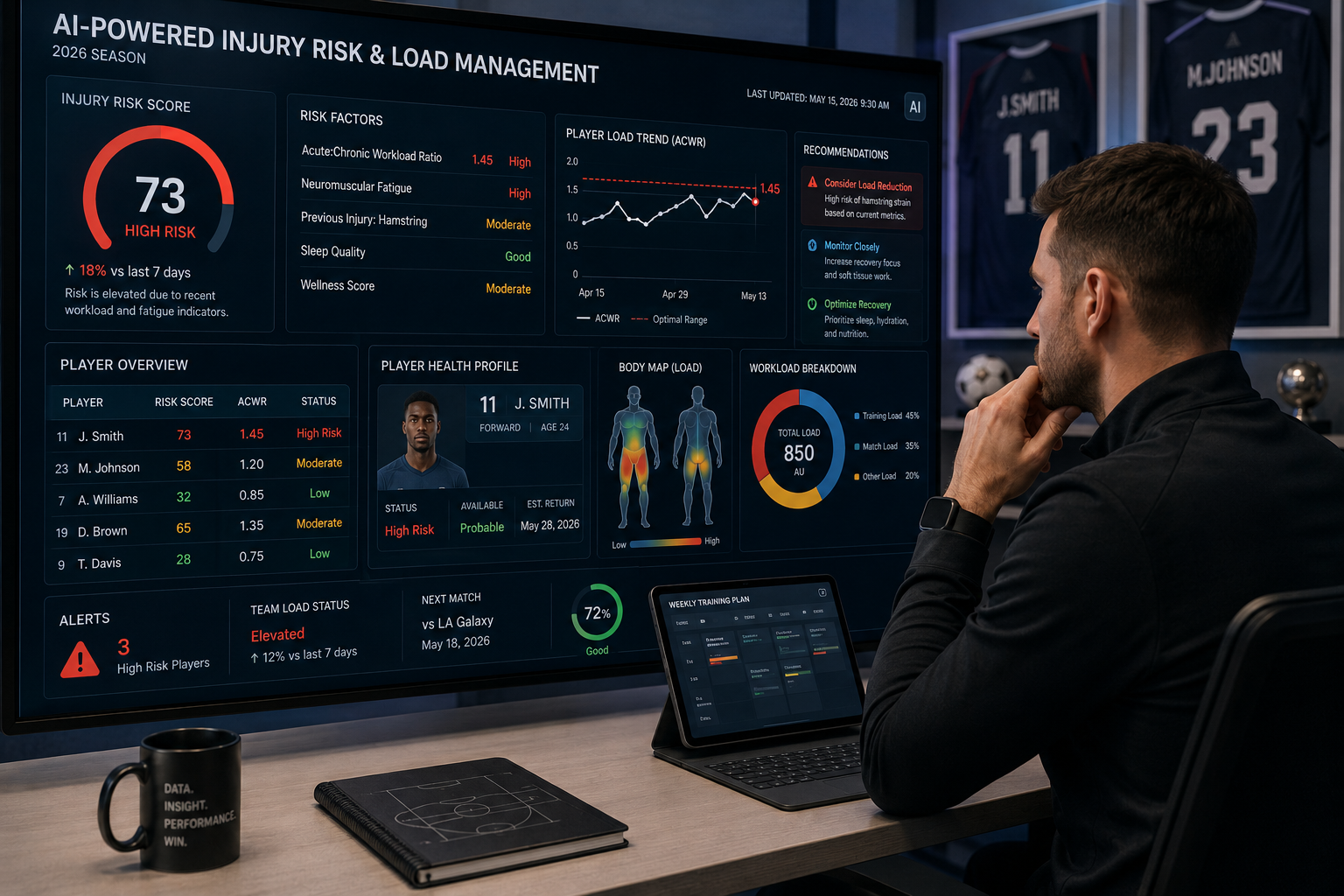
Three years ago, that decision relied on the coach’s gut feel, the athletic trainer’s physical assessment, and whatever the player said when you asked how they were feeling. In 2026, it relies on all of those things plus an AI model that has processed thousands of data points across that player’s entire career, compared them to historical injury patterns, and issued a specific risk score.
That’s not a marginal improvement. That’s a different kind of decision.
Injury Prevention: Where AI Has the Clearest Documented Impact
Professional sport has always understood that healthy players are a competitive advantage. What it lacked was the ability to predict, with any precision, when a player was approaching the threshold where training stress converts from adaptation to breakdown.
Machine learning models predicting injury risk with 85-90% accuracy — by analysing biomechanical and load data — represent a genuine capability shift. The models work by identifying patterns in the data that precede injury, across large populations of athletes over multiple seasons. A basketball player whose jump fatigue index and landing force patterns start mirroring those of players who got injured in the past triggers a red flag. The coach sees it on a dashboard before the player limps off the court.
Sparta Science’s AI-powered force plates demonstrate the clinical precision now available at the elite level. Athletes jump; the system analyses their jump dynamics to flag strength imbalances and fatigue that precede injury, then prescribes personalised exercise adjustments. This isn’t a general warning that someone seems tired — it’s a specific, biomechanically grounded intervention targeting the specific asymmetry that, historically, has preceded the specific injury type the model has learned to associate with it.
Kitman Labs combines everything — game stats, practice workload, recovery metrics, injury history — into one intelligence platform. The documented outcome from a professional rugby team that implemented Kitman’s system: 30% fewer injuries and 10% higher player availability over two seasons. Player availability is directly correlated with performance in professional sports — the team with more of its best players available wins more games. A 10% improvement in player availability across a full squad is a genuine competitive advantage.
Premier League football clubs use GPS tracking vests from Catapult that measure distance, sprint counts, and speed to help coaches optimise player workload and selection. The AI tracks athletes via heatmaps to assess whether their positioning aligns with tactical objectives — and flags when workload patterns suggest recovery should be prioritised over training intensity.
The NFL’s Digital Athlete programme, mentioned in the 2025 innovations timeline, uses biomechanical simulation to model injury risk across different game scenarios — informing both training practices and rule changes designed to reduce dangerous collisions.
The Operations Use Case Nobody Talks About Enough
Before the sophisticated performance analytics, before the injury prediction models, there’s a class of AI use case in sports that is less glamorous and more immediately impactful: operational logistics.
The San Antonio Spurs now use AI to create their full season travel logistics in 20 minutes. Previously, that task took three weeks.
This is worth dwelling on because it illustrates something about AI’s impact that gets missed in the performance analytics conversation. Professional sports operations involve managing 15-20 players, a coaching staff, medical staff, equipment across 82 games (NBA) in 30+ cities. Coordinating flights, hotels, practice facilities, arena schedules, and back-to-back game sequencing while minimising fatigue from travel (which affects performance) is a complex optimisation problem.
A human operations director working for three weeks to optimise this can do a good job. An AI that can run thousands of optimisation simulations in minutes and identify solutions that reduce cumulative travel fatigue while respecting scheduling constraints can do a better job. The operational decision that follows — which routing minimises red-eye flights before high-stakes games — is one that affects both win probability and athlete welfare.
The broader front office AI story involves scouting and roster construction. AI systems that analyse player movement data, performance in specific game contexts, and injury history across leagues that traditional scouting couldn’t cover have extended every front office’s effective scouting coverage. The teams that identified and signed specific players before their market value reflected their actual performance were often doing so on the basis of AI-surfaced insights their competitors hadn’t processed.
Refereeing, Officiating, and the Line Questions That Changed Everything
VAR — Video Assistant Referee — has been controversial in football (soccer) since its introduction. The controversy isn’t about whether video review improves accuracy; it does. The controversy is about disruption to the flow of the game and inconsistent application.
Semi-automated offside technology, deployed at the FIFA Women’s World Cup and major European league games, uses camera tracking and pose estimation AI to make offside determinations in seconds rather than minutes. The system generates a 3D reconstruction of the relevant players’ positions at the moment of the pass, determines whether any body part capable of scoring a goal was in an offside position, and delivers a result with a visual representation that can be understood by fans watching on broadcast.
This is materially different from traditional VAR offside review, which involved human reviewers drawing lines on video frames — a process that could take several minutes and still produced contested results because the methodology wasn’t consistent. Semi-automated offside reduces review time and removes the human subjectivity from the line-drawing step.
IBM’s data analytics solutions at Wimbledon and the US Open rank players’ momentum and predict match results based on explainable factors: previous win-loss ratio, win margin, rank differential, court surface, and injury status. Combined with fan sentiment from social media NLP analysis, these models provide broadcast enrichment that changes how tennis is covered rather than just how it’s played.
MLB’s ongoing consideration of automated strike zones is the next significant officiating AI deployment. The technology exists; pitch-tracking systems already generate the data in real time. The question is about fan experience, transition management, and whether the human element of pitch calling represents a feature (judgment, variability) or a bug (inconsistency, controversy) worth addressing.
Broadcast and Fan Experience: AI Democratising Coverage
ESPN uses generative AI to produce quick game recaps and summaries for many leagues, including underserved ones — freeing journalists to focus on deeper analysis while ensuring comprehensive coverage.
The specific application that makes this meaningful: smaller leagues that couldn’t justify the cost of dedicated broadcast coverage can now have their game data converted into readable recaps automatically. A minor league baseball game, a college women’s lacrosse match, a lower-division football game — these generate box scores and play-by-play data. AI converts that data into written summaries, making coverage available for games that previously received none.
NBC Sports used an AI-generated version of legendary narrator Jim Fagan’s voice for select promos and opening sequences in its 2025 NBA coverage. This is the more controversial application — using AI to replicate a specific human voice — and it sits in the middle of the ongoing debate about creative rights, consent, and what authenticity means in broadcast.
WSC Sports generates personalised highlight packages for each fan based on their favourite team, preferred players, and viewing history. A Manchester City fan gets different highlights from the same Premier League match than an Arsenal fan — the same 90 minutes of football generates thousands of personalised content packages automatically.
The technology trajectory for 2026-2027 includes AR glasses in arenas for live data overlays — speed, force, heart rate displayed on the fan’s view of the player in real time. The experiential question is whether additional data enhances the live experience or distracts from it. The technology is ready; the fan acceptance testing is ongoing.
The Honest Concerns: Governance, Bias, and the Human Element
PwC’s sports AI analysis is direct about what’s being left undiscussed in the rush toward adoption: “The same systems that can improve scouting, strategy, or fan engagement can also introduce risks around bias, data privacy, and fairness.”
Scouting AI trained on historical performance data will reflect whatever biases existed in how those players were evaluated historically. If certain player profiles were systematically undervalued by human scouts, the AI trained on their assessments will reproduce that undervaluation. Critically examining what the training data represents is not optional when the outputs affect people’s careers.
Player data ownership is an open question in most sports. The biometric data generated by GPS vests, force plates, and wearables is enormously commercially valuable. The athletes generating that data — their sprint speeds, heart rate patterns, biomechanical signatures — don’t always have clear rights to it or clear visibility into how it’s used. This is the sports version of the broader AI data ownership debate, and it hasn’t been resolved.
The human element isn’t simply a romantic attachment to tradition. Great coaching — the ability to inspire, to read a player’s psychological state, to make a half-time speech that changes the course of a season — doesn’t appear in any dataset. The teams winning with AI are using it to make better-informed human decisions, not to replace the human decisions. The coaches who understand what AI tells them and what it can’t tell them are the ones whose teams are winning.
The AI tells you that Player X’s jump fatigue index suggests injury risk. The coach decides whether to rest them for Thursday’s game or give them the choice because they’re the kind of player who responds better to autonomy. The data informs the decision. The human makes it.