In February 2026, commercial real estate stocks shed tens of billions in value on concerns about AI-driven disintermediation. That’s a sign the market is taking this seriously. But the honest picture is more nuanced — some use cases are genuinely transformative, others are still mostly demos. Here’s what’s actually working.
Real estate has always had an interesting relationship with data. The industry sits on enormous amounts of it — every transaction, every lease renewal, every maintenance call, every utility bill — and historically has done very little with it. The average asset manager at a commercial real estate firm spent more time in spreadsheets than on strategy, wrestling with fragmented data from property management systems, accounting platforms, and maintenance logs that rarely talked to each other.
That specific frustration — what Colliers has called the “AI productivity gap,” the distance between knowing AI could help and actually having it integrated into real workflows — is what makes the 2026 real estate AI story interesting. Over 90% of leading real estate firms now consider AI a strategic priority. More than 60% have active pilot programmes. The global AI in real estate market reached $303 billion in 2025 and is projected to grow to $989 billion by 2029.
But here’s the number that matters more than any of those: only 5% have achieved all their AI programme goals.
That gap — enormous investment, modest completion rate — is the real state of AI in real estate in 2026. The technology works. The integration, data quality, and organisational readiness often don’t. Let me walk through what’s genuinely transforming the industry and where the gap lives.
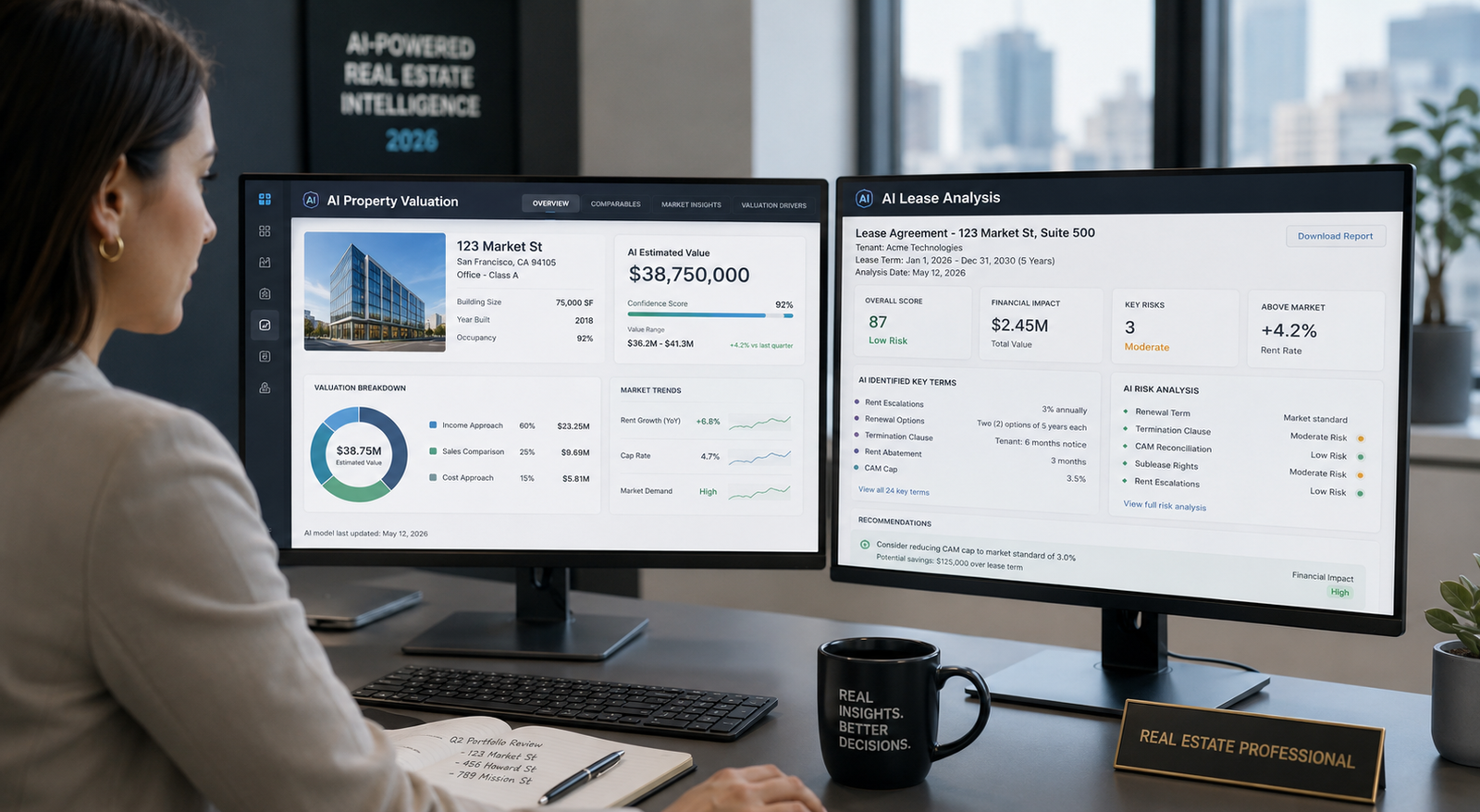
Property Valuation: From 10-15% Error to 2.4%
The most technically mature AI application in real estate is automated property valuation, and the accuracy improvement over five years is stark enough to have changed how the industry thinks about pricing.
Traditional Automated Valuation Models — the kind that Zillow’s Zestimate was built on — achieved median error rates of 10-15%. That’s a wide band. A property valued at $500,000 could reasonably be worth anywhere from $425,000 to $575,000 by the model’s own admission. Not a tool you’d base a $2 million commercial acquisition on.
Current AI-powered AVMs achieve median error rates of 2.4-2.8%, down from 10-15% five years ago. Zillow’s neural network, trained on millions of photos and home values, now reads listing photos for relevant information and factors them into valuations alongside metrics like square footage. Clear Capital’s ClearAVM updates hourly rather than daily, covers over 139 million US properties, and processes valuations 50% faster than traditional appraisals. A case study showed a 30% increase in loan approvals using ClearAVM compared to previous valuation methods — not because the model was more generous, but because it was more accurate, approving loans the old model would have conservatively rejected.
CoreLogic (rebranded as Cotality in 2025) achieves 99% accuracy across various scenarios with 3.9% year-over-year tracking accuracy, covering 99.9% of US properties. Their specialised risk analysis for natural disasters — hurricanes, wildfires, and floods — is becoming essential for insurance and investment decisions as climate risk becomes more material in property pricing.
What this means practically: investment decisions that used to rest on manual appraisals taking weeks are now informed by AI models that update continuously. A portfolio manager watching a market shift can get a real-time view of how valuations across their assets are moving — not a snapshot from the last quarterly appraisal.
Deal Underwriting: Days to Minutes
This is the use case where the gap between pilot and production is most dramatic, and where the 5% completion rate statistic feels most relevant.
Fifth Dimension, an AI-native operating system for real estate built on Google Cloud, has deployed an AI agent called Ellie that can execute complex workflows like deal screening and underwriting with full portfolio context — compressing processes that once took days of manual assembly into five to ten minutes. That’s not an incremental improvement. That’s a workflow transformation.
Traditional commercial real estate underwriting involves pulling data from multiple systems, reconciling it, running financial models, checking comparable transactions, and assembling a memo for investment committee review. At a medium-sized real estate investment firm, a single deal might take two analysts a full week to underwrite properly.
Ellie does the data assembly and initial analysis in minutes. The human analyst reviews the output, exercises judgment on market conditions and relationship context that the model can’t assess, and makes the investment recommendation. The value isn’t replacing the analyst — it’s compressing the mechanical work so the analyst spends their time on the parts that require their actual expertise.
The implementation challenge is exactly what you’d expect: real estate firms run on a mix of proprietary systems, legacy databases, and spreadsheets that don’t expose clean APIs. Getting AI to work across them requires the data integration work that’s unglamorous but essential — and this is where most firms’ AI programmes stall between pilot and production.
Lease Analysis: The Document Problem Finally Getting Solved
In 2026, real estate asset managers are still spending an average of 4-8 hours manually abstracting a single commercial lease. Multiplied across a portfolio of thousands of properties, this means teams are drowning in document review instead of strategic analysis and deal execution.
The manual extraction of key dates, financial terms, rent escalation clauses, renewal options, co-tenancy provisions, and exclusivity clauses from PDFs consumes thousands of hours annually and introduces error rates that can reach 10% or higher. Missing a lease renewal option or misunderstanding an exclusivity clause has real financial consequences.
AI lease abstraction tools are addressing this directly. Gazelle, which serves Swedish and Norwegian real estate agents, uses Gemini models to extract key information from lengthy property documents and generate sales content. The results are documented: output accuracy increased from 95% to 99.9%, content generation time dropped from four hours to 10 seconds, and the company launched four new products in less than a year using the freed capacity.
While that specific figure reflects a simpler document type than major commercial leases, the accuracy and time compression apply across the category. For complex commercial leases, AI tools like Kira Systems and LexCheck handle multi-document portfolios simultaneously, flagging issues for human review rather than attempting to make legal determinations autonomously.
PwC’s Emerging Trends in Real Estate analysis is direct about where this is headed: “As AI use expands further into research, underwriting, and reporting tasks, it is becoming a larger threat to hiring, particularly for entry-level roles.” The paralegals and junior analysts who spent careers doing document review are the workers most directly affected. The senior professionals who did the judgment-intensive work are seeing their effective capacity multiplied.
Tenant Experience and Property Operations
NoBroker, India’s largest real estate platform, has deployed an AI system called ConvoZen powered by Gemini to automate customer support across multiple Indian languages. The platform processes 10,000 hours of recordings daily, with AI agents projected to handle 25-40% of future calls — saving customers an estimated $1 billion annually through more efficient service.
For property managers in the US market, AI is being deployed for the high-volume, low-stakes inquiries that consume front-desk staff time: maintenance request routing, lease renewal reminders, amenity booking, package notifications, move-in coordination. One property management firm deploying an AI agent for first-response to every inbound inquiry within 90 seconds, qualifying leads through conversational exchange, and handing off to human agents only when prospects are ready to schedule a call — is a real deployment pattern, not a hypothetical.
Virtual staging — using AI to furnish empty listings with photorealistic furniture — has produced documented sales results. NAR data shows properties that have been staged (including virtually) receive 1-5% higher offer prices, with 81% of buyers saying staging helps them visualise living in the space. Images can be returned within three hours. A property on the market for six months that sold in one day after virtual staging is a documented case, not an anomaly.
The pattern across tenant experience AI is consistent: it handles volume, it handles repetition, it handles the moments where speed matters more than human judgment. The moments that require empathy, negotiation, and relationship — still human.
The Honest Gap: Why 95% Haven’t Achieved Their Goals
The 5% full-programme success rate isn’t a commentary on AI’s capability. It’s a commentary on data infrastructure, integration complexity, and organisational change management.
Real estate data is notoriously fragmented. Property management systems, lease administration software, accounting platforms, maintenance management, and market data feeds rarely share a common data model. Getting AI to operate effectively across all of them requires data integration work that takes months and often years — work that isn’t interesting to showcase in demos but determines whether the AI actually delivers value.
The firms making progress are the ones that treated data infrastructure as a strategic investment before attempting AI deployment. They built unified data environments, defined consistent data standards across systems, and established governance for who owns and maintains which data. Then they deployed AI into environments where the data quality could support reliable outputs.
The firms stalling are the ones that bought AI tools and discovered that the tools are only as good as the data they can access — which, in most legacy real estate operations, is inconsistent, incomplete, and incompatible across systems.
The market reaction in February 2026 — commercial real estate stocks shedding tens of billions on AI disintermediation concerns — reflects investor anxiety about the trajectory. The trajectory is real. The timeline is longer than the anxious reaction implies.