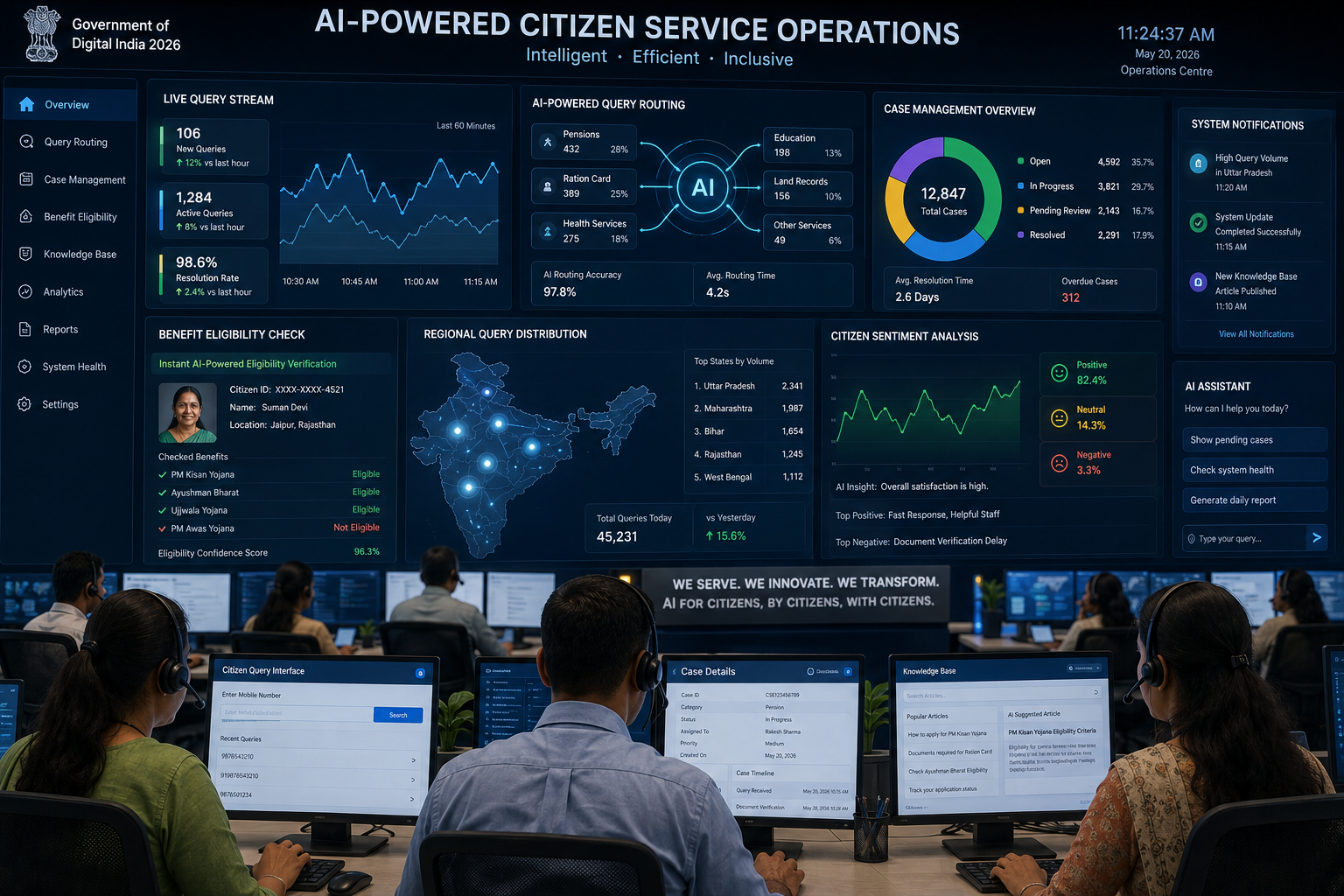
The city of Kyle, Texas has an AI agent answering its 311 calls. The federal government is spending a record $75.7 billion on IT this year. 82% of public sector organisations have deployed agentic AI. And 60% of agency heads believe they’re ahead of the private sector on adoption. Government AI in 2026 is more interesting — and more complicated — than most people realise.
Government gets a bad reputation on technology adoption. The stereotype — creaking legacy systems, multi-year procurement cycles, risk-averse bureaucracies, employees who learned Lotus Notes in 1994 and haven’t looked back — has enough truth to it that it sticks. And it makes the actual AI story in government in 2026 genuinely surprising.
IDC surveyed government leaders this year and found that 82% of public sector organisations have adopted agentic AI. Sixty percent of agency heads believe they are ahead of the business community on AI adoption. Eighty-nine percent believe that by 2030, humans and AI agents will work side-by-side across their organisations. And the White House is backing these shifts with a record $75.7 billion dedicated to supporting IT projects at federal agencies.
These numbers don’t fit the stereotype. Let me walk through what’s actually happening and where the genuine progress is — and where the genuine problems remain.
Why Government Is Surprisingly Well-Positioned for AI
Before the specific examples, a structural observation that helps explain the IDC findings.
Government has something that many private sector organisations don’t: a “critical mass of concentration of common use cases,” as one government technology leader described it at a recent Salesforce event. Benefits administration, eligibility determination, document processing, citizen inquiry handling — these are high-volume, repetitive, rule-based processes that occur identically across hundreds of agencies in dozens of jurisdictions. The AI solution developed for benefits eligibility in one state can be adapted for another. The chatbot deployed for one city’s 311 service can be replicated in the next city.
This commonality means that when AI works in one context, the learnings transfer. That’s different from the private sector, where company-specific processes and proprietary data mean more custom development per deployment.
The Alan Turing Institute quantified this opportunity with a specific and striking estimate: AI could help automate around 84% of repetitive transactions across 200 government services, freeing up resources for more complex citizen interactions that require human judgment. That’s an enormous potential efficiency gain if realised.
Google Cloud’s research found that nearly 90% of US federal agencies are planning or already using AI, with the most common applications being document and data processing (54% of agencies), citizen service automation, and fraud detection. Security and adversarial risk (48% of agencies) and reliability concerns (35%) are the primary barriers to faster adoption.
Agent Kyle: What Municipal AI Looks Like in Practice
The city of Kyle, Texas, deployed what they call “Agent Kyle” to handle 311 customer service calls — the general non-emergency service line through which residents report potholes, request services, and get information about city operations.
311 services are a perfect first AI agent deployment for local government: high volume, high repetition, clear success criteria, and relatively low stakes if the agent misclassifies a request (the consequence is a delayed pothole repair, not a critical infrastructure failure). Agent Kyle handles the standard inquiry load — service requests, status updates, operating hours, reporting — and routes the genuinely complex cases to human staff.
This pattern is appearing across municipal governments nationwide. AI agents are being deployed for benefits casework — helping caseworkers spend less time on administrative tasks and more time on the judgment-intensive aspects of case management. They’re handling routine permit inquiries, licensing status checks, and the enormous volume of repetitive questions that previously consumed civil servant time without adding strategic value.
Route Fifty’s analysis of state and local government AI in 2026 describes a shift toward “AI super prompters” — staff who understand both how government work flows and how to direct AI effectively within that context. The goal isn’t to replace policy judgment with automation. It’s to automate the administrative scaffolding around policy judgment so that human employees can focus on the interactions that require their actual expertise.
Tax Administration: Where AI Is Saving Real Money
Tax fraud and evasion cost governments hundreds of billions annually worldwide. AI is changing the detection economics in ways that rule-based systems never could.
The mechanism is straightforward in principle and technically sophisticated in practice. Traditional rule-based fraud detection identifies known patterns: income reported doesn’t match employer records, VAT claims exceed industry norms, asset values seem inconsistent with reported income. These rules catch the obvious cases. Sophisticated fraud is specifically designed to evade obvious rules.
AI analyses structural and unstructured data — including images and social media content, not just financial records — to surface patterns that indicate evasion without matching any specific pre-defined rule. Machine learning models learn from successfully prosecuted evasion cases and identify characteristics that are shared with new suspicious returns. They sort cases by risk and route them to appropriate staff, concentrating investigator attention on the cases most likely to be productive.
Tax administrations in European countries have been among the most active deployments. The European Central Bank’s Athena system, which analyses more than 5 million documents using AI across its supervisory function, demonstrates what’s possible when government agencies commit to data-intensive AI deployment. For tax specifically, several EU member state revenue authorities have reported significant increases in evasion detection rates with AI, though specific figures are generally not published.
In the US, the IRS’s ongoing technology modernisation effort includes AI components for identity verification, fraud pattern detection, and document processing. The specific challenge the IRS faces is representative of government AI broadly: legacy systems with decades of technical debt don’t integrate cleanly with modern AI infrastructure. Modernising the plumbing before deploying AI is often the majority of the real work.
The Department of Energy’s Scientific AI Platform
One of the more ambitious federal AI deployments of 2026 is the Department of Energy’s platform bringing together its 17 national laboratories, roughly 40,000 scientists and engineers, and private sector partners into a shared AI research environment.
The platform processes massive, multi-domain datasets through AI-driven simulations and real-time experimental data analysis. Researchers can run scenarios that would previously have taken years of sequential experimentation in days or weeks of parallel AI-assisted modelling. Teams can combine supercomputing outputs, laboratory results, and AI-generated insights into unified pipelines rather than working in the institutional silos that have historically slowed scientific collaboration.
This is the kind of infrastructure investment that produces results over decades rather than quarters, which is why it tends not to generate the press coverage that a chatbot deployment does. But the scale of what’s possible — 40,000 scientists with shared AI infrastructure across the world’s most powerful research complex — represents a genuinely significant public investment in AI-accelerated science.
Smart Traffic Management: 25% Time Reduction, 15% Emissions Cut
The infrastructure example that has the most documented, specific outcomes involves traffic management systems.
AI-powered smart traffic systems adjust signal timing in real time based on actual congestion rather than fixed schedules. They integrate with public transport systems — adjusting bus and train coordination dynamically based on traffic conditions. They optimise across the full network rather than intersection by intersection, which is where traditional systems create the compensating congestion that eliminates local improvements.
The documented outcomes from smart traffic AI implementations: 25% reduction in travel time in high-traffic zones and 15% reduction in vehicle emissions from better traffic flow — the emissions reduction comes from eliminating the stop-and-go patterns that generate disproportionate fuel consumption and pollution.
For a city with significant traffic congestion, those numbers represent both economic value (hours of productive time restored to residents) and environmental value (emissions reductions that contribute to air quality and climate commitments). Google’s Green Light project, which uses traffic data and machine learning to recommend signal timing adjustments, reports results consistent with this range across multiple cities where it’s been deployed.
The Governance Challenge That Government Is Taking More Seriously Than Most
One pattern that makes government AI implementations different from private sector deployments: the accountability requirements are higher and, in many cases, better specified.
When a government AI system makes a decision that affects a citizen — an eligibility determination, a tax assessment, a benefits allocation — that decision must be explainable and defensible in a way that private sector decisions often don’t need to be. Government agencies operate under statute, public accountability, and freedom of information obligations that require AI decisions to have “traceable outputs tied to source data, governing policies, and documented human approvals,” as Route Fifty’s analysis describes.
This accountability requirement is often described as a barrier to government AI adoption. It’s also, honestly, a feature. The impulse to explain and audit AI decisions in government is producing better governance infrastructure than many private sector deployments have developed. The agency that can show what AI did, what data it used, what human reviewed it, and what the outcome was is also the agency that can detect when the AI is producing biased or incorrect outputs — and correct course.
Brookings Institution research on federal AI adoption found that use remains concentrated among a handful of large agencies, with smaller agencies lacking the technical capacity to deploy effectively. The talent pipeline problem is real: federal salaries struggle to compete with private sector compensation for AI expertise, and promotion paths in technical roles are limited. These are structural problems that the record IT investment alone won’t solve.
The progress is real. The “government can’t do AI” stereotype is increasingly outdated. The challenges — legacy systems, talent competition, legal constraints on data use, public trust requirements — are also real, and they’re harder to solve than writing a budget line.