486 university students. A six-week randomised controlled trial. Significant improvements in positive affect, resilience, and reduced loneliness. That’s the first real RCT proving an AI wellbeing app works. But 14 million therapy sessions are now happening through AI apps in a context where waiting lists for human therapy stretch months. Both numbers matter. Here’s the full, honest picture.
Mental health is the AI use case where the stakes of getting it wrong are most personal.
When an AI misidentifies a legal citation, a judge notices and sanctions follow. When an AI gives a wrong answer in a customer service context, a ticket gets escalated. But when an AI interacts with someone in emotional distress — someone who is anxious, depressed, grieving, or in crisis — the consequences of getting it wrong are harder to see and potentially much more serious.
That context matters enormously for how to think about AI in mental health in 2026. This is not a domain where impressive demos, engagement metrics, and user satisfaction scores are sufficient evidence. It’s a domain that requires clinical evidence, safety protocols, and honest acknowledgment of what current AI can and cannot do.
The good news: the clinical evidence is beginning to arrive, and some of it is genuinely promising. The honest assessment: most AI mental health apps significantly overstate their therapeutic credentials, and the gap between “AI-powered wellness app” and “evidence-based mental health intervention” is wider than the marketing suggests.
The Evidence That Actually Exists
For most of the history of AI mental health apps, the evidence base has been thin. Apps claimed therapeutic benefit, cited the underlying principles of evidence-based therapies (CBT, ACT, DBT), and collected user satisfaction data. That’s not the same thing as clinical evidence.
The situation is improving. The most significant development of 2025-2026 is the publication of the first multi-institutional, longitudinal, randomised controlled trial of a generative AI wellbeing app.
The study: 486 undergraduate students from three US institutions, randomised over six weeks in autumn 2024. The intervention: the Flourish app, which uses generative AI to deliver positive psychology, CBT, and ACT-based wellbeing support. The control: waitlist condition.
The results, published in a peer-reviewed paper: participants in the treatment condition reported significantly greater positive affect, resilience, and social wellbeing — including increased sense of belonging, closeness to community, and reduced loneliness. Crucially, AI app users were buffered against declines in mindfulness and flourishing that were observed in the control group.
That’s a meaningful finding from a rigorous design. An RCT with multiple institutions, a preregistered protocol, and positive outcomes for positive affect, resilience, and loneliness reduction represents a qualitatively different level of evidence than what most AI mental health apps cite.
Woebot, one of the oldest and most-studied AI mental health tools, has published peer-reviewed research demonstrating effectiveness for reducing depression and anxiety symptoms in specific populations. A 2017 Stanford study found Woebot significantly reduced symptoms of depression in college students over two weeks. More recent studies have examined its effectiveness with postpartum depression and substance use disorders. The evidence base is not as strong as for established cognitive-behavioural therapy protocols, but it’s substantially stronger than most digital health interventions.
The honest caveat: effect sizes in AI mental health research tend to be moderate, most studies are short-term (weeks rather than months), and very few studies have compared AI interventions directly to human therapy in equivalent populations. The evidence supports “AI tools help” better than it supports specific claims about relative effectiveness.
What the AI Mental Health Apps Are Actually Doing
The landscape of AI mental health apps falls into roughly three categories, and they’re not equivalents.
Evidence-based AI therapy tools: Woebot and Wysa are the most established. Both are built on structured clinical frameworks — CBT, ACT, DBT techniques — designed with mental health professionals. Both have published research. Neither claims to replace therapy; both are explicit that they’re complementary to professional care and refer users to professional help when appropriate. Both have crisis detection protocols that direct users experiencing acute distress to crisis lines. These are the tools that have the most credible clinical backing, while being honest about their limitations.
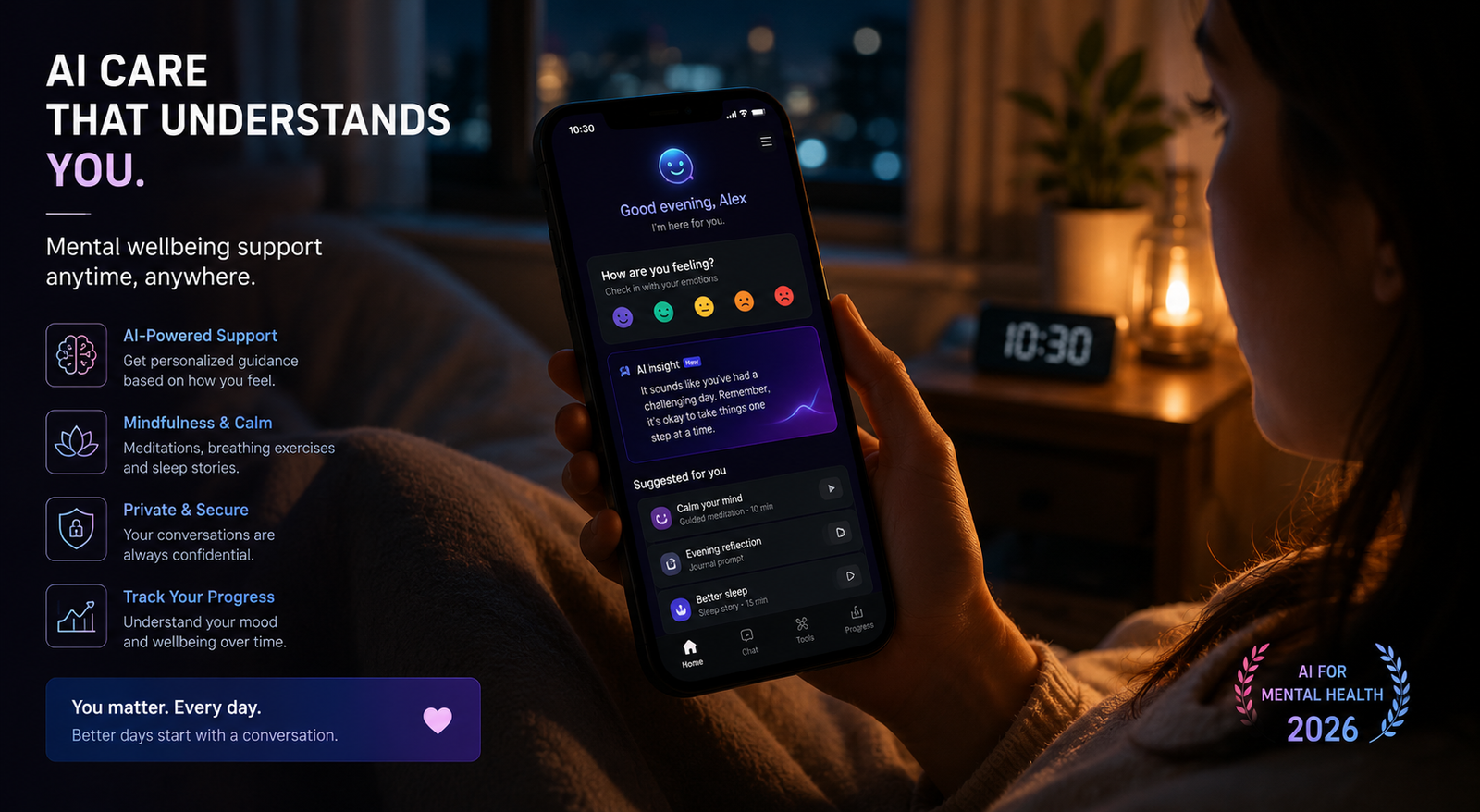
AI wellbeing coaching platforms: Flourish, Youper, and Headspace’s Ebb fall into this category. They use generative AI for personalised support, habit building, emotional processing, and stress management. Flourish now has RCT evidence. Youper has over 2 million users and therapist-backed design. These tools are more comprehensive than the therapy-specific tools but make correspondingly broader claims. The evidence base is growing but less mature than for Woebot.
AI companion apps: Replika occupies a distinct category — AI companionship for emotional connection and social support rather than therapeutic intervention. It’s often described as an “AI friend” rather than a therapy tool. For users who experience loneliness or social anxiety, the companionship dimension may have genuine value. The evidence base for companion AI is different from — and weaker than — the evidence for structured therapeutic tools.
The “chatbot in disguise” problem: A significant proportion of AI mental health apps are general AI chatbots with mental health framing — a structured UI, some therapeutic language, mood tracking features, and no underlying evidence base. They’re not dangerous in the way a fraudulent medical device is dangerous, but they may provide an illusion of mental health support that delays seeking genuine help. The honest consumer advice: look for published clinical research, crisis detection protocols, and explicit referral pathways to professional care before trusting an app with your mental health.
The Access Problem: Why This Matters Beyond the Technology
The most compelling argument for AI mental health tools in 2026 is not “AI is better than therapy.” It’s that therapy is unavailable for enormous numbers of people who need it.
Waiting lists for mental health services in many countries stretch months. Out-of-pocket therapy costs run $100-300 per session in the US, inaccessible to large portions of the population without insurance or with inadequate insurance. Rural and underserved communities often have no local therapists at all.
In this context, an AI tool that provides genuine — if limited — therapeutic benefit at any hour, at zero or low cost, with no waiting list, addresses a real problem. The argument is not that AI therapy is equivalent to human therapy. It’s that something evidence-based is substantially better than nothing, and nothing is what many people currently have access to.
The global AI mental health market is projected to grow at 24% annually through 2030. That growth is being driven not primarily by people choosing AI over therapy, but by people who have no practical access to therapy finding AI as an available option.
For this population — people who would otherwise receive no support at all — the evidence-based tools represent a genuine improvement in access to mental health support. This is the use case where AI mental health tools are most defensible and most valuable.
The Critical Boundaries: What AI Genuinely Cannot Do
Being honest about what AI mental health tools can do requires equal honesty about what they cannot.
Crisis intervention. When someone is in acute mental health crisis — experiencing suicidal ideation, psychotic symptoms, or immediate danger — they need human connection, professional assessment, and potentially emergency intervention. AI tools can detect crisis signals and direct people to crisis resources, and the established tools take this responsibility seriously. But the role of AI in acute crisis is strictly limited to routing, not managing. Every credible AI mental health tool makes this explicit.
Complex psychiatric diagnosis and treatment. Diagnosing depression, anxiety disorders, bipolar disorder, PTSD, or other mental health conditions requires clinical training, comprehensive assessment, and ongoing therapeutic relationship. AI tools can support symptom awareness and provide coping strategies. They cannot substitute for psychiatric evaluation or the kind of trauma processing that requires a trained therapist’s presence.
Trauma work. Evidence-based trauma therapies — EMDR, CPT, trauma-focused CBT — require highly specialised training, careful pacing, and the kind of attunement to client distress that current AI cannot replicate. The therapeutic relationship itself is a treatment mechanism for trauma. AI can provide some adjacent support — grounding techniques, psychoeducation, symptom monitoring — but not the core trauma treatment.
Ongoing therapeutic relationship. The evidence base for human psychotherapy includes a large component that researchers attribute to the therapeutic alliance — the relationship between therapist and client. This relationship involves genuine attunement, consistent presence over time, and the therapist’s emotional attunement to the client’s state. AI simulates aspects of this, but the evidence that AI relationship provides equivalent benefit to human therapeutic relationship is not established.
These boundaries are not temporary limitations that better AI will overcome in the near term. They reflect something fundamental about what certain types of mental health support require.
How to Think About AI Mental Health Tools — An Honest Framework
Use AI mental health tools for: Daily emotional support and check-ins, CBT skill practice (thought records, behavioural activation, cognitive restructuring), mindfulness and stress management, mood tracking and pattern awareness, mild to moderate anxiety and low mood that doesn’t meet clinical criteria, moments when professional support isn’t available, support between therapy sessions, and building long-term wellbeing habits.
Seek professional care for: Symptoms that persist for more than two weeks and affect daily functioning, suicidal thoughts or self-harm urges, trauma history that is causing ongoing distress, severe anxiety that prevents normal activity, psychosis or significant breaks from reality, substance use disorders with physical dependence, and any clinical condition requiring diagnosis and treatment.
Choose tools with: Published clinical evidence, explicit crisis protocols and referral pathways, evidence-based design (genuine CBT/ACT/DBT frameworks rather than therapeutic language), transparent limitations, and therapist involvement in design or oversight.
The AI mental health landscape in 2026 represents genuine progress in access to evidence-based support. It also contains significant overreach in what apps claim versus what evidence supports. Both of those things are simultaneously true — and understanding the boundary between them is what enables people to use these tools in ways that actually help.