John Deere’s See & Spray system distinguishes individual weeds from crops at 5 miles per hour and applies herbicide with 2.5cm accuracy. A farmer described it to us as “a sniper, not a shotgun.” That specificity — not the general promise of “AI in agriculture” — is what the technology is actually delivering in 2026.
Agriculture has a problem that most technology sectors don’t face: it’s feeding 8 billion people on a planet where arable land is finite, water is increasingly scarce, and climate change is making growing conditions less predictable every year. The Food and Agriculture Organization of the United Nations estimates the world needs to produce 70% more food by 2050 to meet projected population and income growth, largely without expanding into new agricultural land.
That’s not a problem you solve by doing what we’re already doing slightly more efficiently. It requires producing more from the same land, with less water, less chemical input, and more resilience against weather variability. The honest version of “AI in agriculture” is not a technology trend story. It’s a story about whether we can scale food production fast enough to feed everyone who will need to eat over the next thirty years.
The technology is contributing to that goal in specific, documentable ways. Not enough, not fast enough, not equitably distributed. But meaningfully, measurably, and with a trajectory that the evidence supports taking seriously.
Precision Crop Monitoring: Catching Problems Before They Become Disasters
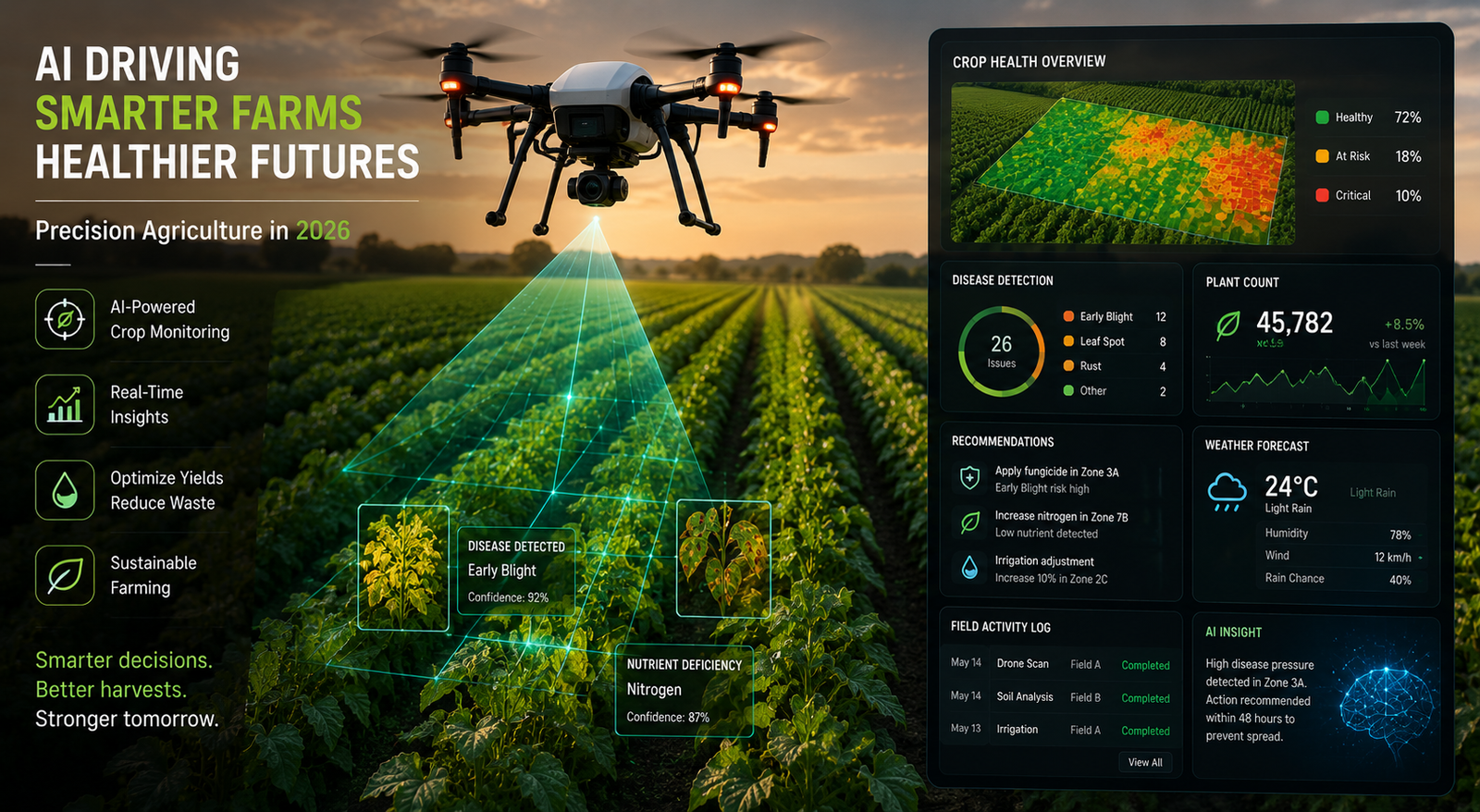
Plant diseases and pest infestations spread exponentially if undetected. A fungal infection that a farmer might notice when 30% of a field is affected could have been detected at 2% coverage — 14 days earlier — by an AI system monitoring the crop continuously from satellite imagery, drone footage, and ground sensors.
That 14-day window is the difference between a manageable intervention and a crop failure.
AI-powered crop monitoring works by training computer vision models on hundreds of thousands of images of healthy and diseased plants across dozens of crop varieties and dozens of disease types. The models learn the specific visual signatures of each disease at each stage of progression — signatures that are often invisible to human inspection until the disease is well advanced.
The commercial systems are now sophisticated enough that they can distinguish between disease types that require different interventions. Knowing that a field has early-stage Fusarium blight rather than early-stage Septoria leaf blotch matters because the treatment is different. A system that detects “disease present” is useful. A system that identifies the specific pathogen at the earliest observable stage and recommends the specific treatment is transformative for crop protection.
One major agricultural cooperative reported that AI crop monitoring across its member farms identified disease outbreaks at an average of 14 days earlier than traditional scouting, reducing crop losses by 23% across the pilot season. The economic value per acre varies by crop — the calculation is very different for wine grapes than for commodity corn — but across the cooperative’s scale, the loss reduction represented millions in preserved revenue.
Satellite-based monitoring allows this at scales that drone-based or ground-level monitoring cannot practically achieve. Major satellite imagery providers now offer AI-processed crop health indices as standard products, with weekly resolution during growing seasons. Farmers can see anomalies in specific field zones without physically walking every acre.
Precision Herbicide and Pesticide Application: The “Sniper” Model
Traditional herbicide application operates on a “shotgun” model: spray the whole field, accept that a large percentage of the chemical lands on crops that don’t need it, in soil that becomes chemically loaded, running into waterways that pay the ecological cost.
John Deere’s See & Spray Ultimate system is the most widely deployed example of an alternative approach. The system uses computer vision to distinguish individual weeds from crop plants at 5 miles per hour travelling speed, with 2.5-centimetre positional accuracy. It applies herbicide only to identified weeds, not to the surrounding crop or bare soil. The result: up to 77% reduction in herbicide use on treated fields compared to blanket application, with equivalent or better weed control.
The economics are equally compelling. Herbicide costs are a significant variable input for row crop farmers. A 77% reduction in herbicide application doesn’t just reduce chemical load in the environment — it reduces cash operating costs per acre by an amount that has made the See & Spray system compelling even at its premium price point relative to conventional sprayers.
The same computer vision approach is being applied to pest identification. An AI system that identifies the presence of specific pest species — aphids, thrips, spider mites — at the individual plant level allows targeted spot treatment rather than prophylactic whole-field application. This is particularly valuable in permanent crops (vineyards, orchards, citrus) where the ecological and regulatory costs of chemical inputs are highest.
Aigen Element, an agricultural robotics system highlighted at NVIDIA’s National Robotics Week, uses autonomous rovers equipped with AI vision to perform mechanical weeding in crops where chemical options are limited — organic production, herbicide-resistant weed populations, or crops where soil health is a priority. The system can treat 15-20 acres per day with a small team managing the robot fleet rather than manually weeding.
Precision Irrigation: Halving Water Use Without Reducing Yields
Agriculture accounts for approximately 70% of global freshwater withdrawal. In water-stressed regions — which are expanding as climate change redistributes precipitation — the economic and environmental stakes of agricultural water use are enormous.
Traditional irrigation operates on schedule and regional averages. Water is applied according to a calendar — so many acre-inches per week during the growing season — rather than according to what the specific soil and crop in the specific field actually need on a specific day. Over-irrigation is common because farmers operate under the asymmetric risk that under-irrigation kills crops while over-irrigation merely wastes water.
AI-powered precision irrigation changes this by integrating multiple real-time data sources to determine actual crop water need at the field-resolution level: soil moisture sensors at multiple depths, weather station data, satellite-derived vegetation indices that indicate actual crop stress, and evapotranspiration models calibrated to local conditions.
The documented water savings from precision irrigation systems range from 20-50% compared to conventional irrigation scheduling, with equivalent or better yields. For a 2,000-acre operation in a water-stressed region, a 30% reduction in water use represents potentially millions of gallons per season — and in regions where water is priced, priced by quotas, or subject to regulatory restrictions, those savings have direct financial value.
California’s Central Valley — which produces a substantial fraction of the US’s fruits and vegetables under significant water constraint — has seen rapid adoption of AI irrigation management. Several large-scale growers have reported that AI-managed drip and micro-sprinkler systems, continuously adjusted based on crop need signals, have maintained yields while reducing water use enough to bring operations within regulatory limits that were threatening profitability.
The technology is not uniformly accessible. The sensors, connectivity, and computing infrastructure required for precision irrigation have capital costs that are practical for large commercial operations and challenging for smallholder farmers who dominate food production in developing countries. This equity dimension — who captures the benefits of agricultural AI — is one of the honest challenges the sector hasn’t fully resolved.
Autonomous Equipment: Tractors That Drive Themselves at 2.5cm Accuracy
John Deere’s autonomous tractor system — available as an add-on to existing equipment — allows tractors to operate fully autonomously during field operations including tillage, planting, and spraying. GPS guidance achieving 2.5-centimetre accuracy eliminates overlapping passes (which waste inputs and compact soil unnecessarily) and allows 24-hour operations during planting windows that are often compressed by weather.
The labour dimension is real and growing more urgent. Agricultural labour shortages in developed economies are structural — the work is physically demanding, seasonal, and increasingly uncompetitive with alternatives available to potential workers. In the US, the H-2A temporary agricultural worker programme is at record volumes and still insufficient to meet demand. Autonomous equipment doesn’t solve this problem entirely, but it changes the labour calculation for certain field operations from “hours of operator attention” to “hours of supervision by a smaller team.”
An autonomous tractor operating at night — when temperatures are cooler and soil conditions may be better for certain operations — adds effective capacity during compressed seasonal windows. Farmers managing large acreages report that autonomous planting operations allowed them to complete planting during optimal soil temperature windows that previously would have required additional equipment or extended hours beyond what operators could safely maintain.
Harvesting remains more challenging for full autonomy — the mechanical complexity of harvest equipment and the real-time judgment required for variable crop conditions means that autonomous harvest systems are more limited than autonomous tillage and planting. But autonomous equipment in logistics — moving harvested product from field to storage — is operational at scale in several large operations.
The data these systems generate is itself valuable. Every autonomous operation creates a structured record of exactly what was done where — inputs applied, operations performed, timing, yield outcomes from that specific location. Aggregated across seasons, this builds the farm-specific data foundation that allows AI yield prediction models to improve continuously.
AI in Animal Agriculture: Precision Livestock Management
The use cases in crop production get the most coverage, but AI applications in livestock management are equally significant and in some ways more immediate.
AI-powered computer vision systems monitoring dairy herds detect early signs of lameness, mastitis, and respiratory illness by analysing movement patterns and behaviour across video feeds of large groups of animals. A dairy cow with early lameness — not yet showing obvious limping — changes her movement pattern subtly enough that human observers miss it but consistently enough that trained AI systems detect it. Early intervention prevents both animal welfare harm and the production losses that accompany untreated lameness.
Similar systems monitor feed intake, social behaviour, and reproductive status across large herds. The management of a 5,000-cow dairy operation is fundamentally different with AI monitoring systems than without — the effective observation-to-animal ratio that a farm management team can maintain changes from “periodic checks of representative samples” to “continuous monitoring of every animal.”
In poultry production, AI systems monitoring house conditions — temperature, humidity, CO2, ammonia, and bird behaviour — allow automatic adjustment of ventilation, heating, and feeding systems to maintain optimal conditions. These systems can respond to environmental changes in minutes rather than hours, maintaining more consistent growing conditions that improve feed conversion rates and reduce mortality.
Precision nutrition — formulating individual animal diets based on real-time milk production data, body condition scoring from computer vision, and metabolic indicators — allows dairy operations to optimise feed cost per unit of milk production. Feed is the largest variable cost in dairy production; even marginal improvements in feed conversion efficiency translate to significant economics at scale.
The Honest Challenges: Who This Technology Reaches and Who It Doesn’t
Agriculture in 2026 is deeply stratified. The large commercial operations in developed economies — the John Deere customers, the California Central Valley growers, the European precision agriculture adopters — are seeing real, documented benefits from AI tools. The smallholder farmers who produce a substantial majority of the world’s food in South Asia, sub-Saharan Africa, and Southeast Asia largely aren’t.
The barriers are practical: connectivity (many smallholder farms have limited or no reliable internet access), capital (the sensors, equipment, and subscriptions are priced for commercial operations), and technical capacity (using and maintaining these systems requires skills that aren’t uniformly available).
This doesn’t invalidate the technology’s value. It raises the question of whether agricultural AI’s benefits will primarily accrue to large commercial operators in wealthy countries, or whether the technology can be adapted and deployed in ways that reach the farmers who most need productivity support.
Some efforts are underway. Mobile-based crop disease identification tools — where a farmer photographs a sick plant and AI identifies the likely disease — are functional on basic smartphones without internet connectivity requirements. These tools are reaching smallholder farmers in India, Kenya, and Bangladesh. The accuracy is lower than sophisticated sensor-integrated systems, but the baseline is “nothing,” and improvement over nothing is substantial.
The equity story in agricultural AI is not a reason to dismiss the technology. It’s a reason to be honest about who currently benefits, and to direct effort toward extending those benefits more broadly. The technology exists. The challenge is distribution.