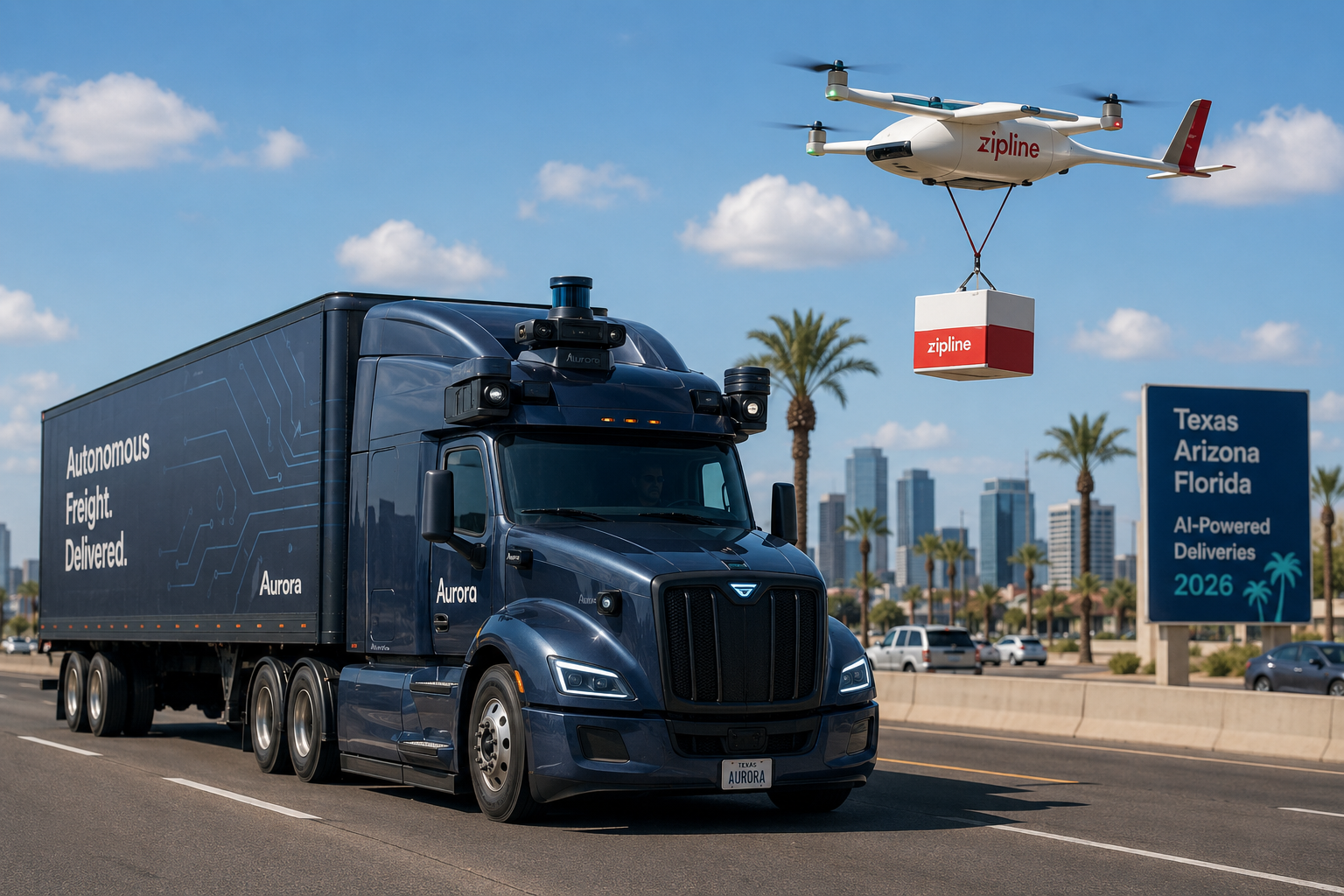
Aurora launched its first commercial driverless trucking routes in the Sun Belt in early 2026. Zipline’s drone service reduced maternal fatalities by 88% in Rwanda while delivering Walmart orders in the US. The gap between autonomous promise and operational reality has narrowed significantly. Here’s what the numbers actually show.
There’s a specific way the autonomous vehicle story has been covered since 2017 that has, unintentionally, made the actual progress harder to see.
The early promises were enormous. Fully autonomous vehicles everywhere by 2021. Truck drivers obsolete within five years. The predictions turned out to be wrong on timing in ways that made subsequent coverage sceptical of all claims. When Aurora announced commercial driverless trucking operations, the automatic reaction in many quarters was “we’ve heard this before.”
The reaction isn’t wrong to be cautious. But it’s obscuring something: in 2026, autonomous systems in logistics are actually operating, at commercial scale, doing real economic work. Aurora has logged 250,000+ miles with zero collisions on Sun Belt routes. Its capacity is fully booked through Q3 2026. Zipline has completed 2 million autonomous deliveries. Walmart’s AI-powered automated fulfillment has cut shipping costs by 30%.
These aren’t projections. They’re operational results. The story isn’t “autonomous logistics has arrived and solved everything.” It’s more nuanced and more interesting than that.
Aurora: The Commercial Reality of Driverless Trucks
Aurora Innovation launched its first commercial driverless trucking service in the US in early 2026, operating on Sun Belt routes between Texas cities. The service runs without a safety driver in the cab — genuinely autonomous, fully commercial, carrying freight for real customers.
Partners include FedEx, Werner, Schneider, and Uber Freight. Capacity is fully booked through Q3 2026. The company has logged over 250,000 miles with zero collisions.
This is meaningfully different from the testing programmes that characterised autonomous trucking from 2017-2024. Those programmes required safety drivers, operated under permit conditions, and were explicitly not commercial. Aurora’s current operation is commercial without safety drivers on specific, well-mapped routes where the operational design domain — the conditions the system is designed to handle — has been validated.
The “specific, well-mapped routes” qualifier is important and honest. Aurora is not offering autonomous trucking everywhere. It’s offering autonomous trucking on the specific routes where the system has been validated to the standard required for commercial operation. The Sun Belt geography — consistent weather, well-maintained highways, lower complexity than dense urban areas — is where the operational design domain is most established.
The economic case is compelling even on limited routes. Long-haul trucking is facing a structural driver shortage — estimates suggest over 60,000 unfilled positions in the US. The human factors that create safety risk in long-haul trucking — fatigue after 10 hours of driving, reduced alertness in the early morning hours — don’t apply to autonomous systems. A truck that can operate continuously without rest requirements, on routes where autonomous operation is validated, is a different economic proposition than the per-mile cost of human-driven freight.
Uber Freight’s platform shows the adjacent AI story: using algorithms to match loads to truck drivers, reducing empty miles by up to 15%. For a platform processing over $20 billion per year in freight, a 15% reduction in empty miles represents hundreds of millions in economic value — without requiring any vehicle to be autonomous.
Zipline: The Drone Service That Delivers Baby Formula and Saves Lives Simultaneously
Zipline is the most interesting logistics AI story in 2026 because it’s operating simultaneously in contexts with radically different stakes.
In Rwanda, Zipline’s autonomous medical delivery network has been operating for years. The documented outcome: an 88% reduction in maternal fatalities in the areas it serves, achieved by delivering blood and medical supplies to clinics that were previously too remote for reliable restocking. A clinic that runs out of O-negative blood during an emergency birth is a life-threatening situation. A Zipline delivery arriving within 30 minutes changes the outcome.
That is the unambiguous humanitarian version of what autonomous delivery can be.
The same company is also delivering Walmart orders, Wendy’s food, and Chipotle burritos in the United States. The stakes are obviously different. The operational technology is essentially the same.
This dual deployment reveals something important about how autonomous delivery actually works: the capability is domain-agnostic, but the value is domain-specific. Zipline’s 2 million autonomous deliveries demonstrate operational reliability at scale. The specific value of those deliveries varies enormously depending on what’s being delivered and to whom.
For last-mile logistics, the economics are becoming compelling in specific contexts. Drones can bypass traffic entirely, reducing delivery times and costs in congested urban and suburban areas. JD.com has deployed autonomous delivery robots in urban China that navigate city streets and deliver to doorsteps. Amazon Prime Air is expanding drone delivery operations with a 30-minute delivery target.
DHL’s Parcelcopter — the autonomous drone that delivered medical supplies in a 60-kilometre trip taking 40 minutes in rural Africa — demonstrates the gap-filling capability for areas where road infrastructure is limited or unreliable.
The honest state of drone delivery in 2026: regulatory progress has been significant but uneven, and most operations remain in defined geographic areas rather than everywhere. The technology works. The airspace management frameworks, liability standards, and community acceptance issues are taking longer to resolve than the technology did. BCG’s estimate that only around 10% of light trucks will drive autonomously by 2030 reflects this — not a technology failure, but a deployment and regulatory constraint.
Walmart and Amazon: AI Inside the Warehouse
The most economically significant AI in logistics in 2026 isn’t on the road or in the air. It’s inside warehouses.
Walmart’s AI-powered automated fulfillment has cut shipping costs by 30%, with 65% of stores targeted to be serviced by automated fulfillment by end of 2026. Amazon’s warehouse robot fleet crossed 1 million units. The combination of computer vision, autonomous mobile robots, and AI scheduling is transforming what a fulfilment centre can process per shift without proportional increases in labour.
AI-powered warehouse systems — pick-and-place robots, vision-guided forklifts, automated sorting — reduce picking errors by 67% and labour costs by 30-40% in high-SKU environments. US distribution companies report a 30-50% increase in warehouse throughput with AI and robotics integration.
The specific mechanism: AI scheduling systems coordinate human workers and autonomous robots simultaneously, dynamically allocating tasks based on real-time conditions. When human workers arrive in the morning, the system has already pre-staged the overnight orders, identified the replenishment priorities, and mapped the optimal picking sequence for the current inventory configuration. The robots handle the bulk movement and storage; human workers handle the exceptions, verifications, and tasks that require dexterity and judgment that current robotics don’t reliably replicate.
Amazon’s DeepFleet AI system — which coordinates the million-unit robot fleet — achieved a 10% improvement in travel efficiency across the network. At Amazon’s scale, 10% travel efficiency improvement across a million robots is an enormous operational gain.
Maersk’s AI Control Tower: The Global Shipping Intelligence Layer
Maersk, the world’s largest container shipping company, operates an AI “control tower” that continuously scans global port congestion, weather patterns, and demand signals to recommend routing cargo via alternative ports or intermodal links before disruptions materialise.
This is the logistics AI use case that operates at the largest scale: not individual deliveries or warehouse operations, but global maritime shipping affecting the movement of a significant fraction of world trade.
The mechanism: the system ingests real-time data from port sensors, AIS transponders on vessels, weather services, labour situation monitoring, and historical pattern data to identify developing disruptions days before they peak. When the model detects that Port X is developing congestion that will worsen over the next 72 hours, it can recommend pre-emptive rerouting through Port Y — avoiding the delay entirely rather than reacting to it.
The economics of avoided shipping delays are significant. A container vessel waiting at anchor outside a congested port costs approximately $30,000-50,000 per day in operating costs and opportunity cost. Avoiding a 5-day congestion event on a large vessel is a $150,000-250,000 direct saving per vessel. Across Maersk’s fleet, the aggregate impact is substantial.
DHL’s logistics agents work in the same mode: monitoring global shipments in real time, identifying disruptions, and autonomously suggesting alternative routes to maintain delivery continuity. The global shipping market is specifically where AI’s ability to process many simultaneous signals produces outcomes impossible at human processing speed.
The Honest Assessment: What’s Working and What Isn’t
Autonomous vehicles at full commercial scale remain constrained to specific operational domains. The Sun Belt routes where Aurora is operating are not everywhere. The urban delivery contexts where self-driving passenger vehicles have struggled — complex intersections, unpredictable pedestrian behaviour, edge cases that require genuine situational judgment — remain hard.
Generic AI chatbots deployed as logistics customer service have largely disappointed. The more interesting customer service AI in logistics is context-aware, knows the specific shipment, can provide genuine status updates, and handles exceptions intelligently — which requires data integration that many logistics companies haven’t built.
The AI that is working — route optimisation, warehouse automation, demand forecasting, disruption monitoring — is working because it’s deployed against well-defined problems with clean data and clear success metrics. The AI that isn’t delivering is typically the AI that was deployed as a general-purpose tool against a problem that wasn’t well-defined.
The global AI in logistics market exceeds $25 billion in 2026. The companies capturing the value from that investment are the ones running production systems, not pilots. Aurora’s booked capacity through Q3 2026, Zipline’s 2 million deliveries, Walmart’s 30% shipping cost reduction — these are the production benchmarks against which logistics AI should be evaluated.