The International Energy Agency ran the numbers. If AI applications in energy are widely adopted, they could reduce emissions by 1,400 megatons of CO2 by 2035 — three times more than all AI data centre emissions combined. That should be a great story. The catch: “there is currently no momentum that could ensure the widespread adoption of these AI applications.” Here’s the honest, complicated picture.
Climate AI coverage tends to fall into one of two narratives, and both are incomplete.
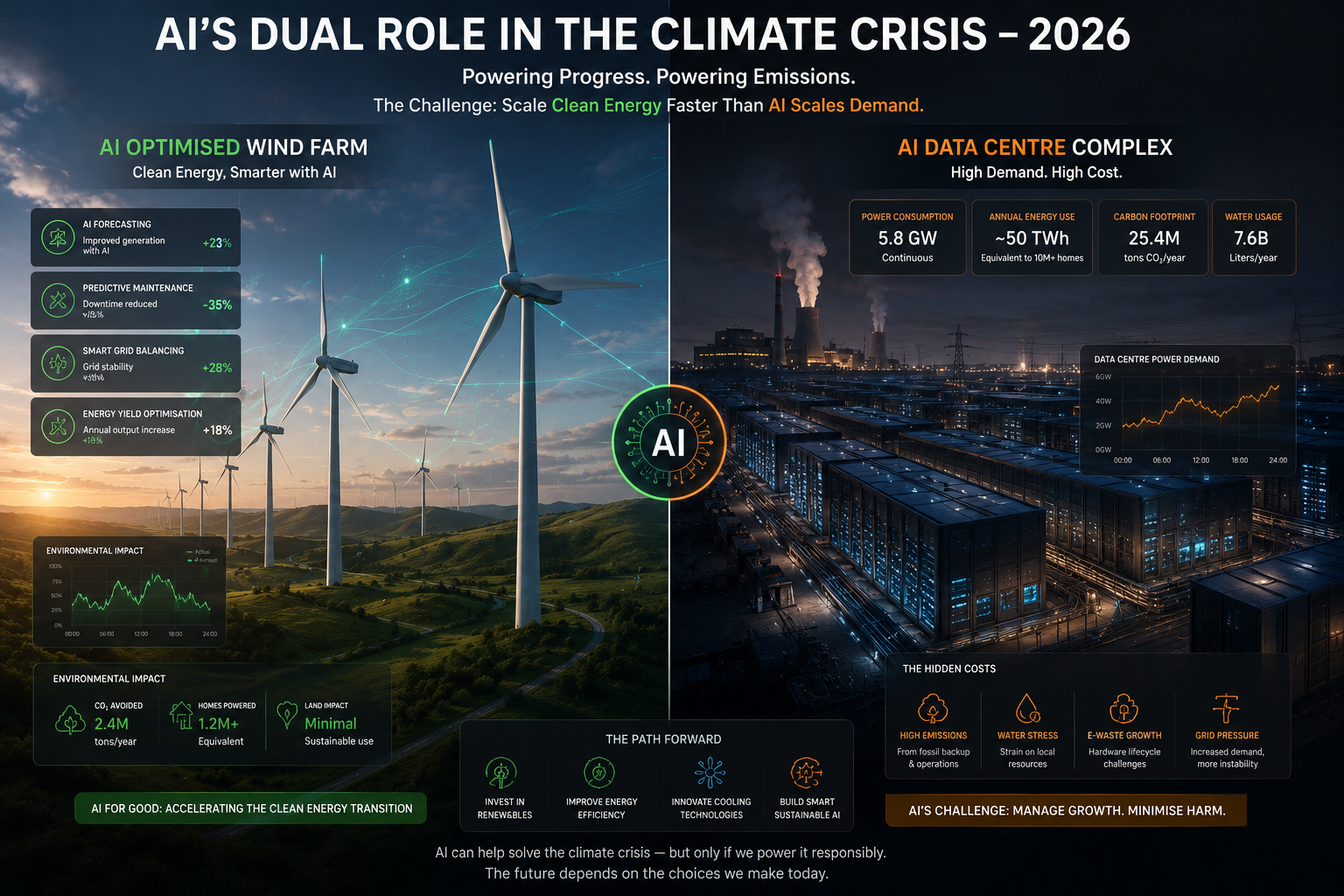
The first narrative: AI is the villain. Data centres are consuming electricity equivalent to Japan’s annual usage. AI is blamed for a 2.4% uptick in US fossil fuel emissions last year. New gas plants are being built specifically to power AI infrastructure. Big tech companies that had ambitious renewable energy commitments are quietly walking them back as compute demand outstrips what renewables can supply. This narrative is accurate.
The second narrative: AI is the solution. AI-powered grid management, precision weather forecasting, accelerated materials discovery, optimised renewable energy dispatch, smarter buildings — applied at scale, these could reduce global emissions by more than data centres emit. This narrative is also accurate.
Both narratives are incomplete because they ignore the conditional that makes each one true: AI’s impact on the climate depends entirely on what AI does and what AI runs on. The same technology that processes weather patterns to optimise wind farm dispatch is consuming enormous electricity to do so. Whether that’s a net positive for the climate is a function of what the electricity comes from, what efficiency the model achieves, and whether the insight produced actually changes anything.
Let’s work through this honestly.
What AI Data Centres Are Actually Doing to Energy and Emissions
The numbers are real and the direction is concerning.
Global data centre electricity consumption is projected to exceed 1,000 terawatt-hours by the end of 2026 — equal to Japan’s entire annual electricity usage. Data centres currently account for approximately 180 megatons of indirect CO2 emissions from electricity consumption, about 0.5% of global combustion emissions. The IEA projects that share to grow to 1-1.4% by 2030, with data centres among the few sectors seeing absolute emissions increases.
The fossil fuel connection is direct. Fortune’s reporting, citing Rhodium Group research, attributes the 2.4% increase in US fossil fuel emissions last year partly to AI data centre energy demand. An industry observer quoted by Fortune put it plainly: “It is only because of these data centers that these gas plants are being built. There are no two ways about it.”
Big tech companies that publicly committed to 100% renewable energy and net-zero emissions are encountering a hard physical constraint: renewable energy — particularly solar and wind — is intermittent and location-dependent. A data centre needs reliable baseload power, 24 hours a day, which renewables alone cannot reliably provide without grid-scale storage that doesn’t yet exist at the required scale. The gap is being filled with natural gas.
As of 2026, at least 27 US states are considering or have passed legislation related to data centre development, specifically addressing the energy infrastructure cost question. California, Ohio, and Utah have passed laws requiring data centre developers to bear the costs of new energy infrastructure rather than socialising those costs to all ratepayers. This is the right direction — the organisations creating the demand should fund the infrastructure it requires.
The carbon footprint of individual AI interactions varies enormously by model size and task type. Google’s research found a median estimate of about 0.24 watt-hours for a typical text prompt — roughly as much energy as watching nine seconds of television. Image generation and complex reasoning tasks use significantly more. The scale comes from volume: hundreds of millions of interactions per day, not the per-interaction cost.
What AI Is Actually Doing for the Climate — The Real Examples
Now the other side. And this side is genuinely significant — the problem is that the scale of deployment required to realise it isn’t happening.
Grid management and renewable energy integration. The fundamental challenge with renewable energy is predictability. Wind and solar generate electricity when meteorological conditions allow, not when demand requires. AI dramatically improves the ability to predict renewable output hours and days in advance, enabling grid operators to plan dispatch more effectively, reduce curtailment (wasted renewable generation), and integrate more renewable capacity without sacrificing reliability.
AI-based fault detection in grids can reduce outage durations by 30-50%, according to the IEA. A grid that fails less means less diesel backup generation, less disruption to commercial and industrial processes, and more reliable delivery of renewable power. The International Energy Agency reports that AI applications in energy can lead to cost reductions of up to 20% and productivity gains of 70%.
Google’s Green Light project is the most specifically documented example of AI applied to a large-scale emissions problem. The system uses traffic data and machine learning to recommend traffic-signal timing adjustments at intersections with the goal of reducing stop-and-go driving — the type of driving that generates disproportionate fuel consumption and emissions relative to steady-state travel. Google reports that Green Light is reducing emissions at intersections where it’s deployed by approximately 10%. At scale across thousands of intersections in cities worldwide, this compounds.
Smart buildings. Commercial and residential buildings account for approximately 30-40% of global energy consumption. AI building management systems optimise HVAC, lighting, and equipment operation based on occupancy patterns, weather forecasts, and energy price signals. The documented efficiency gains range from 10-25% in energy consumption, with corresponding emissions reductions. For a large commercial building spending $180,000 per month on energy, a 15% reduction is $27,000 per month — $324,000 annually from one system.
Materials discovery and clean energy. AI is accelerating the discovery of materials relevant to clean energy — better battery chemistries, more efficient solar cell materials, catalysts for hydrogen production. The mechanism: AI processes vast datasets on material properties, identifies promising candidates, and prioritises experimental investigation. What traditionally required years of laboratory trial-and-error can be compressed to months. In the climate race, that time compression matters.
Weather forecasting accuracy. DeepMind’s GraphCast model and similar AI weather prediction systems have achieved accuracy superior to traditional numerical weather prediction models in medium-range (7-10 day) forecasting at a fraction of the computational cost. Better weather forecasting improves the accuracy of renewable energy output predictions, enables better storm preparation and agricultural planning, and helps utilities manage demand-side variability.
The Gap Between What AI Could Do and What It’s Actually Doing
The IEA’s analysis is the most comprehensive quantitative assessment of AI’s climate potential, and it contains a conclusion that deserves significant emphasis.
“The adoption of existing AI applications in end-use sectors could lead to 1,400 Mt of CO2 emissions reductions in 2035 in the Widespread Adoption Case. This does not include any breakthrough discoveries that may emerge thanks to AI in the next decade. These potential emissions reductions, if realised, would be three times larger than the total data centre emissions.”
That’s the headline number: if AI’s climate applications are widely adopted, the climate benefit could be three times larger than the climate cost.
The sentence that follows, however, is the one that should be on every policy maker’s desk: “It is vital to note that there is currently no momentum that could ensure the widespread adoption of these AI applications. Therefore, their aggregate impact, even in 2035, could be marginal if the necessary enabling conditions are not created.”
There is currently no momentum that could ensure widespread adoption.
The AI applications with the greatest climate potential — smart grid management, building optimisation, precision agriculture, industrial process efficiency — face barriers that are not primarily technical. They require access to data that is currently fragmented across utilities, building operators, and industrial companies. They require digital infrastructure in contexts — rural areas, developing countries, aging industrial facilities — where that infrastructure doesn’t exist. They require regulatory frameworks that don’t currently facilitate the data sharing that makes AI optimisation possible. They require business model innovation that doesn’t yet align incentives toward deployment.
The AI applications that are being deployed at scale — large language models for text generation, image creation, code assistance, chatbots — are the ones with enormous energy footprints and modest direct climate benefit. The climate-beneficial AI applications are the ones with deployment barriers that the current market isn’t resolving on its own.
The Honest Policy Implication
The climate AI story is genuinely not a technology story. The technology exists and it works. The IEA’s numbers are based on existing, demonstrated applications, not speculative future capabilities.
It’s a political economy story. The barriers to climate-beneficial AI deployment are institutional — data access, regulatory frameworks, infrastructure investment, and incentive alignment. The barriers to energy-intensive AI deployment are much lower — cloud providers sell GPU access by the hour, and the market demand is enormous.
If nothing changes, the current trajectory produces AI that is a net emissions contributor through 2030, with uncertain and delayed climate benefits as beneficial applications slowly build adoption. The IEA’s Widespread Adoption scenario requires deliberate policy intervention — data access mandates, regulatory frameworks that enable AI-optimised grid management, building code updates that require smart management systems, and infrastructure investment in the contexts where climate-beneficial AI currently can’t reach.
Renewables are the genuine bridge. Optera’s analysis is right: renewables already account for over 90% of new utility-scale generating capacity because they’re faster to deploy and cheaper to operate. The AI sector’s enormous and growing energy demand is, inadvertently, creating economic pressure to accelerate renewable deployment — there simply isn’t enough carbon-free baseload power for the planned data centre buildout, which means either the buildout is constrained or the grid gets cleaner faster.
Whether AI turns out to be a net climate asset or a net climate liability is genuinely undetermined. The outcome depends on policy choices being made right now — on data centre energy sourcing requirements, on beneficial AI application deployment incentives, on renewable energy permitting reforms, and on whether the gap between what AI could do for the climate and what it’s actually doing gets closed in time to matter.
That’s not a comfortable conclusion. It’s the honest one.