AI is no longer just assisting work — in 2026, it’s starting to do the work. But the reality is more nuanced than the headlines suggest. Here’s what’s actually happening on the ground, with real examples, real stumbles, and real lessons.
Let’s start with a story most people haven’t heard.
In 2023, Klarna — the Swedish fintech giant — made headlines by replacing 700 customer service agents with an AI system. The numbers looked impressive. The AI handled the equivalent workload. Costs dropped. Executives celebrated. The “AI replaces humans” narrative had its poster child.
Fast forward to 2025. Klarna’s CEO publicly admitted they had gone too far. The company started rehiring human agents, building what they now call a hybrid model — AI handles the routine, high-volume queries; humans handle the complex, emotionally charged ones. The full replacement thesis failed. Not because the technology was bad. Because customer service isn’t just about resolution. It’s about relationship.
This is the story of AI agents in 2026. Not a revolution. A construction site. And understanding what’s actually being built — and where the foundations are still being poured — is the only way to navigate it intelligently.
What an AI Agent Actually Is (And Isn’t)
Before getting into what’s changing, it’s worth being precise about what we’re talking about — because the term “AI agent” has been stretched to cover everything from a basic chatbot to a fully autonomous digital employee, and those are very different things.
An AI agent, in the meaningful sense of the word, is a system that can take a high-level goal and work toward it across multiple steps — without needing a human to guide every action along the way. It can plan, use tools, make decisions, course-correct when things go wrong, and hand off results.
The critical word is autonomous. Not “responds when prompted.” Autonomously acts.
In practice, this means an agent might: receive a brief like “prepare a competitive analysis of our top three rivals,” then independently search the web, pull data from internal databases, draft a structured report, flag the three most significant insights, and drop it into a shared folder — all while you’re in a meeting.
That’s meaningfully different from typing a query into ChatGPT. And in 2026, that kind of workflow is genuinely being deployed at scale — just not everywhere, and not without friction.
The Numbers Are Real — And Moving Fast
If you want to understand the scale of what’s happening, the data is striking.
IDC projects that AI agents will be embedded in nearly 80% of enterprise workplace applications by the end of 2026. The AI agent market — valued at $7.84 billion in 2025 — is growing at a compound annual rate of 46.3%, on a trajectory toward $52 billion by 2030. Salesforce research shows a 282% jump in AI adoption over the past two years.
Around 35% of organizations already report broad AI agent usage. Another 27% are in limited deployment or active experimentation. And 17% have rolled agents out company-wide.
These are not vanity metrics from AI vendors trying to justify valuations. They reflect a genuine behavioral shift in how enterprises are allocating technology budgets and restructuring workflows.
“By 2026, the workplace won’t evolve through more apps or digital assistants, but through Connected Intelligence — where people, data, and digital workers work together side by side.” — Aruna Ravichandran, SVP & CMO, Cisco
But numbers at this scale always risk obscuring what’s actually working versus what’s being piloted with optimism and a generous definition of “deployment.” So let’s get specific.
Where AI Agents Are Genuinely Delivering — With Real Examples
Customer Service: The Triage Model Wins
The lesson from Klarna is being absorbed across the industry. Telecom leads agent adoption at 48%, retail at 47% — and the companies succeeding in both sectors are using agents for triage and routing, not full conversation replacement.
The model that’s working: an agent receives the customer contact, identifies the nature of the issue, handles anything transactional or routine autonomously, and escalates complex or sensitive cases to a human with full context already prepared. The human walks into the conversation informed, not starting from scratch.
Danfoss, the global manufacturer, deployed AI agents to automate email-based order processing. The result: 80% of transactional decisions are now handled automatically, and average customer response time dropped from 42 hours to near real time. That’s not replacing the customer relationship — it’s removing the latency that was degrading it.
Operations and Manufacturing: Digital Twins and Agent Oversight
PepsiCo, working with Siemens and NVIDIA, has deployed AI agents inside high-fidelity 3D digital twins of its manufacturing and warehouse facilities. The agents simulate end-to-end plant operations, identify up to 90% of potential issues before any physical changes are made, and have already delivered a 20% increase in throughput on initial deployments. Capital expenditure has been reduced by 10–15%.
This is not a chatbot. This is an agent-driven operational layer that runs continuous simulations, flags anomalies, and informs human decision-making with a level of detail that was previously impossible at this speed.
Software Development: The Clearest Win
If there is one area where AI agents have delivered the most unambiguous value in 2026, it is software development.
LangChain’s 2026 State of Agent Engineering report — drawn from over 1,300 practitioners — found that the tools developers actually use daily are, overwhelmingly, coding agents: Claude Code, Cursor, GitHub Copilot. Not the elaborate multi-agent orchestration frameworks that get written about in research papers. Coding assistants.
Cursor alone has over a million users and 360,000 paying customers. Claude Code is described by developers as the most capable agent for hard, open-ended problems — the ones where other tools give up. The most effective workflow, by practitioner consensus, is hybrid: an IDE-integrated agent for daily work, a terminal-based agent for genuinely difficult problems.
Meanwhile, Suzano — the world’s largest pulp manufacturer — deployed an AI agent that translates natural language questions into SQL code across 50,000 employees. Time required for database queries dropped by 95%.
More than 57,000 Telus employees are regularly using AI and saving 40 minutes per AI interaction. — Google Cloud, 2026 AI Agent Trends Report
The New Infrastructure Behind It All
One reason 2026 feels different from previous years of “AI is going to change everything” is that the underlying infrastructure has finally matured enough to support real deployment.
Two protocols are worth understanding specifically.
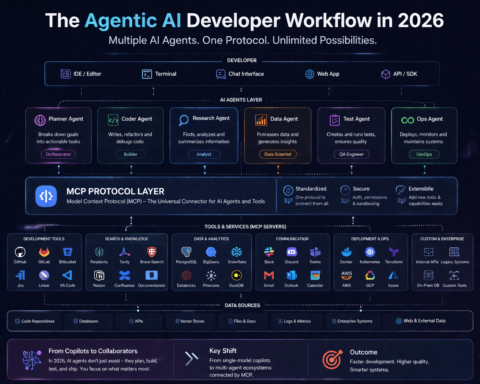
MCP (Model Context Protocol) — developed by Anthropic and now adopted by OpenAI, Microsoft, and Google — is essentially a USB-C standard for AI agents. It allows any agent to connect to external tools: databases, APIs, calendars, file systems, CRM platforms, code editors. Before MCP, every integration required custom engineering. Now, it’s standardized. That dramatically reduces the cost and complexity of deploying agents in real business environments.
A2A (Agent-to-Agent protocol) — being built by Salesforce and Google Cloud — takes this a step further, allowing agents from different platforms to communicate and hand off work to each other. The vision is a “digital assembly line” where specialized agents handle their domain and pass outputs upstream, just as humans do in a well-structured team.
Microsoft, at its Ignite 2025 conference, unveiled a full platform for deploying “fleets of production-ready AI agents” across the enterprise, complete with dedicated infrastructure called Work IQ, Fabric IQ, and Foundry IQ — giving agents persistent memory, access to real-time business data, and reliable knowledge bases. They also launched Copilot Studio Lite, a low-code toolkit so non-technical teams can build and customize their own agents without waiting on IT.
The infrastructure is being built at pace. That’s what makes 2026 different from 2024.
The Part Nobody Talks About: Governance and Trust
Here is where most AI agent coverage goes quiet — and it shouldn’t.
Giving an AI agent the ability to take actions in the real world is not a small thing. It can send emails on your behalf, move files, execute transactions, update records. When that goes right, it’s powerful. When it goes wrong — and it does go wrong — the consequences are real.
The industry is responding to this, though unevenly.
Microsoft is assigning every enterprise AI agent a unique digital identity through its Entra ID system, so that every action an agent takes is tracked and attributable, just like a human employee’s. Organizations are implementing real-time dashboards that monitor what all agents are doing, compliance flags when an agent steps outside defined boundaries, and detailed decision logs for audit purposes.
Forrester’s 2026 enterprise software predictions note that the next big leap is “role-based” AI agents — not just task-based — which means HR technology is being repositioned as a system of record for a hybrid human-AI workforce. Your org chart, in 2026, may soon include agents alongside employees.
The honest reality: companies that deploy agents without these governance frameworks in place are taking on real risk. An unmanaged agent can send erroneous communications, make unauthorized decisions, or produce outputs that cause compliance problems. The governance conversation is not optional — it’s what separates the deployments that scale from the ones that get quietly shut down.
What’s Overhyped Right Now
In the interest of giving you a genuinely useful picture: not everything being marketed as “agentic AI” deserves the label, and not every use case is mature enough for unsupervised deployment.
The elaborate multi-agent orchestration frameworks — where dozens of specialized agents collaborate on complex tasks with minimal human oversight — remain more impressive in demos than in production. The most widely used frameworks (LangGraph for production pipelines, CrewAI for prototyping) are improving rapidly, but the practitioner consensus is clear: keep humans in the loop for anything high-stakes.
The “one AI that runs your entire company” narrative is still years away. What’s here now is something more modest but still significant: AI that reliably handles specific, well-defined categories of work, freeing the humans in that workflow to operate at a higher level.
That’s worth taking seriously. It’s just not the same as the headline.
What This Means for How You Work
The practical question for most people reading this isn’t “will agents take my job” — it’s “how do I position myself well in a workplace where agents are increasingly part of the team.”
The answer is becoming clearer.
The professionals who are thriving alongside AI agents are not the ones who know how to code them. They’re the ones who know how to direct them — who can break a complex goal into clear component tasks, evaluate whether the output meets the brief, catch errors before they propagate, and know when to hand something back to a human.
This is a different skill from deep technical expertise. It’s closer to good management: clear communication, systematic thinking, quality judgment, and the discipline to verify before you trust.
Organizations are catching up to this. A growing number are establishing “AI workforce manager” roles — people responsible for coordinating blended human-AI teams, assigning work intelligently between human employees and agents based on context and risk, and ensuring the agents are operating within the right parameters. It is, genuinely, a new kind of job.
The companies building an AI-ready workforce right now — not just buying AI tools, but training their people to work alongside agents effectively — are the ones that will have a structural advantage by 2027. The technology is accessible to everyone. The operational know-how to use it well is not.
The Honest Summary
AI agents in 2026 are not a revolution. They are a serious, accelerating shift in how work gets structured — and the gap between organizations that are figuring this out and those that aren’t is widening every quarter.
The wins are real: Danfoss cutting 42-hour response times to near real time. PepsiCo getting 20% throughput gains in manufacturing. Hundreds of thousands of developers working faster with coding agents every day. These are not pilot projects anymore.
The stumbles are also real: Klarna learning that full replacement doesn’t work for relationship-driven work. Multi-agent orchestration still needing more maturity before it can be trusted with unsupervised high-stakes decisions. Governance frameworks still being built in most organizations.
The picture is neither the utopian nor the dystopian version you see in most headlines. It’s more interesting than either — a genuine, substantive change happening at an uneven pace, with clear winners already emerging among the organizations paying careful attention.
MEFAI will keep tracking what’s actually working, with specifics, not abstractions. That’s the only kind of coverage worth your time.