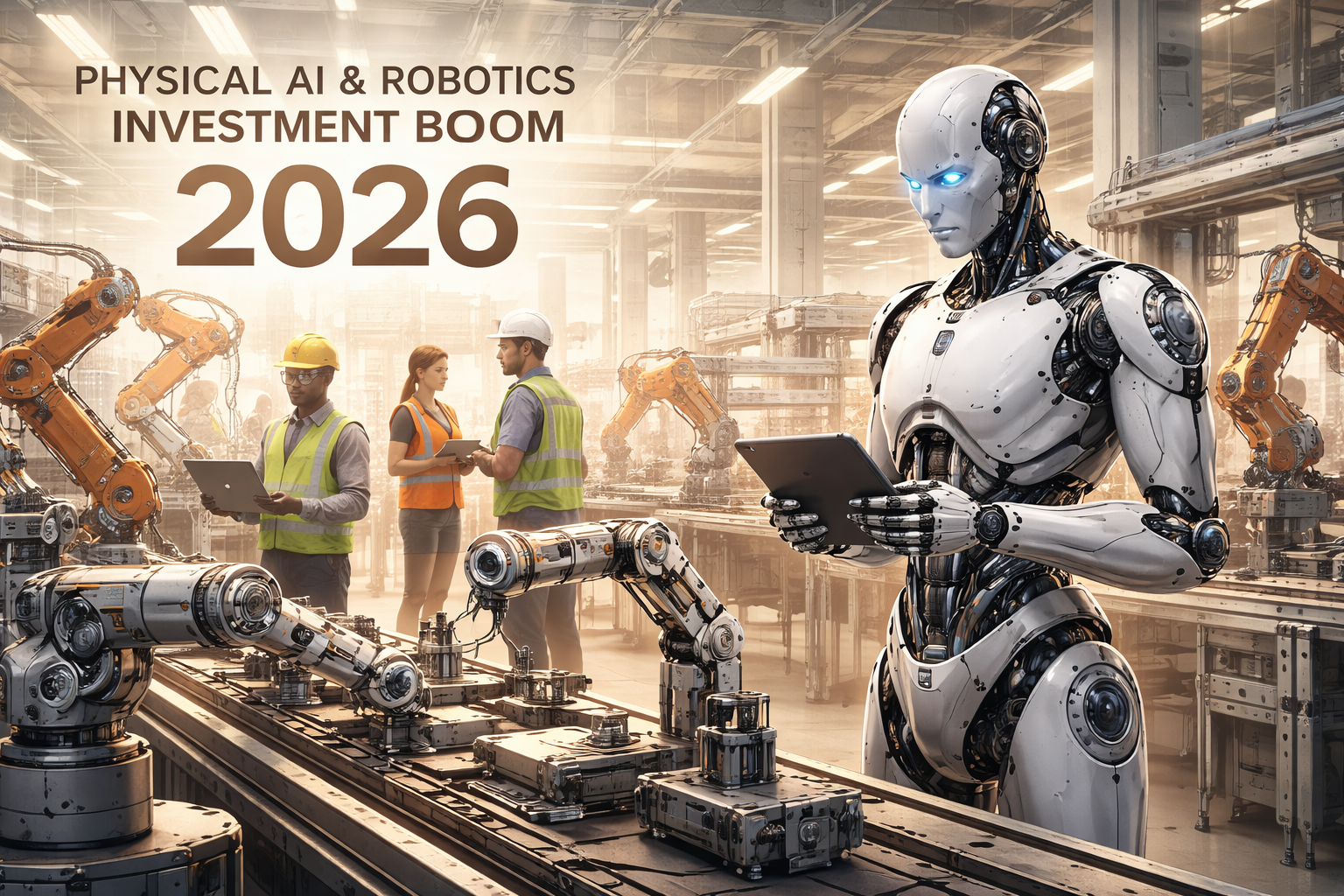
Seven Series A rounds above $200 million in a single quarter. Humanoid robots completing 20-hour shifts in BMW factories. Amazon’s warehouse robot fleet crossing 1 million units. Physical AI has graduated from science project to institutional investment thesis. Here’s what’s happening.
There’s a particular kind of excitement that travels through a technology sector when institutional money stops dipping a toe and starts cannonballing. In Q1 2026, that happened to physical AI.
Twenty-seven physical AI startups raised $50 million or more in a single quarter, collectively pulling in $6.4 billion. Seven of those closed Series A rounds exceeding $200 million each — a pattern that breaks convention, since Series A rounds are supposed to be about funding product development, not capital-intensive manufacturing buildout. What this anomaly signals is that investors who want meaningful equity positions in humanoid robotics or custom AI silicon cannot wait for a Series B. The window for getting in at reasonable valuations is narrowing fast, and sophisticated money knows it.
This is not purely speculative. The robots are working.
What’s Actually Deployed Right Now
Figure AI’s robots are completing shifts at BMW’s manufacturing facilities. Not in demos. In production. Demonstrating eight distinct autonomous cleaning skills in controlled trials in March 2026 — wiping, sweeping, scrubbing, mopping, vacuuming, dusting, polishing, and organising — and working 20-hour continuous shifts on actual factory tasks.
Amazon’s warehouse robot fleet crossed 1 million units in June 2026, with its DeepFleet AI system boosting travel efficiency by 10% across the network. Robotic surgeries now account for 60% of procedures in major hospitals, with robotic-assisted procedures representing 55% of complex surgeries in developed nations. Agility Robotics’ Digit is actively moving totes between autonomous mobile robots and conveyors in Amazon facilities.
These are not laboratory results. They’re quarterly operations metrics.
The performance-to-hype gap is real and worth honest acknowledgment. In controlled environments, leading humanoid systems achieve 95% accuracy. In real-world conditions, that can drop to 60% due to environmental variability, lighting differences, and unpredictable physical interactions. Robotics pioneer Rodney Brooks has warned that the industry has “not actually seen any improvement” on the gap between controlled demo performance and production reliability. That criticism is valid and worth holding alongside the progress.
But 60% real-world accuracy on industrial tasks that previously required dedicated human labour — repeated across thousands of units — is commercially interesting even if it’s below the demo numbers. The trajectory matters.
The Funding Picture: Who’s Raising What
The Q1 2026 physical AI funding data reveals several distinct sub-markets, each with its own investment logic.
Humanoid robots for industrial use attracted the largest checks and the most strategic capital. Mind Robotics, a Rivian spinout building an industrial robotics platform trained on real manufacturing data, raised a $500 million Series A co-led by Accel and a16z — among the largest Series A rounds in robotics history. Sunday, founded by roboticists Tony Zhao and Cheng Chi, reached unicorn status with a $165 million Series B backed by Coatue, Tiger Global, Benchmark, Bain Capital Ventures, and Fidelity. The company’s “skill capture” approach — where robots learn new tasks by watching demonstrations rather than being explicitly programmed — is the interaction model that could make home robots practical.
Figure AI is in talks for a $1.5 billion funding round at a $39.5 billion valuation. For context, Figure AI raised approximately $700 million from Microsoft, Nvidia, OpenAI, and Jeff Bezos as recently as April 2025. The valuation has jumped dramatically in twelve months, reflecting both the BMW deployment credibility and the broader market’s pricing of physical AI potential.
The automotive manufacturers are the hidden investors. Hyundai backs Atlas (Boston Dynamics), Mercedes backs Apollo (Apptronik), BMW backs Figure, Toyota backs Digit. Google appears as investor, AI partner, or technology provider in at least three of the nine leading humanoid robot programs. When you see $26 billion in Hyundai US investment with a factory targeting 30,000 Atlas robots per year by 2028, you’re looking at a manufacturing capital commitment that dwarfs the venture funding in the sector combined.
Industrial robotics automation in warehouses and logistics is the most commercially mature segment, attracting strategic capital from logistics operators who can’t afford to sit out the automation race. LocusONE and similar platforms are managing mixed human-robot teams in production environments, dynamically allocating tasks based on congestion and capability.
AI chip and semiconductor hardware absorbed $2 billion of the Q1 physical AI total. Custom silicon for AI inference — particularly the energy efficiency angle — is attracting both strategic and financial investors who see the power consumption problem as both the constraint on AI deployment and the opportunity for hardware differentiation.
The Competitive Map: Nine Robots, Very Different Approaches
Boston Dynamics committed all of its 2026 Atlas production to just two customers: Hyundai and Google DeepMind. That single fact reveals more about where the technology is than any benchmark score. If Atlas were production-ready for broad deployment, Boston Dynamics would be selling to any buyer willing to pay. Exclusive commitment to two sophisticated partners suggests the manufacturing capacity and real-world reliability challenges are still being worked through.
Tesla’s Optimus has the most aggressive production targets and the most visible skepticism about those targets. Elon Musk claims Optimus will represent 80% of Tesla’s future value. Independent reporting suggests 2025 production was in the hundreds of units, not the thousands that were projected. The gap between stated ambition and verified output is the characteristic Tesla tension that investors have learned to discount appropriately.
The most commercially validated platform for general-purpose industrial tasks is Agility’s Digit — actively deployed in Amazon warehouses, documented to complete real shifts doing real work. It’s not the most impressive in a demo context. It is the most deployed in a production context. That distinction matters.
Figure AI’s approach — BMW partnerships, autonomous cleaning skill demonstrations, 20-hour continuous shifts — represents the most credible near-term commercial deployment story among the newer entrants.
For the home robotics segment, Sunday’s “skill capture” approach is the most interesting technically. Robots that learn by watching demonstrations, rather than being explicitly programmed, could lower the deployment barrier enough to make consumer robotics practical. A $165 million Series B at unicorn status signals serious institutional conviction in the timeline.
The Honest State: What Physical AI Still Can’t Do
The robots that exist today are genuinely impressive. They’re also dramatically constrained.
Battery life is the most immediate operational limit. Apollo (Apptronik) requires a human to physically change battery packs. Figure 03 uses wireless inductive charging with autonomous docking. Atlas uses autonomous hot-swap battery replacement taking about 3 minutes. Optimus has no published autonomous charging capability. For 24/7 industrial deployment, autonomous power management is not optional — it’s a prerequisite.
The real-world performance gap is documented and persistent. The same robot that achieves 95% accuracy in a controlled trial achieves 60% in production. That gap narrows with each generation and with accumulated real-world training data, but it hasn’t closed, and anyone representing otherwise is overstating the current state.
The manufacturing scale challenge is underappreciated. Hyundai’s factory targeting 30,000 Atlas robots per year by 2028 is among the most credible large-scale manufacturing plans in the sector. Most others are still in the hundreds to low thousands per year range. You can’t build a meaningful physical AI economy at hundreds of units per year. Scale is the constraint that capital alone doesn’t solve.
Why This Matters Beyond the Investment Narrative
The physical AI investment boom matters for reasons that extend well beyond returns for the investors participating.
Manufacturing, logistics, agriculture, construction, and healthcare collectively represent the majority of global GDP. These sectors have been relatively untouched by the software AI wave because their value is created through physical work in physical environments. Physical AI — robots that can learn from demonstration, adapt to variable environments, and perform a range of tasks with increasing reliability — is potentially the catalyst for productivity improvement in these sectors that software couldn’t reach.
The 15-20% annual growth rate in the warehouse automation sector alone is already reshaping what labour markets look like in logistics-intensive industries. The question of what physical AI displacement means for the workers in those sectors is one of the important social and policy questions that the investment community is not, by professional incentive, well-positioned to answer.
What’s clear from the capital flows is that physical AI is being treated as inevitable infrastructure, not speculative technology. When sophisticated institutional investors write $200 million Series A cheques into robotics companies and automotive manufacturers commit $26 billion to humanoid robot manufacturing, they’ve moved past the question of whether physical AI will be economically significant. They’re competing to be positioned when it scales.
That transition — from “interesting technology” to “inevitable infrastructure” — is the most important status change in the physical AI sector in 2026.