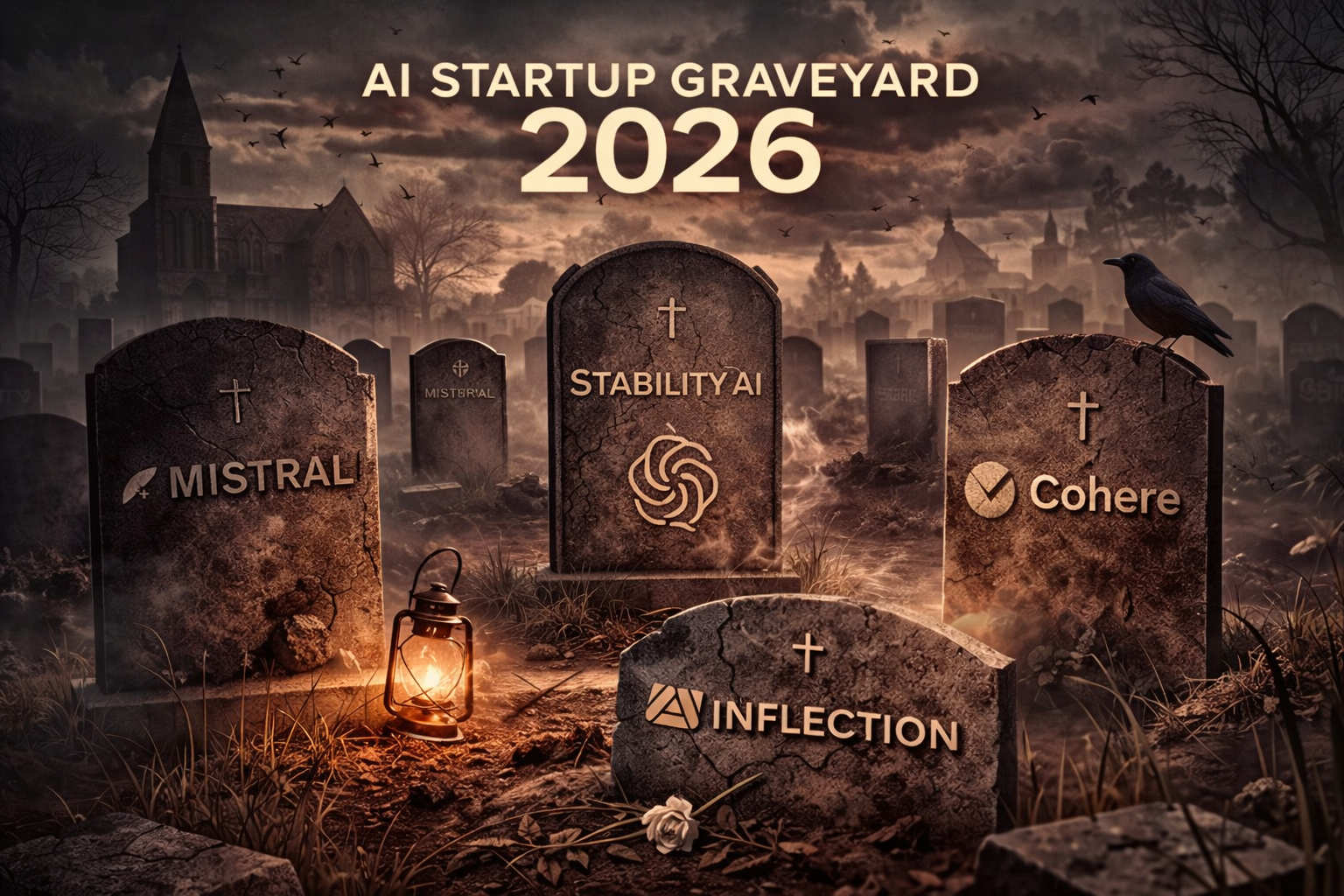
Jasper, Copy.ai, Character.AI. Dozens of well-funded AI startups that raised real money have disappeared, pivoted into oblivion, or been talent-acquired for their teams, not their products. The cause isn’t bad AI. It’s building a feature and calling it a company. Here’s the survival framework that’s emerging from the wreckage.
In 2024, 14,000 new AI startups launched globally, according to CB Insights. By early 2026, 40% of them were dead or restructured. That’s not a collapse — general startup failure rates at 24 months run 50-60% — but it’s a faster-than-average attrition rate in a sector that was supposedly on an unprecedented growth wave.
The founders who failed weren’t incompetent. Many built working products with real users. Some had significant revenue. The problem wasn’t the AI. The problem was the competitive structure of the industry they entered.
The pattern is consistent enough that it’s worth naming: startups built a layer on top of OpenAI’s API, added a useful interface, got early traction, and then got systematically undercut as the foundation model providers kept expanding their native capabilities. Features that required a third-party startup in early 2023 were bundled into ChatGPT, Claude, or Gemini by late 2024. The startups that built those features didn’t fail because they made mistakes. They failed because they built in the shadow of entities with infinite compute budgets and every incentive to absorb adjacent capabilities.
Understanding this failure mode is the first step to building something that doesn’t repeat it.
The Failure Patterns, Named Specifically
After analysing 50+ failed AI startups and reviewing post-mortems from founders, investors, and early employees, five patterns appear repeatedly.
Pattern 1: The API Wrapper Without a Moat. The most common failure mode. The core product is an API call to a foundation model wrapped in a UI, a billing system, and a Stripe integration. There is no proprietary data. No unique training. No workflow integration that creates switching costs. The entire product could be rebuilt by a junior developer in a few hours. When the foundation model provider adds the feature natively — which they eventually will, because these features improve their core products — the wrapper becomes redundant.
The companies that survived at this stage did so by adding proprietary data layers, building deep workflow integrations, or pivoting to enterprise with multi-year contracts before the native competition arrived. The ones that didn’t move fast enough became features.
Pattern 2: Mistaking Traffic for Revenue. The early AI boom produced enormous user numbers on products that charged very little or nothing. Founders and investors interpreted engagement as validation. Revenue was harder to generate because users were comparison-shopping across free-tier access from every major provider. By the time monetisation pressure arrived, the customer retention math was painful: users who came for free had no loyalty when pricing appeared.
The startups that navigated this built paid conversion funnels from the beginning, targeting business users with specific workflow pain points rather than consumer users with general curiosity.
Pattern 3: No Proprietary Data. Foundation model providers have trained on essentially the public internet. The competitive advantage available to startups is private, vertical, or proprietary data that the big labs don’t have and can’t easily acquire. Medical records. Legal case history. Financial transaction data. Manufacturing sensor data. Scientific literature with expert annotation. Agricultural telemetry. When a startup’s training or fine-tuning data represents genuine knowledge asymmetry, the foundation model providers can’t simply replicate the product by adding it to their base model.
The failed startups in this category used the same publicly available data as everyone else and competed on interface quality — a competition they couldn’t win against teams with 10x the engineering resources.
Pattern 4: Consumer Targeting Without a 10x Advantage. The consumer AI market is dominated by ChatGPT, Gemini, and Claude, all of which are free or near-free and improving rapidly. A consumer AI product that does one thing somewhat better than ChatGPT in a category ChatGPT is actively improving in is not a business — it’s a temporary novelty.
The startups that built durable consumer products found genuine niches where the general-purpose models underserve specific audiences: language learning for specific mother tongue speakers, AI tutoring for specific curriculum standards, creative tools for specific professional workflows. Specificity creates enough defensibility that the general-purpose providers don’t bother optimising for the niche.
Pattern 5: Unit Economics Ignored Until Too Late. AI inference costs scale with usage. A consumer product with viral growth and high engagement burns compute at a rate that the subscription price can’t cover. Several well-funded startups hit the wall when they discovered that their most engaged users were also their most expensive users — that the engagement metrics they were optimising for were inversely correlated with the margin they needed to survive.
The surviving companies audited inference costs per user segment early, built pricing that reflected genuine cost structure, and restricted features that generated cost without corresponding willingness to pay.
The Specific Companies Worth Learning From
The collapse of consumer-facing AI writing tools is a case study in the wrapper failure mode. Jasper raised over $100 million, hit approximately $90 million in ARR, and then got systematically undercut as ChatGPT and Claude added native writing assistance. The company pivoted to enterprise, added model routing, and tried to build a moat through workflow integration. It’s still operational but underwent significant valuation cuts and executive turnover. That’s what survival looks like when your product was fundamentally a feature.
Copy.ai raised $80 million, merged with a competitor rather than continue independently. Character.AI, the social conversational AI, was talent-acquired by Google — the team was worth more than the product. Descript’s Overdub voice cloning feature was shut down. Tome pivoted away from AI entirely.
The pattern across these: products that were genuinely impressive in 2022-2023, that attracted real users and real funding, and that became redundant as the underlying models they relied on absorbed their value propositions. Being first doesn’t help when your first-mover advantage is a feature that can be replicated by the infrastructure you depend on.
What the Survivors Are Doing Differently
The AI startups that are navigating 2026 in good shape share identifiable characteristics that distinguish them from the casualties.
They have proprietary data. The legal AI companies with court reporting data, the agricultural AI companies with sensor and yield data, the healthcare AI companies with clinical outcome data, the industrial AI companies with manufacturing process data — these have information asymmetries that foundation model providers can’t easily bridge. Proprietary data is the highest-quality moat in AI because it compounds: more deployment generates more data, which improves the model, which attracts more deployment.
They’re deeply embedded in enterprise workflows. A startup whose AI is integrated into the daily workflow of 500 enterprise employees has switching costs that are difficult to dislodge even if a competitor offers marginally better performance. Multi-year enterprise contracts with deep system integration are qualitatively different from monthly subscriptions with low switching costs.
They’re building in regulated industries. Healthcare AI, legal AI, financial AI, defence AI — sectors where regulatory requirements create compliance barriers to entry that the general-purpose providers either can’t or don’t want to navigate. Claude and ChatGPT are not going to build HIPAA-compliant clinical decision support tools as a core product focus. The startups that are doing that work benefit from the regulatory moat their customers require.
They’re solving physical-world problems. The startups building AI for manufacturing, agriculture, construction, and logistics are tackling problems that require physical integration — sensors, actuators, robotics — that software-only foundation model providers can’t address without hardware partnerships. Physical-world problems create switching costs that pure software competitors can’t replicate.
Their unit economics work. The seed-to-Series A conversion rate for AI startups has dropped from 24% to 18% because investors are now demanding $1 million or more in ARR, 120%+ net revenue retention, and gross margins that don’t require perpetual VC subsidy. The companies that raised Series A rounds in 2026 demonstrated, with real numbers, that the business model works at current scale.
The Honest Survival Checklist
The framework emerging from the failure analysis is simpler than the individual stories make it seem.
Before building or continuing to build, answer five questions honestly:
Do you have a real moat? Proprietary data, distribution at scale, regulatory position, or physical-world integration. If the moat is “we have a better UI,” that’s not a moat — it’s a temporary advantage.
Do your unit economics work? Does your inference cost scale with usage in a way that your pricing can absorb? Are your best customers also your most profitable customers, or are they your most expensive?
Will your market pay? B2B beats B2C in AI in 2026, almost categorically. Businesses with specific pain points and budget authority are better customers than consumers with general curiosity and access to multiple free alternatives.
Can it be copied in a weekend? If a junior developer with access to OpenAI’s API and a Stripe account could rebuild the core of your product in 48 hours, what you have is a feature. Features get commoditised. Fast.
Are you solving a problem the big labs won’t solve? Too niche, too regulated, too enterprise-specific, or requiring physical-world integration are the categories where startups can sustainably operate. The general-purpose providers optimise for the middle of the distribution. The edges are where startup opportunities live.
Three or more of these answered affirmatively is the minimum bar for a defensible AI business in 2026. Fewer than three is a serious warning sign that the competitive dynamics are working against you.
Why This Is Healthy, Not Catastrophic
The 40% failure rate sounds alarming, but the honest read is that it’s a correction rather than a collapse.
The AI infrastructure is getting genuinely better, faster, and cheaper. The market is sorting companies by whether they create durable value above that improving baseline. The companies that created features have been ruthlessly exposed. The companies that created genuine capabilities on top of proprietary advantages have been validated.
This is the normal pattern of technology markets maturing past the hype phase. The dot-com crash of 2000 killed thousands of companies — and left behind Amazon, Google, and eBay. The mobile app explosion of 2010-2012 produced millions of apps — and left behind a handful of platforms that reshaped entire industries.
The AI startups that survive the current correction won’t be the most technically impressive. They’ll be the ones that built real businesses, with real data, solving real problems for customers who pay real money and can’t easily switch.
That’s the most boring possible conclusion. It’s also the most reliable.