A top 5 US P&C insurer deployed AI on 2.8 million auto policies and generated $15 in prevented losses for every new policy — projected at $30M+ annually. Underwriting that took 3 days now takes 3 minutes. Straight-through processing rates jumped from 10% to 70-90%. But only 7% of insurers have successfully scaled AI to production. Here’s what separates the 7% from everyone else.
Insurance exists because humans have always been bad at estimating risk. Not dishonest — just genuinely poor at integrating multiple probabilistic signals across large populations and adjusting dynamically as conditions change. The actuary’s job exists because the human brain can’t do actuarial mathematics intuitively.
AI is, in a very literal sense, doing precisely what insurance was always supposed to do but struggled to do at scale: process enormous volumes of varied signals simultaneously, identify patterns that predict risk, and price policies based on actual risk rather than demographic proxies.
That’s the optimistic framing, and it’s real. The honest complication is that 88% of auto insurers and 70% of home insurers report using or planning to use AI — but only 7% have successfully scaled AI systems into production. The gap between pilot and production in insurance is wider than in most industries because the specific artifacts insurance teams process don’t look like clean datasets. They look like scanned handwritten FNOL forms, 50-page risk engineering reports with embedded tables, multi-language documents, and submissions built on decades-old legacy systems that predate structured data.
The 7% that have scaled successfully are the ones who built for that reality, not the demo version.
Fraud Detection: The $80 Billion Problem AI Is Actually Solving
Insurance fraud costs the US industry an estimated $80 billion annually. That’s not a rounding error — it’s a structural cost that inflates premiums by 10-20% for every policyholder who isn’t defrauding anyone.
Traditional fraud detection works from rules: claim above a certain threshold triggers manual review, multiple claims in a short period triggers investigation, claims from known fraud hotspots trigger scrutiny. Rules-based systems catch the obvious fraud. Sophisticated fraud — staged accidents with consistent injury patterns, provider networks billing for unnecessary treatment, ghost brokers selling misrepresented policies to unsuspecting consumers — evades rules designed for simpler patterns.
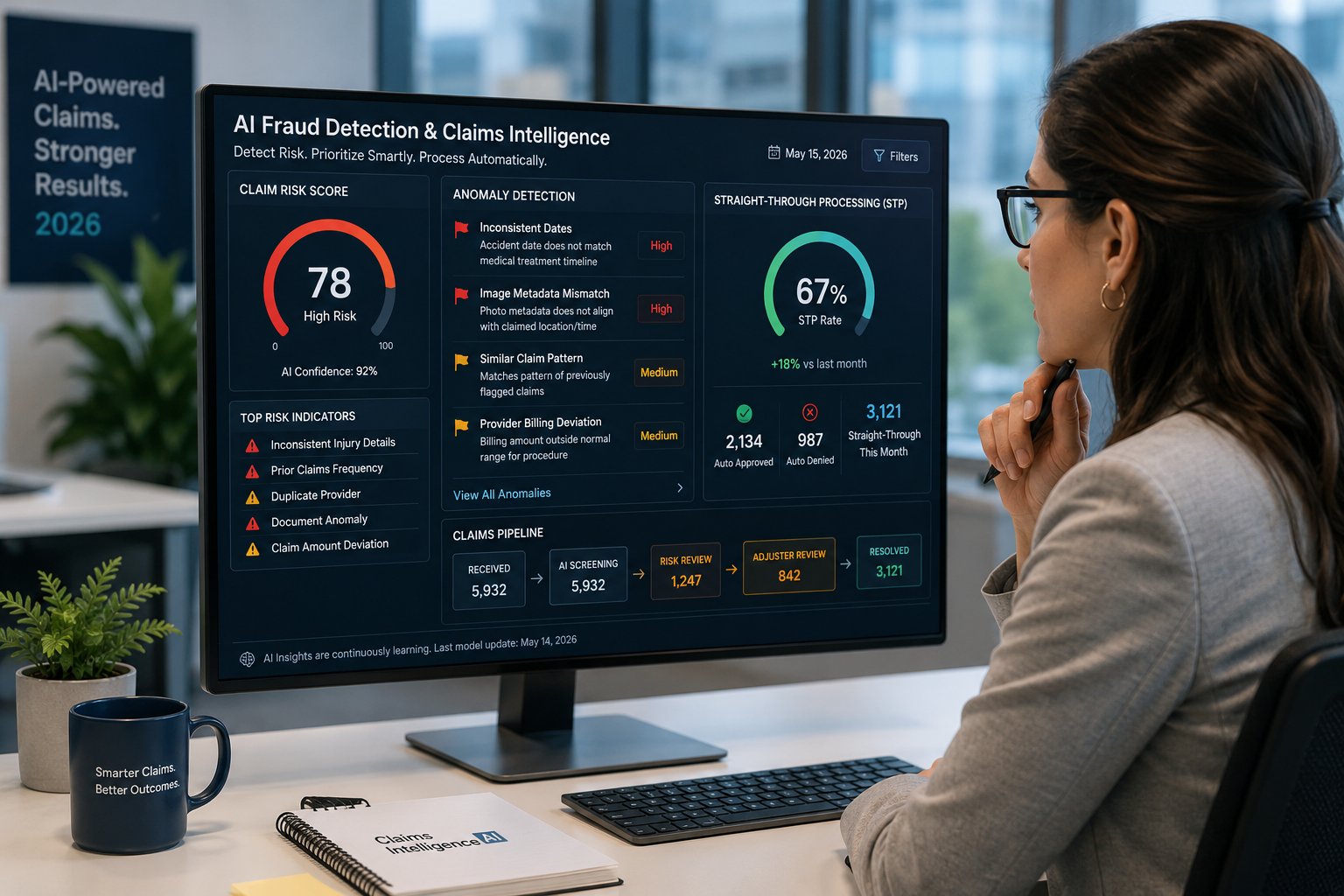
The case study from a top 5 P&C insurer illustrates what AI makes possible. Their fraud task force partnered with Shift Technology to deploy AI detection models on 2.8 million auto policies. The system ran daily analysis during the new business “free look” period — before costly claims could be paid on fraudulent policies. The results were documented and audited: AI generated more than $15 for every new policy in incremental prevented losses, projected at over $30 million annually in underwriting mitigation — all while maintaining existing underwriting staff levels.
The specific fraud vectors the system caught: misrepresentation detection for risk and fraud during the policy “free look” period; entity resolution AI that uncovered policyholders using fraudulent information to hide prior claims history; and ghost broker schemes selling misrepresented policies with an average 500% loss ratio.
The industry-wide documented outcomes from AI fraud detection: 29-35% improvement in detection rates, depending on implementation, versus rule-based systems. False positive rates down dramatically, which matters because unnecessary investigations have real costs and damage the customer relationship with legitimate policyholders.
Modern AI fraud detection also addresses the deepfake and synthetic identity threat that has emerged with AI-powered fraud tools. Criminals are now generating synthetic identities and deepfake documentation at scale. The same AI capabilities that defenders use to detect fraud patterns are being used by attackers to create more convincing fraud. The arms race in insurance fraud mirrors the cybersecurity dynamic — both sides are using AI, and the question is whose is better calibrated to the current threat environment.
Claims Processing: From Weeks to Minutes for Straight-Through Cases
Claims processing is where AI delivers the most immediate, visible ROI for insurers — and where the customer experience impact is most direct.
Traditional claims handling involves multiple handoffs: first notice of loss received, assigned to an adjuster, adjuster reviews documentation, requests additional information, evaluates coverage, determines liability, sets reserves, and authorises payment. For a simple auto glass claim or a straightforward homeowner’s water damage, this process can take days to weeks even when there’s no dispute.
AI straight-through processing changes the economics for simple, clearly documented claims. The system ingests the FNOL — first notice of loss — verifies coverage automatically, checks for fraud indicators, assesses documented damage against pricing databases, and authorises payment without human intervention. Straight-through processing rates have jumped from 10-15% (where traditional systems could automate simple cases) to 70-90% in the most sophisticated implementations.
For the customer, the experience is genuinely different: call to report a claim, and the payment confirmation arrives before the call ends. For the insurer, the cost per settled claim drops dramatically — AI systems handle high volumes at consistent cost, while human adjusters concentrate on the complex, disputed, high-value cases where their judgment is genuinely needed.
One documented outcome captures the magnitude: a 23-day reduction in liability determination time on complex cases at one major insurer. In complex liability cases — multi-vehicle accidents, slip-and-fall claims with disputed circumstances — 23 fewer days means 23 fewer days of legal exposure, 23 fewer days of reserve being held, and a significantly better experience for claimants who aren’t disputing the liability.
Claims processing AI also addresses the specific challenge of image-based damage assessment. Computer vision models trained on thousands of images of auto damage, property damage, and equipment failures can assess damage from photos with accuracy approaching experienced human adjusters — and do it in seconds rather than the hours or days a physical inspection would require.
Underwriting: 3 Days to 3 Minutes
The most transformative change in insurance underwriting AI isn’t fraud detection. It’s speed.
Traditional personal lines underwriting for auto and homeowners policies involves pulling data from multiple sources — MVR, CLUE report, credit-based insurance score, property data — reconciling them, applying rating rules, and making an accept/decline/modify decision. For a straightforward application, this takes hours. For anything with complications, it takes days.
AI-enabled underwriting compresses this to minutes. The system ingests application data, queries external data sources automatically, applies risk models, and generates an underwriting decision with a complete explainability trail showing which factors drove the outcome.
The explainability requirement is not optional in insurance. State insurance regulators require that underwriting decisions be explainable and not result in unfair discrimination. The black-box model that produces accurate outcomes but can’t explain them is legally unusable in most markets. The most sophisticated insurance AI deployments are built on explainable model architectures specifically because the regulatory requirement exists.
Underwriting timelines collapsing from 3 days to 3 minutes; straight-through processing rates jumping from 10-15% to 70-90%; fraud detection improving by over 30% — these are audited, production-level results from major insurers, not projected outcomes.
The commercial lines story is harder because commercial risk is genuinely more complex and variable than personal lines. A 50-page risk engineering report for a large manufacturing facility — embedded tables, handwritten notes, photos of equipment — doesn’t parse cleanly into structured data. The AI tools that handle this are more specialised, more expensive to deploy, and currently more limited in scale. But they’re proving out: AI is analysing 50-page risk engineering reports, extracting EML calculations and mitigation recommendations, and producing structured summaries for underwriter review.
What the 7% Who Scaled Successfully Are Doing Differently
The gap between 88% planning or starting AI and 7% achieving scaled production is the honest story of insurance AI in 2026. The difference between the two groups isn’t access to better technology. It’s workflow design.
The failure pattern is consistent across carriers: a vendor demonstrates impressive accuracy on a clean dataset, the pilot shows promise on structured data samples, and then the project dies during integration with actual workflows that involve scanned handwritten documents, multi-format submissions from brokers, and data that exists across three legacy systems with different field definitions.
The 7% who succeeded started by augmenting existing workflows, not replacing them. An AI agent that extracts data and populates fields in the current policy administration system delivers value immediately. A project to replace the entire policy administration system takes years and may never complete. They built AI around the existing infrastructure rather than requiring the infrastructure to change before AI could work.
They also defined success metrics before deployment, not after. The firms that could show specific, audited numbers — $30M annually in prevented losses, 23-day reduction in liability determination time — defined those metrics as the programme objective before the technology was selected. That clarity is what produced the clarity.
The industry-wide calculation: 30% operational cost savings and 60% faster claims settlements for insurers that deployed AI agents. Carriers still relying on manual workflows are losing competitive ground to insurers who can offer instant quotes, same-day claim approvals, and personalised policy recommendations — while operating at lower cost.
The global AI in insurance market is projected to reach $141.44 billion by 2034, growing at 33% annually. The 5% of enterprises achieving substantial AI ROI at scale — versus the average 1.7x payoff — are the ones that will capture that market. The rest are paying for pilots that never reach production.