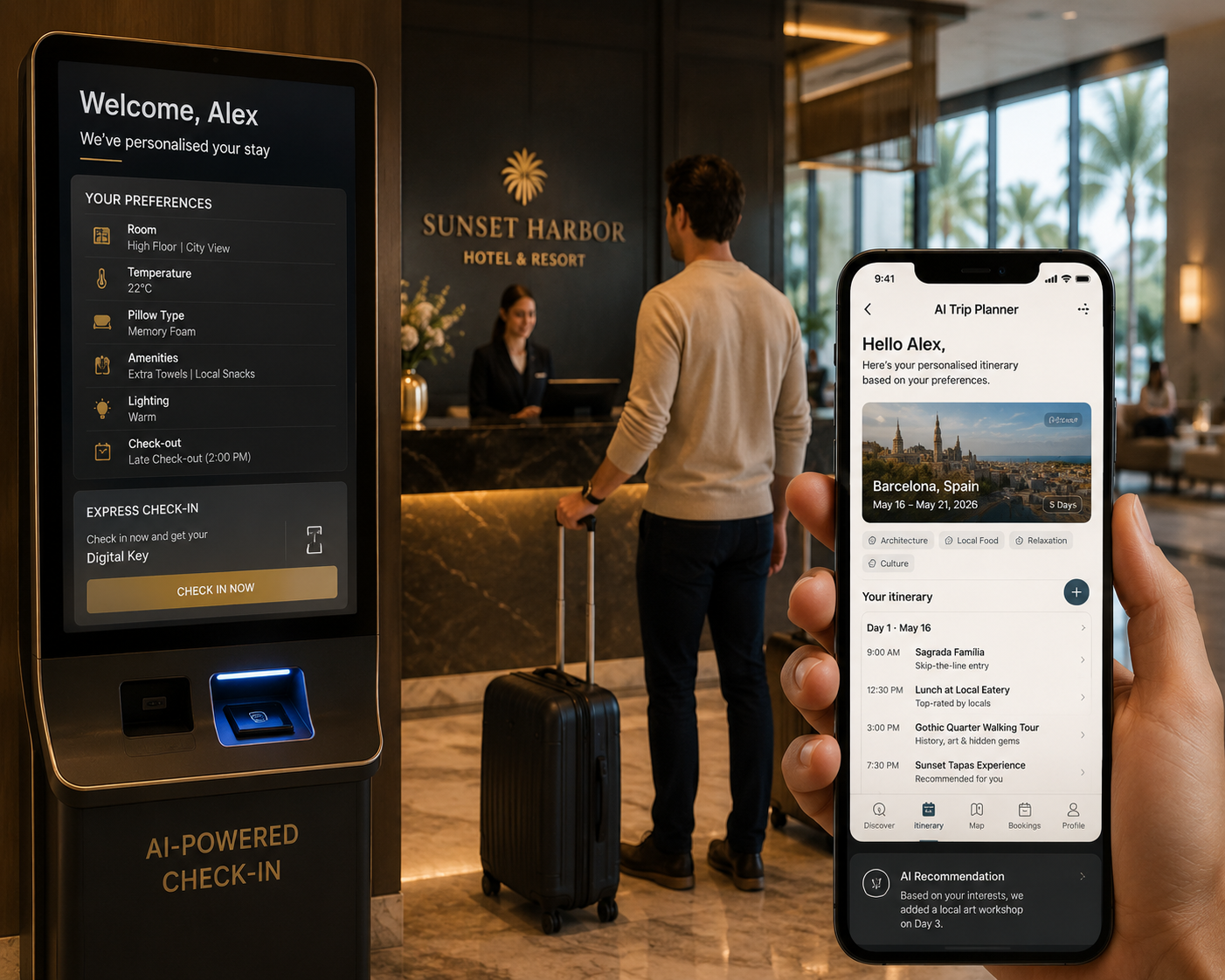
By 2030, 30% of travel bookings will be executed by AI agents without a human ever browsing a website — IDC’s prediction. Today, Hilton and Marriott are already using AI to personalise stays before you check in. TUI generates inspirational travel videos with AI. Airlines recover from disruptions faster by predicting them first. Here’s what’s actually happening in travel AI in 2026.
Travel has always been an industry where tiny differences in the customer experience compound into enormous differences in loyalty. The guest who got the room they wanted, on the floor they preferred, with the pillow type they mentioned three stays ago, who found their breakfast order remembered without being asked — they come back. The guest who waited 40 minutes at check-in and got a room two floors below their loyalty status deserved — they don’t.
The frustration for hotels and airlines has always been that delivering the first experience at scale is impossibly labour-intensive. You can do it for VIP guests. You can’t do it for everyone when you’re processing tens of thousands of check-ins and booking queries per day.
AI is changing this calculus. Not by making the personalisation flawless — it isn’t yet — but by making it possible at scale for the first time. The AI hospitality market is projected to grow from $90 million in 2023 to $8 billion by 2033. The AI segment within tourism is expanding at close to 30% CAGR. And 84% of travel executives now see AI as key to their growth objectives.
Here’s what that actually looks like in practice.
Dynamic Pricing: Revenue Management Gets Real-Time
Revenue management has existed in airlines since the 1970s — the yield management systems that vary seat prices based on demand were genuinely innovative when they were introduced. Hotels adopted similar approaches in the 1990s. For decades, the core technology was static rate rules: charge X during high season, Y during low season, add a premium on weekends.
Modern AI revenue management is meaningfully different. Instead of static rules, it’s continuous optimisation. The system ingests real-time demand signals — booking pace, competitive pricing changes, events in the destination market, weather forecasts, cancellation patterns — and adjusts pricing dynamically to maximise revenue while maintaining target occupancy.
The documented outcomes from hotels adopting AI revenue management: 3-7% revenue lift per room compared to traditional approaches. For a 300-room hotel generating $15 million annually, a 5% lift is $750,000 in additional revenue per year. That’s significant enough to justify the technology investment in the first year.
Airlines have been doing sophisticated yield management for decades, but generative AI is adding a new layer: dynamic bundling and offer personalisation. Instead of a fixed set of fare classes and add-on menus, AI can construct personalised offers for specific customers based on their purchase history, loyalty status, and real-time behaviour signals. A business traveller who always purchases an upgrade when one is available gets a targeted upgrade offer at a different price point than a leisure traveller who has never purchased one.
52% of hospitality and travel marketers plan to invest in AI-driven personalisation by the end of 2025. The investment is following the results.
Guest Personalisation: From Data You Give to Data You Generate
The distinction that matters in hotel AI personalisation is between the preferences you explicitly told the hotel (room type, pillow preference, dietary restrictions) and the preferences you demonstrate through behaviour without stating them (how often you use the gym, whether you order room service after 10pm, which concierge recommendations you follow and which you ignore).
Traditional hotel loyalty programmes capture the first category. AI captures the second.
Hilton and Marriott are both deploying AI systems that combine loyalty programme data with on-property behaviour patterns to generate personalised recommendations, targeted upsell offers, and proactive service interventions. The guest who has used the spa on every third-night stay for the past year gets a targeted spa offer on arrival night two. The guest who has never used the restaurant but orders room service every stay gets a different in-room dining promotion than the guest who eats out on every occasion.
Smart room technology adds the physical dimension. Lighting adjusts automatically to recognised patterns. Temperature adapts to the preferences the previous stay established. AI coordinates the systems — optimising comfort and energy efficiency simultaneously.
The critical data requirement: all of this personalisation depends on a unified, real-time view of the guest. IDC’s forecast is clear: “Achieving that level of personalisation requires connecting property management systems, loyalty programs, guest profiles, and on-property interactions into a single, actionable data fabric.” Most hotel groups have these systems running on separate platforms with limited integration. The AI is only as personalised as the data infrastructure underneath it allows it to be.
Revenue uplifts of 3-15% and ROI increases of up to 20% from AI implementation are the documented range. The hotels at the upper end of that range have the data infrastructure. The hotels at the lower end are deploying AI on top of fragmented data and getting proportionally fragmented results.
AI Agents and the Future of Booking
IDC’s most consequential prediction for travel: by 2030, 30% of travel bookings will be executed by AI agents, with the first interaction never involving a human browsing a website.
This is not a speculative claim about distant technology. It’s a logical extrapolation of what’s already happening. As AI assistants like ChatGPT, Claude, and Gemini become the primary interface through which people research and plan travel, they’re being asked to book as well as advise. The agentic capability that allows an AI to go from “I want to go to Barcelona for five days in September” to confirmed flights, hotel, and restaurant reservations without the user manually navigating any booking interface is technically available today.
For hotels and airlines, this represents a fundamental shift in distribution. The historical model: brand.com, OTAs (Booking.com, Expedia), GDS (Global Distribution Systems). The emerging model: AI agent queries a combination of these sources, evaluates against the traveller’s preferences, negotiates offers, and completes the booking.
Who captures the booking — which platform, which hotel, which airline — in this model depends on which AI agent is doing the booking and how that agent has been optimised. “LLM optimisation” — the equivalent of SEO for AI agents — is becoming a real investment area for travel brands who don’t want to be invisible to the AI agents making booking decisions for millions of travellers.
The agent-to-agent commerce model that’s beginning to emerge represents the further extension: a traveller’s personal AI agent negotiating with a hotel’s AI booking agent without either human being involved in the transaction at all. The technology exists. The commercial frameworks and consumer comfort level are developing.
Airlines: From Reacting to Disruptions to Anticipating Them
Flight disruptions — weather delays, mechanical issues, crew scheduling problems, air traffic control constraints — cost airlines and passengers enormously. The direct cost to airlines from flight disruptions in 2024 was estimated at over $25 billion globally.
The traditional response model is reactive: disruption occurs, passengers are notified, alternative arrangements are made under time pressure. The AI-enabled model is predictive: the system identifies a developing situation 6-12 hours before it becomes a disruption, enabling proactive rebooking, aircraft positioning, and crew scheduling adjustments before the cascade of delays begins.
Airlines with mature AI operations monitoring systems can identify, for example, that an incoming weather system will affect specific hub airports at specific times — and begin proactively contacting passengers whose connections are most likely to be disrupted to offer rebooking before the problem materialises. Passengers who receive proactive rebooking offers before their flight is cancelled have a qualitatively different experience than passengers who discover their connection is cancelled while they’re in the air.
This is where AI delivers the revenue-retention value alongside the operational efficiency value: the passenger who was proactively rebooked with a genuine solution is significantly more likely to maintain loyalty than the passenger who spent four hours in a rebooking queue at the airport.
TUI’s generative AI deployment adds the creative dimension. The company uses AI to generate inspirational travel videos and voice/chat agents for customer engagement. The personalised travel content that matches a customer’s stated interests and browsing history makes the discovery phase of travel planning — the “where should I go?” question — a more engaging and personalised experience.
The Honest Challenges: Data, Trust, and the Human Moment That Still Matters
IDC’s forecast that 50% of AI budgets in hospitality and travel will be allocated to personalisation efforts by 2030 is striking because it implies the other 50% is going elsewhere — operations, fraud prevention, revenue management, customer service automation. The industry’s AI investment is broad.
The binding constraint across almost every application is data. Revenue management AI that doesn’t have access to forward-looking demand signals produces worse pricing decisions than one that does. Personalisation AI that can’t connect the guest’s previous stays to their current booking produces generic recommendations. The hotel that has its property management system, loyalty programme, and restaurant point-of-sale on the same data fabric has fundamentally different AI capability than the hotel where those systems don’t talk to each other.
The trust question is real in travel in a way that’s different from most consumer contexts. 61% of consumers remain cautious about trusting AI systems, and travel decisions — which involve significant money, time off, and often emotionally significant experiences — are contexts where the cost of a bad recommendation is high.
The AI chatbot that confidently recommends a restaurant that has since closed, or books a hotel room based on preferences that are two years out of date, or misunderstands the specific accessibility requirements a traveller needs — these failures damage the relationship in ways that algorithmic accuracy improvements alone can’t address. Transparency about AI’s role, combined with easy access to human support when needed, is what maintains trust while delivering the efficiency benefits.
And then there are the moments in travel that are genuinely irreducibly human. The concierge who notices you look overwhelmed, asks where you’re trying to go, and calls ahead to hold a table for you. The flight attendant who remembers that you always ask for extra water and brings it before you ask. The hotel manager who meets you in the lobby when your first visit coincides with a minor property issue, apologises personally, and ensures your stay is exceptional from that point.
AI makes those moments possible by handling everything else efficiently enough that the humans who could create them have time and attention to do so. That’s the honest story of AI in travel and hospitality in 2026: not AI replacing the human moments, but creating the conditions where those moments can happen at scale.