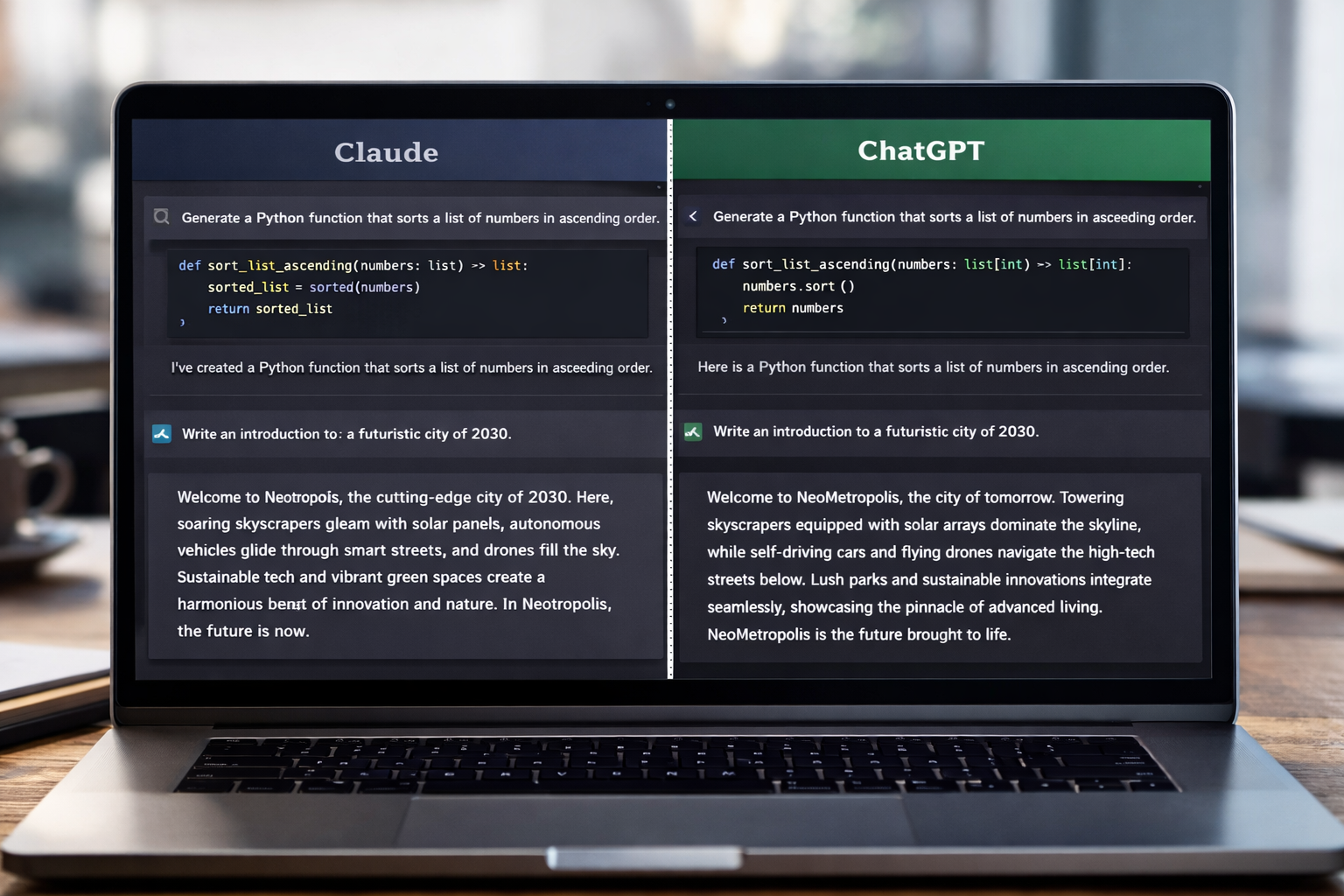
The two most-used AI assistants in 2026 are closer than ever in raw capability — and more different than ever in what they’re optimised for. Here’s the honest breakdown so you can stop guessing and start choosing.
The most searched AI comparison query on the internet right now is “Claude vs ChatGPT 2026.” Approximately 9,900 people search it every month, and the number is growing. That tells you something useful: the question is genuinely hard, and most existing coverage doesn’t actually answer it well.
So let’s answer it properly.
The short version: both are excellent. Both cost $20/month at the standard tier. Claude wins on coding, long-document analysis, and writing quality. ChatGPT wins on multimodal features, ecosystem breadth, and voice. The models are at near-parity on general capability benchmarks. The gap that matters is in specific use cases — and those specific use cases are exactly what this comparison covers.
This is based on published March 2026 benchmark data, independent developer testing results, and hands-on evaluation. No sponsored positions. No vendor talking points.
First: The Models You’re Actually Comparing
As of March 2026, the main models in play are:
Claude: Claude Sonnet 4.6 is the everyday model (fast, capable, handles most tasks well). Claude Opus 4.6 is the flagship — deepest reasoning, best coding, highest capability ceiling. Available through claude.ai.
ChatGPT: GPT-5.3 Instant is the default model for everyday work. GPT-5.4 Thinking is the reasoning-focused tier for hard problems. GPT-5.4 Pro is the highest-capability option. Available through chatgpt.com.
Both platforms have converged significantly in overall intelligence. The Artificial Analysis Intelligence Index scores both GPT-5.4 and Gemini 3.1 Pro at approximately the same level overall. The differences that remain are category-specific, not wholesale.
Pricing: Both $20/Month — With Important Differences at Higher Tiers
At the $20/month tier, you get:
Claude Pro ($20/month): 5x the capacity of free, priority access, Claude Code included, the Cowork feature for desktop automation. Access to Claude Sonnet 4.6 primarily, with Opus 4.6 usage within limits.
ChatGPT Plus ($20/month): Full GPT-5.3 access, 5x usage limits, DALL-E image generation, Sora video (720p, 5-second clips), voice mode, web browsing.
The $20 tier gives ChatGPT more multimedia features. Claude Pro includes Claude Code, which is a significant advantage for developers. Neither company has raised prices despite dramatically upgrading the underlying models.
At premium tiers: Claude Max runs $100-200/month. ChatGPT Pro runs $200/month. For most users, the $20 tier is the right starting point. The premium tiers serve professional developers and heavy enterprise users.
Coding: Claude Leads, But the Gap Has Narrowed
This is the category with the clearest data — and Claude leads it.
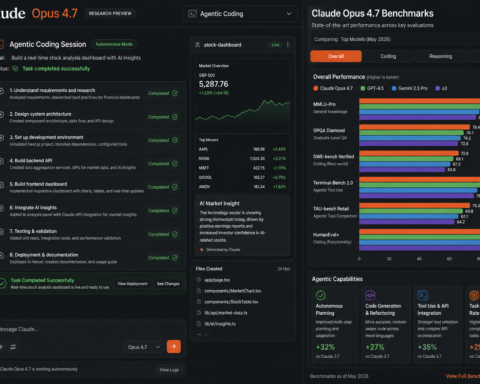
Claude Opus 4.6 scores 80.8% on SWE-bench Verified, the industry standard benchmark for real-world software engineering on genuine open-source repositories. GPT-5.4 lands at approximately 80%, with a more detailed SWE-bench Pro score of 57.7%. The gap at the top is narrow but consistent: Claude has held the coding lead across benchmarks since early 2026.
Developer survey data supports the benchmark results. According to the Stack Overflow 2025 Developer Survey, GPT models are used by 81% of developers — more by raw usage, reflecting ChatGPT’s earlier market dominance. But among developers surveyed about coding preferences specifically, 70% report preferring Claude for coding tasks. Claude Code, Anthropic’s terminal-native agent included with Claude Pro, has achieved a 46% “most loved” rating among developers, compared to Cursor at 19% and GitHub Copilot at 9%.
Claude’s coding advantages in practice: stronger at understanding large codebases, more capable at multi-file refactors, better at explaining complex logic, and more precise in following detailed technical specifications. Independent 30-day testing found approximately 95% functional accuracy on coding tasks for Claude versus approximately 85% for ChatGPT.
Winner: Claude — for coding, and it’s not particularly close on complex tasks.
Writing: It Depends What You’re Writing
This category is more nuanced, and the honest answer genuinely differs by use case.
For long-form writing — essays, reports, analysis, anything over 2,000 words — Claude is the stronger choice. Its 200K token context window (versus ChatGPT’s 128K at the standard tier) means it can hold the thread across longer documents without losing coherence. The writing it produces is also less generically “AI” in tone — Claude sometimes pushes back, suggests alternatives, or acknowledges when a request has tensions that are worth addressing. Some users find this annoying. Most professional writers, once they’ve experienced it, find it more useful than a tool that just executes whatever it’s told.
For versatile, obedient content production — social media, marketing copy, varied format outputs, anything where you want to tell it exactly what to do and have it do that thing — ChatGPT is often more cooperative. It’s less likely to question the brief. That’s a feature or a bug depending on your situation.
The distinction that matters most: Claude produces writing that sounds more like a thoughtful human at the cost of occasional friction. ChatGPT produces writing that sounds like a capable professional, reliably, with less friction.
Winner: Depends. Long-form depth → Claude. Versatile production → ChatGPT.
Multimodal Features: ChatGPT Has a Clear Edge
This comparison tilts decisively toward ChatGPT. If your work involves creating or analysing multimedia, this matters a lot.
Image generation: ChatGPT includes DALL-E 4 image generation natively. Claude does not generate images.
Video: ChatGPT Plus includes Sora for short video generation. Claude has no video generation.
Voice mode: ChatGPT has a mature Advanced Voice Mode that works across devices — you can have a spoken conversation with natural interruptions and human-like cadence. Claude’s mobile app exists but is text-only.
Video analysis: This is where Gemini actually leads both — but between Claude and ChatGPT, ChatGPT can at least accept image inputs for analysis. Claude also accepts image inputs but cannot generate images or process video.
Computer use: GPT-5.4 scored 75% on OSWorld, the benchmark for desktop task automation, surpassing the human expert baseline of 72.4%. Claude Sonnet 4.6 recently hit 72.5% on the same benchmark — essentially at parity with humans. Both are capable; GPT-5.4 leads slightly.
Winner: ChatGPT — for multimodal breadth, it’s not close. If you create visual content or want voice interaction, ChatGPT is your tool.
Research and Long-Document Analysis: Claude Leads
If your core use case is processing and synthesising large amounts of text — research papers, legal documents, lengthy reports, entire codebases — Claude’s context window advantage is decisive at the standard tier.
Claude Pro offers a 200K token context window by default. That’s enough to feed an entire novel manuscript, a long legal contract, or a substantial codebase and maintain coherent analysis throughout. ChatGPT Plus offers 128K by default. GPT-5.4 supports up to 1M tokens via the API, but in the ChatGPT interface you’re working at 128K.
In practical testing: feeding a 40-page research report and asking for a methodologically rigorous critique of the statistical approach — Claude handles this consistently well. ChatGPT handles it competently but can lose thread across very long documents.
For research requiring current, cited information, neither Claude nor ChatGPT is the right primary tool — Perplexity is. But for synthesising documents you already have, Claude is stronger.
Winner: Claude — for long-document analysis and research synthesis.
Ecosystem and Integrations: ChatGPT Wins
ChatGPT has been on the market longer, which means a substantially larger ecosystem of third-party integrations, custom GPTs, and developer tooling built around it.
The integration list: SharePoint, GitHub, Google Drive, Dropbox, Slack, Canva, HubSpot, Asana, Notion, and more. The Custom GPTs feature allows creating task-specific versions of ChatGPT tuned for particular workflows. The developer API ecosystem around OpenAI is more mature.
Claude integrates well into developer stacks via API, and Claude Code works across IDEs. But the consumer-facing integration breadth is narrower.
Winner: ChatGPT — broader ecosystem, more integrations, more options.
The Safety and Refusal Trade-off
This is worth addressing honestly because it affects daily use.
Claude is trained with a constitutional AI approach — it has stronger values about what it will and won’t do, and it’s more likely to flag edge cases, push back on requests it finds problematic, or add caveats to outputs that involve contested claims. For professional research, legal, medical, or sensitive contexts, this is a feature. For creative writing or tasks where you want the AI to just execute the brief without editorial commentary, it can feel like friction.
ChatGPT’s refusal behaviour has evolved significantly — it’s no longer as reflexively restrictive as earlier versions — but it tends to be somewhat more compliant than Claude in edge cases.
No winner here — this is a genuine trade-off that depends on your use case and values.
The Verdict: Who Should Use What
Use Claude if: Your work is primarily text and code. You’re a developer who needs the best available coding assistant. You process long documents regularly. You want writing that sounds distinctly human rather than generically competent. You’re willing to include Claude Code in your workflow.
Use ChatGPT if: You need image or video generation. You want voice interaction. You use a broad range of third-party tools. You want versatile, reliable output across many formats without friction. You’re a generalist who needs one tool to do everything reasonably well.
Use both if: You’re a heavy AI user who can justify $40/month. Many professional developers and knowledge workers use Claude for deep work and ChatGPT for breadth and multimedia — routing tasks to whichever tool handles them better.
The models are closer than they’ve ever been. The right choice is determined by use case, not by which one is “smarter.”